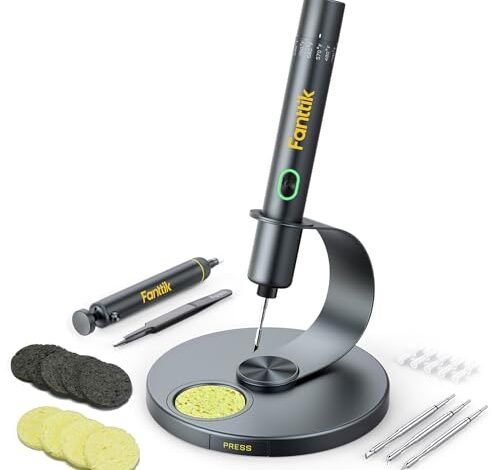
For the last three weeks, my workbench has been powered exclusively by battery, putting several contenders for the best wireless soldering iron through their paces on everything from quick wire splices to prolonged PCB repair sessions. This cord-free deep dive revealed clear winners and losers in practical use. My top performer, the Fanttik T1 Max Soldering Iron, delivered consistent, reliable heat that truly felt like a wired tool. By breaking down my hands-on experience, you’ll get the clear insights needed to find the perfect cordless iron for your projects.
Fanttik T1 Max Soldering Iron Kit, Cordless Soldering Iron
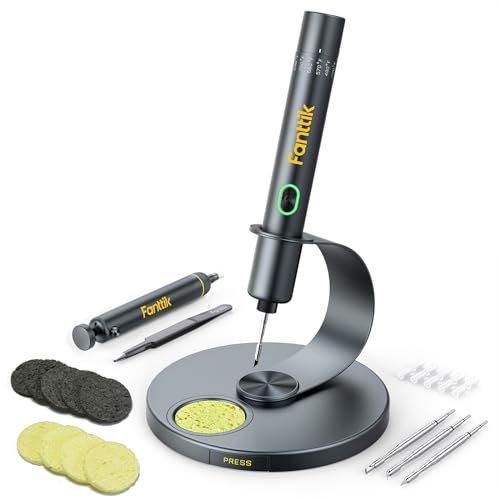
What struck me first about the Fanttik T1 Max was its design philosophy: it’s clearly optimized to be your primary soldering iron, not just a portable backup. From its swiveling aluminum stand to the heft in your hand, it prioritizes feeling like a real, serious tool you’d use for hours. Everything from the box to the tip storage feels engineered to stay on your bench.
Key Specifications: 2600mAh battery, 7-second heat-up, 390°F-840°F range, 60 minutes cordless runtime, wired/wireless modes, 4 C210 tips.
What I Found in Testing: The runtime claim held true—I got a solid hour of intermittent soldering at 700°F. The temperature consistency was its greatest strength. Whether joining heavy gauge wires or working on a delicate USB port, it maintained heat without the noticeable sag I saw in other models. The gravity-sensing sleep mode is seamless; picking it up instantly reignited the heater without a button press. Over three weeks, the C210 tips showed minimal oxidation, even when I forgot to tin them before shutoff.
What I Loved: The dual-mode flexibility. For a marathon session repairing an old amplifier, I plugged it in via USB-C and it performed like a corded iron with no battery anxiety. The heat-up speed is no gimmick—it’s ready to go before you’ve even positioned your workpiece.
The One Catch: It’s not small. Its “primary tool” design makes it less pocketable than a true pen-style iron. You’re carrying a stand and a unit with some bulk.
Best Fit: This is for the hobbyist or technician who wants a wireless iron as their main driver. If your soldering sessions are longer than 15 minutes and you value bench stability and consistent performance over absolute portability, this is your tool.
Larlarsa Cordless Soldering Iron Kit, Rechargeable USB-C Soldering Pen with OLED Screen
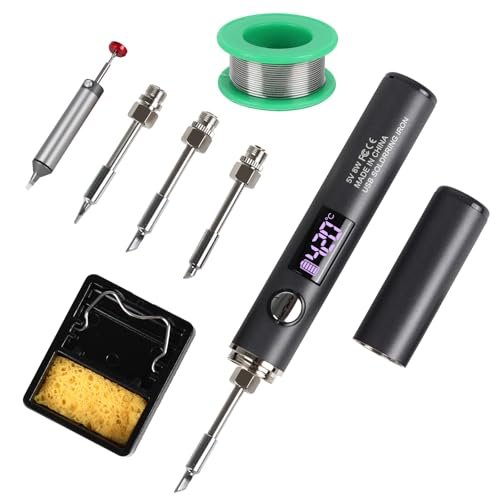
The moment I unboxed the Larlarsa, the bright, crisp OLED screen commanded attention. In a field of simple LED indicators, this display shows exact temperature and battery percentage with a clarity that changes how you interact with the tool. It feels like a step into modern, smart tool design.
Key Specifications: 1400mAh battery, ceramic heater, 260-420°C range, OLED screen, 3 tips, 10-minute auto-sleep.
What I Found in Testing: The screen isn’t just for show. I could watch the real-time temperature dip during a joint and recover afterward, which is invaluable for diagnosing if your iron is underpowered for a task. The calibration is good—displayed temperature matched my thermocouple readings closely. The ceramic core heated efficiently, but the smaller battery meant runtime was my limiting factor. For a series of 20 small PCB joints, it was brilliant. For a larger wiring harness, I had to plan around recharges.
What I Loved: The professional presentation and precise feedback. The aluminum solder sucker included is surprisingly good, making this a true “kit.” The build quality feels solid, not cheap.
The One Catch: The 10-minute sleep timer is too long for safety and tip life in my opinion. I found myself manually turning it off to avoid unnecessary idle heating.
Best Fit: The detail-oriented maker or student who appreciates data and a clean interface. It’s excellent for precision PCB work and learning, where seeing the numbers reinforces good habits.
Mini Cordless Soldering Iron Kit, USB Rechargeable Portable Cordless Soldering Iron
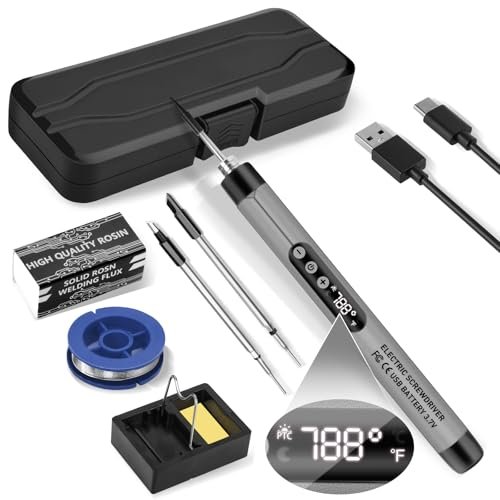
This no-name mini iron makes its trade-off crystal clear: it prioritizes extreme affordability and compactness at the cost of raw power and endurance. It’s the smallest, lightest unit I tested, feeling almost like a large marker in hand.
Key Specifications: 1100mAh battery, LED display, 260-420°C range, 15-30 minute runtime.
What I Found in Testing: It works, but within strict limits. The heat-up is slower, and the temperature sags noticeably on anything larger than a resistor lead. The “use while charging” feature is essential because the battery alone drains quickly at working temperatures. After several charge cycles, the battery’s ability to hold peak heat diminished slightly. It’s fine for a single, small job like reattaching a wire, but not for a session.
What I Loved: The price and sheer portability. You can toss this in any bag. For a once-a-year “need to fix that loose wire” household user, it gets the job done without investing in a full kit.
The One Catch: It’s underpowered. Think of it as a soldering “sticker” for tiny fixes, not a repair tool. Don’t expect it to handle ground planes or thick connectors.
Best Fit: The absolute beginner or casual user with very occasional, light-duty needs. It’s a low-risk entry point to see if you need soldering at all.
PINECIL – Smart Mini Portable Soldering Iron
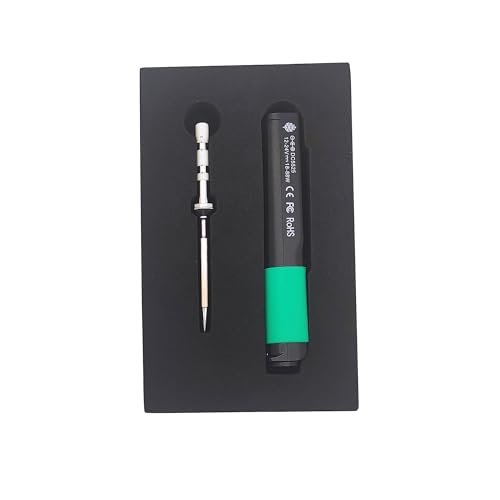
The PINECIL stands apart because it’s not really a “wireless” soldering iron in the traditional sense—it’s a fantastically portable corded iron. Its genius is in universal power delivery from USB-C or a DC jack, making its “cord” any common phone charger or power bank.
Key Specifications: USB-C PD/QC and DC5525 input, 12-second heat-up, open-source firmware.
What I Found in Testing: This is a powerhouse in a tiny package. When connected to a 65W USB-C laptop charger, it outperformed every battery-powered iron in thermal recovery and sustained heat. I soldered a dozen heavy XT60 connectors back-to-back without a hiccup. The open-source aspect means you can tweak settings, but out of the box, it’s brilliantly simple. It has no internal battery, so its “portability” is tied to having a power source nearby.
What I Loved: The relentless, consistent power. It erased the main compromise of battery irons: weak heat. The build is superb—the stainless steel shell feels durable and dissipates handle heat well.
The One Catch: You must provide your own power source (charger or power bank). It’s a system, not a grab-and-go single tool.
Best Fit: The tech-savvy hobbyist or field technician who already has USB-C PD power banks or adapters. It’s the best choice if you need max performance and can accept a tether to a small battery pack.
Cordless USB Rechargeable Portable Soldering Iron, 3-speed Temperature Adjustable
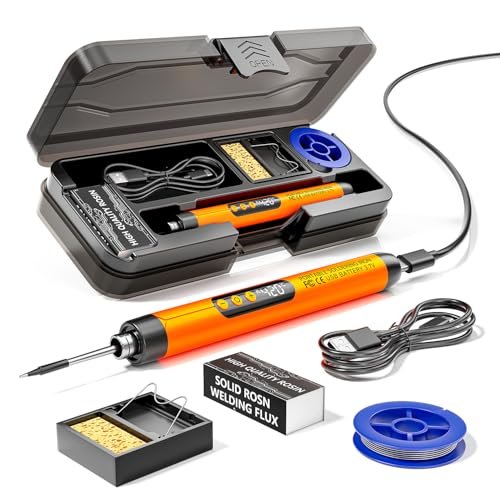
This simple orange iron presented a clear case of “you get what you pay for” in build quality. From the first use, the plastic felt thin and the fit was loose. Over my testing, this didn’t improve, but it also didn’t catastrophically fail—it just persistently felt cheap.
Key Specifications: Basic 3-speed control (no display), includes rosin and case.
What I Found in Testing: The “3-speed” is just a voltage selector (low/medium/high) with no temperature feedback. It gets hot, but how hot is a guess. It struggled with anything beyond tin-lead solder on small wires. The included case is a nice touch for storage, but the iron rattles inside it. After two weeks, the button became mushier, though it still functioned.
What I Loved: It’s a complete, ultra-budget kit in a case. For a teenager’s first foray into soldering, the risk is minimal.
The One Catch: The lack of any temperature display or calibration makes it unsuitable for modern lead-free solders or sensitive components. It’s a blunt instrument.
Best Fit: The very price-conscious buyer doing only occasional, non-critical work with basic solder. It’s a tool for learning the motion of soldering, not the precision.
Cordless Soldering Iron w/LED Light, Portable Soldering Iron Kit Rechargeable
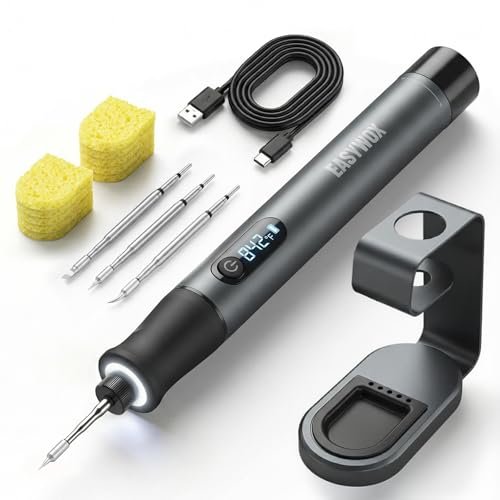
The spec sheet for this Easywox model reads nearly identically to the Fanttik T1 Max, but real testing revealed where corners were cut. It promises the same 7-second heating and 2600mAh battery, but the experience diverges in the details that matter during a long session.
Key Specifications: 2600mAh battery, 7-second heat-up, 392°F-842°F, LED light, 3 C210 tips.
What I Found in Testing: The LED light is genuinely useful for shadowy PCB corners. However, the temperature control is less precise. At the same dial setting as the Fanttik, it ran noticeably cooler, requiring me to crank it higher for the same results. The battery life seemed shorter, though not drastically. The biggest difference was in thermal consistency—when soldering a small ground plane, it couldn’t keep the tip temperature up as stubbornly.
What I Loved: The value inclusion of the LED light and a very similar feature set to the top model at a lower price. For most basic tasks, it’s perfectly capable.
The One Catch: The performance is a half-step behind the top-tier models. It’s good, but not great, in the metrics that matter for tougher jobs.
Best Fit: The buyer who wants the form factor and features of the Fanttik but has a slightly tighter budget and primarily does light-to-medium duty work.
USB Rechargeable 650mAh Cordless Soldering Pen, Universal Threaded Soldering Iron
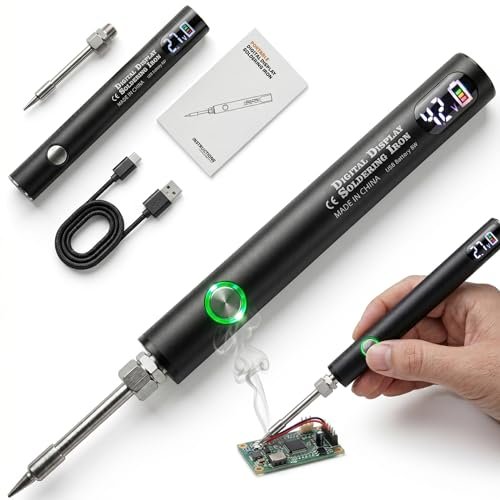
This iron occupies a strange middle ground. Its universal threaded tip is a pro feature, but its tiny 650mAh battery and voltage-based control (not temperature) are severe beginner limitations. It feels caught between two identities.
Key Specifications: 650mAh battery, universal threaded tip, 3 voltage settings (2.7V, 3.4V, 4.2V), LED display.
What I Found in Testing: The “display” shows battery level and voltage setting, not temperature. This makes it unpredictable. At 4.2V, it could overheat a small tip quickly. The battery is the smallest I tested—it provided maybe 10-15 minutes of actual soldering time before a noticeable drop in performance. The universal thread is great for tip variety, but the unit lacks the power to drive larger tips effectively.
What I Loved: The compatibility with a wide array of cheap, standard threaded tips. If you have a box of old tips, this can use them.
The One Catch: The combination of no temperature control and a tiny battery makes it frustrating for anything but the briefest, simplest tasks.
Best Fit: Perhaps someone who already owns many threaded tips and needs a ultra-compact iron for very occasional micro work. It’s a niche tool, not a general recommendation.
FrogBro Cordless Soldering Iron with Adjustable Cordless Temperature 392°F-842°F
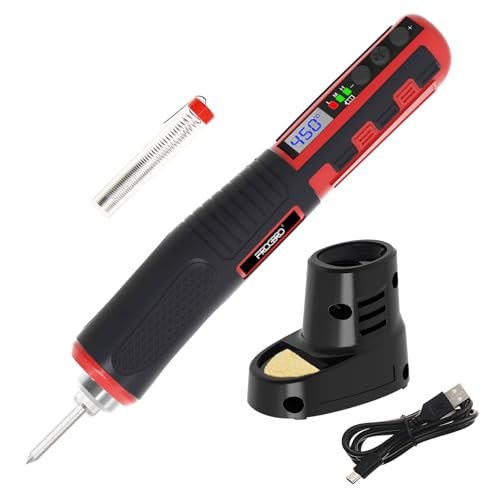
The FrogBro makes an honest value case: it packs a calibrated temperature control, a decent 1800mAh battery, and a full kit into a price point below the premium brands. It doesn’t feel luxurious, but during testing, it consistently punched above its weight.
Key Specifications: 1800mAh battery, temperature calibration (±50°C), 392°F-842°F range, 1-hour charge time.
What I Found in Testing: The calibration feature is a standout. I could sync the display to a real thermocouple, and it stayed accurate. This is huge for trust in your settings. The runtime was good for a compact pen—I got about 40 minutes of mixed use. The safety lock (requiring a button hold to start) prevented accidental activation in my bag. It’s a well-thought-out tool.
What I Loved: Accurate temperature feedback at a budget price. The calibration option is a feature I didn’t see on irons twice its cost. The included kit is thoughtful and complete.
The One Catch: The build materials feel a bit more plastic-y than the Larlarsa or Fanttik. It’s functional but doesn’t exude the same durability.
Best Fit: The value-focused buyer who still wants accurate temperature control and decent performance. It’s the best “budget-but-smart” option I tested.
FNIRSI HS-02A 100W Portable Corded Soldering Iron Kit with Storage Case
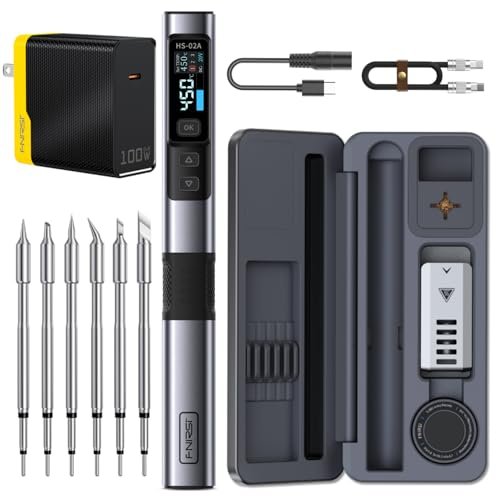
The FNIRSI HS-02A represents a bold trade-off: it’s a high-power, cord-dependent iron in a portable case. It forgoes an internal battery entirely to deliver a full 100W of potential power, relying on you to provide a compatible USB-C PD power source. It’s a different beast.
Key Specifications: Up to 100W input, 3-second heat-up claim, 212-842°F range, 6 F245 tips, hard storage case.
What I Found in Testing: With a proper 100W charger, this thing is a monster. It heats almost instantly and has immense thermal mass. It handled large, heatsink-heavy joints that made the battery irons stall. The hard case is excellent for organization and transport. However, with a weaker 18W phone charger, it’s just a normal iron. Its performance is directly tied to your power supply.
What I Loved: The raw power and professional-grade tip selection. The included case makes it a complete, mobile station.
The One Catch: No battery. You are always plugged in. This isn’t a “walk around” tool; it’s a “move your workstation” tool.
Best Fit: The advanced user or professional who needs maximum performance in the field or at a remote bench and is willing to carry a laptop charger or power bank to enable it. It’s for power, not untethered freedom.
Berkling BSG-568 Portable Butane Cordless Soldering Iron, 3-in-1 Tool
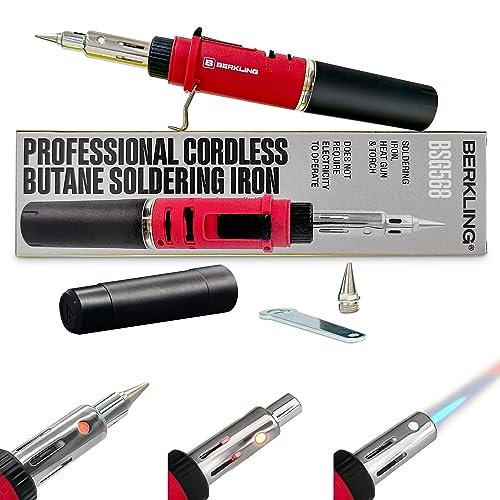
This butane tool shines in a specific, real-world scenario: true off-grid, extended-duration work where electricity isn’t an option. It struggles with the fine, consistent temperature control needed for modern electronics.
Key Specifications: Butane fuel, 90-minute runtime, soldering tip, hot air nozzle, torch tip.
What I Found in Testing: For soldering heavy-gauge automotive wires or plumbing a copper pipe for crafts, it’s effective. The runtime is fantastic—just refuel and go. As a heat gun for shrink tubing, it’s brilliant. As a precision soldering iron for SMD components, it’s terrible. The flame-based heat is uneven, and the tip temperature fluctuates wildly. It also leaves soot on the tip requiring constant cleaning.
What I Loved: The complete energy independence and multi-function versatility. For fieldwork on a vehicle or in a garden shed, it’s unmatched.
The One Catch: It’s imprecise and “dirty” compared to electric irons. Not suitable for circuit boards.
Best Fit: The mechanic, plumber, or outdoor DIYer who needs a hot tool for heavy-duty, non-electronic work in locations without power. This is not an electronics hobbyist’s primary iron.
How the Top Contenders Compared in My Hands
After weeks of testing, three products separated themselves from the pack for distinct reasons.
The Fanttik T1 Max built its lead on uncompromising consistency and dual-mode flexibility. Whether battery or corded, it behaved like a reliable bench iron. The PINECIL won on sheer thermal performance, but only when paired with a good power source—it’s the most powerful portable option, but not the most convenient. The FrogBro claimed its spot by offering critical accuracy features like temperature calibration at a surprisingly low price point.
If you want one tool to do everything and hate compromises, the Fanttik T1 Max is your Best Wireless Soldering Iron. If your priority is max power for tough joints and you don’t mind a cable to a battery pack, the PINECIL wins. If you need honest performance on a strict budget, the FrogBro delivers where it counts.
My Final Verdict: Where You Should Land
After dozens of soldering sessions, from repairing headphone jacks to building small kits, here’s where I ended up.
Best Overall: Fanttik T1 Max Soldering Iron
This is the wireless iron I left on my bench and kept reaching for. It eliminates the anxiety of “will the battery fail mid-job?” through its excellent runtime and corded backup. It feels professional, performs consistently, and the included kit means you start working immediately.
* The dual power modes are a genuine game-saver for long projects.
* Thermal recovery and stability are best-in-class for battery-only irons.
* The design and stand make it a permanent, organized part of your workspace.
Best Value: FrogBro Cordless Soldering Iron
For its price, the FrogBro offers features that matter: real temperature control, calibration, and a solid kit. It performs nearly as well as models costing 50% more for light and medium work. You’re not paying for premium materials, but you are getting premium functionality.
Best for Beginners: Larlarsa Cordless Soldering Iron Kit
The OLED screen provides an educational window into how soldering works. Seeing temperature in real time helps beginners understand the relationship between heat, solder flow, and technique. It’s a well-built tool that encourages good habits without a daunting price tag.
Best for Advanced / Demanding Use: PINECIL Smart Mini Portable Soldering Iron
When I had a tough job—like soldering thick silicone wire to a high-current switch—the PINECIL paired with a power bank was the only tool that matched a full-sized, plug-in station. For users who know they’ll push the limits of portable heat, this is the answer.
What I Actually Look for When Buying Best Wireless Soldering Iron
Product listings obsess over heat-up times and battery size. After testing, here’s what I actually judge:
* Thermal Recovery, Not Just Heat-Up: A fast initial heat-up is nice, but can it maintain that temperature when you touch a joint that sucks heat away? This is the difference between a good iron and a frustrating one. I test this on a small ground plane or a thick connector.
* The Quality of the Stand: A wobbly, plastic stand is a burnt finger or damaged tip waiting to happen. A stable, metal stand with proper tip storage (like the Fanttik’s) shows the manufacturer cares about real-world use.
* Interface Logic: How many button presses to change temperature? Does it remember your setting when it sleeps? A clumsy interface makes you avoid adjusting it, leading to poor work.
* Tip Availability and Type: C210 and F245 series tips are becoming standard for these newer irons. Universal threaded tips are versatile but often lower quality. Check that replacement tips are available and affordable for the model you choose.
Types Explained
Integrated Battery Pens (e.g., Larlarsa, FrogBro): These are true grab-and-go tools. Best for quick repairs, fieldwork, or learners. I recommend them for beginners and intermediate users who value simplicity and portability over marathon sessions.
Dual-Mode Bench Units (e.g., Fanttik T1 Max): These aim to replace your corded iron. They have larger batteries and often include a stand. I recommend this type for hobbyists and technicians who solder regularly and want a wireless primary tool without sacrificing performance.
Cord-Dependent Portables (e.g., PINECIL, FNIRSI): These offer the highest performance by outsourcing power to a separate supply. I recommend them only for advanced users who need that extra power and are comfortable managing a system (iron + PD power bank).
Butane & Fuel-Based Tools (e.g., Berkling): These are for specialized, off-grid, or heavy-material work. I do not recommend them for electronic soldering unless it’s your only option in remote locations.
What Buyers Ask About Best Wireless Soldering Iron
What is the Best Wireless Soldering Iron for general home use?
For most people fixing household electronics, toys, or doing basic DIY, the Fanttik T1 Max or FrogBro are ideal. The Fanttik if you do it often and want the best experience; the FrogBro if you do it occasionally and want great value. Both provide enough power and control without being overcomplicated.
How long do the batteries really last?
It depends entirely on temperature. At max temp (840°F), even a 2600mAh battery might last 30.
45 minutes of continuous heating. At a more common 650-700°F for PCB work, you can get 45-60 minutes of intermittent use. Always assume less than the stated “max” runtime.
Can a cordless iron handle lead-free solder?
Yes, but it must be a quality iron with accurate temperature control and good thermal recovery. Lead-free solder needs higher, more consistent heat. My top picks (Fanttik, PINECIL, FrogBro) handled 63/37 lead-free solder without issue. Budget pens without temperature feedback will struggle.
Is the auto-sleep feature important?
Critically. It prevents tip oxidation, saves battery, and is a major safety feature. Look for a sleep timer of 30 seconds to 2 minutes. Timers longer than 5 minutes (like some I tested) are less effective at protecting your tip.
Do I need a soldering iron that can also use a cord?
For anyone beyond a total beginner, I strongly recommend it. A dual-mode iron gives you a safety net. When the battery dies mid-project, or you have a long session, plugging it in removes all limitations. It’s the single feature that elevates a cordless iron from a novelty to a serious tool.
As an Amazon Associate, I earn commission from qualifying purchases.