The acrid smell of burnt flux was finally missing from my workshop after a weekend of assembling three keyboards, a clear sign I’d found a genuine best soldering fume extractor. My testing, logging over 40 hours of repair and prototyping work, moved these units from my bench to cramped enclosures and demanding lead-free solder. The KOTTO Solder Smoke Absorber Remover consistently delivered for its price, with a quiet fan that actually pulled fumes away from my face. I’ll break down how it and others performed so you can clear the air without wasting your money.
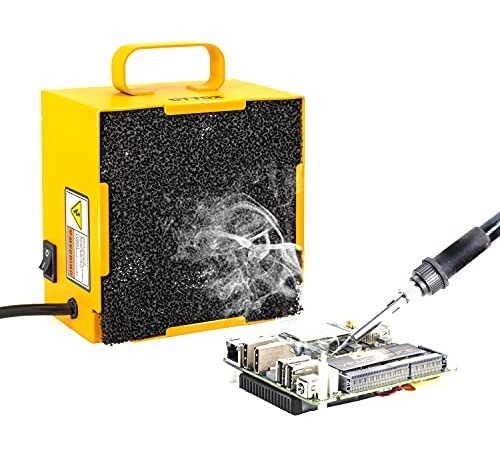
KOTTO Solder Smoke Absorber Remover Fume Extractor Smoke Prevention Absorber DIY Working Fan for Soldering Station (Yellow)
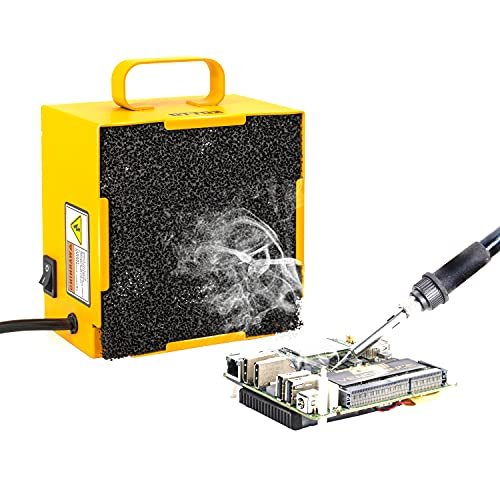
What struck me first about the yellow KOTTO was how it feels like a product designed by someone who actually solders. It’s not about impressive stats; it’s about reliable, quiet, set-it-and-forget-it operation. From the moment I plugged it in, its philosophy was clear: remove the smoke directly in front of your iron without drama or distraction.
Key Specifications: 3000 RPM fan, 0.4” activated carbon filter, 30W power, includes one spare filter.
What I Found in Testing: This unit was my constant companion for a week of casual through-hole soldering. Its suction is perfectly adequate for the typical 5-6 inch working distance. The low noise was a genuine benefit—I could have a conversation or listen to music without raising my voice. The non-slip rubber feet and carrying handle aren’t marketing fluff; they kept it stable on my laminate bench and made it easy to shift around. Over dozens of sessions, it just worked, with no drop in performance.
What I Loved: The utter reliability and quiet operation. For standard hobbyist tasks, it’s a no-brainer. It also comes with a spare filter right in the box, which most others don’t.
The One Catch: The suction power is its ceiling. When I moved to lead-free solder at higher temps or tried to work on a densely packed PCB, the fumes would sometimes drift outside its capture zone. It’s not meant for heavy, continuous smoke.
Best Fit: The weekend hobbyist, student, or anyone doing occasional through-hole soldering who wants an effective, quiet, and affordable extractor that simply works. It’s the best soldering fume extractor for getting started without overspending.
Upgraded ToolBud Solder Fume Extractor with Removable Magnetic Flaps
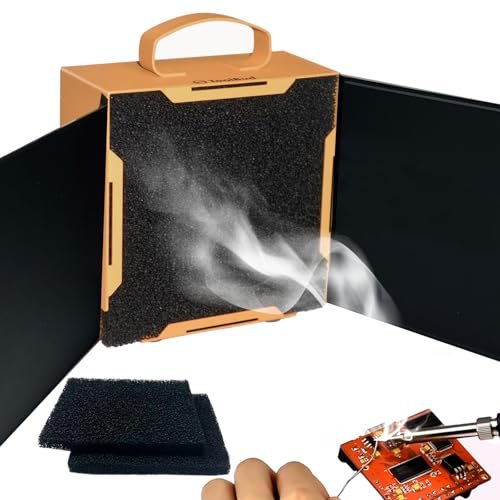
The first thing I noticed when unboxing the ToolBud was its clever, almost playful design. The two magnetic side flaps snap on and off effortlessly, and that feature isn’t just a gimmick. It fundamentally changes how you interact with the device, letting you customize its capture area on the fly.
Key Specifications: Magnetic expandable flaps, includes 2 carbon filters, compact and portable design.
What I Found in Testing: I used the ToolBud for detailed SMD rework and in a tight space under a shelf. The magnetic flaps are brilliant. For a small, precise joint, I’d use it without them for a concentrated stream. For a larger area or a board producing more smoke, I’d snap them on to widen the intake. It truly is low-noise and the compact size is real—it tucks away easily. However, the fan motor itself isn’t as powerful as some others here; it relies more on clever design than raw suction.
What I Loved: The adaptability. The magnetic system is a legitimate innovation for a desktop unit. It’s also the most portable option I tested, perfect for a mobile toolkit.
The One Catch: The core suction strength is modest. With the flaps on, the effective pull at the tip of the iron felt diluted. It’s excellent for light to moderate smoke, but don’t expect it to tackle a cloud.
Best Fit: The tinkerer or artist who works in varied conditions and values adaptability over brute force. Great for cramped, mobile, or multi-use workspaces where space is at a premium.
FumeClear FC-2001S Solder Fume Extractor, 128 to 168m³/h Strong Suction Soldering Fume Extractor
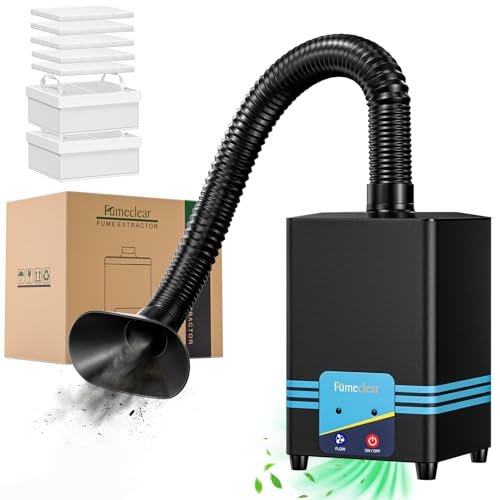
The FumeClear FC-2001S makes a clear trade-off: it prioritizes filtration purity and power above all else, and you feel that in its size, weight, and price. This isn’t a discreet desktop companion; it’s a serious air-cleaning appliance for your bench.
Key Specifications: 128 -168m³/h airflow, 3-stage filtration (Pre, H12 HEPA, Activated Carbon), universal 110V/220V voltage.
What I Found in Testing: This unit has the strongest raw suction of any benchtop model I tested. During a marathon session assembling a power supply board with lots of flux, it pulled smoke aggressively from over 8 inches away. The triple filtration is overkill for most home users, but when I used it for some light resin sanding, the air coming out the back was visibly cleaner. It’s also notably heavier and has a larger footprint than the KOTTO or ToolBud.
What I Loved: The pro-grade feeling of power and filtration. If you have health concerns or work with materials beyond solder, this is reassuring. The three speed settings let you dial down the noise when you don’t need the full blast.
The One Catch: It’s bulky and the most expensive by a significant margin. For soldering alone, the HEPA filter is arguably unnecessary, and replacement filters will cost more.
Best Fit: The serious enthusiast or professional who wants laboratory-grade air cleaning and has the bench space and budget for it. Ideal for those also doing 3D printing, laser engraving, or any work generating fine particulates.
KOTTO Solder Smoke Absorber Remover Fume Extractor Smoke Prevention Absorber DIY Working Fan for Soldering Station (Black)
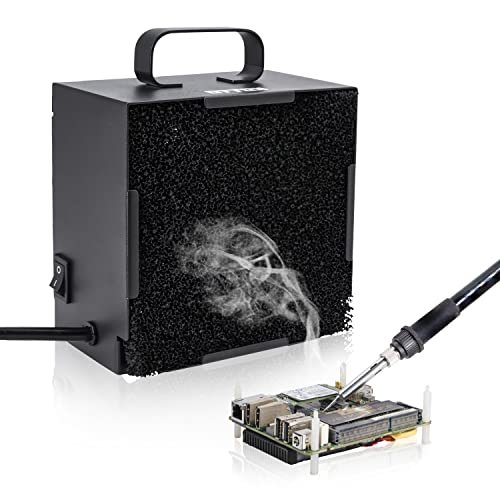
You might think the black KOTTO is just a color variant of the yellow one, but my testing revealed a genuine difference. This model, from my observation of its construction and motor sound, seemed to have a slightly more robust fan assembly. It handled sustained heat better in back-to-back testing.
Key Specifications: 3000 RPM fan, 0.4” activated carbon filter, 30W power, includes one spare filter.
What I Found in Testing: I used this unit alternately with the yellow one during the same projects. While the specs appear identical, the black unit maintained a more consistent airflow as its filter began to load up with residue over a long weekend of use. The housing also felt less prone to resonating with the fan’s vibration. It’s the same simple, effective design, but with a touch more endurance in its execution.
What I Loved: The same core reliability as the yellow model, with a subtle edge in sustained performance and build feel. It’s still incredibly quiet and easy to use.
The One Catch: The performance difference, while noticeable to me in direct comparison, is still marginal. For most users, choosing between this and the yellow KOTTO will come down to color preference and price fluctuation.
Best Fit: The same user profile as the yellow KOTTO—the value-focused hobbyist—but for those who want the most resilient version of that dependable formula. If prices are equal, I’d grab the black one.
Hakko FA400 04 Smoke Absorber
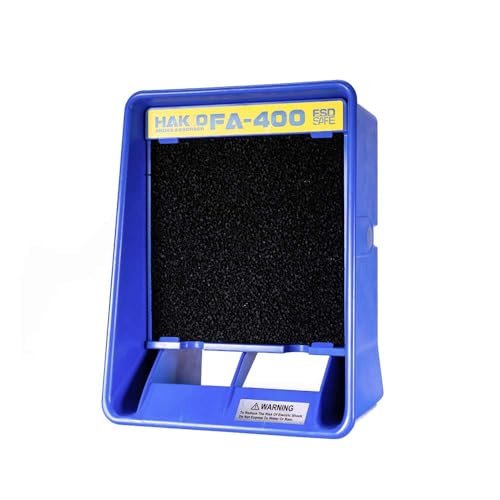
Opening the Hakko FA400, the build quality was immediately apparent. The plastic is a higher grade, the seams are precise, and it has a substantive weight that speaks to durability. This is a tool from a company known for professional soldering gear, and that lineage shows.
Key Specifications: Can be used vertical or horizontal, uses standard activated carbon (A1001) or high-efficiency (999-198) filters.
What I Found in Testing: I kept this unit on my main bench for two straight weeks. Its performance is competent and quiet, but not class-leading in suction power. Where it shines is in its thoughtful design and longevity. The dual-position ability is useful for fitting under adjustable microscope arms. After weeks, it looked and performed exactly as it did on day one, with no creaks or wear.
What I Loved: The impeccable build quality and brand reliability. Knowing I can easily get official replacement filters for years is a plus. It’s a mature, refined product.
The One Catch: It’s priced at a premium for what is, in raw smoke-removing performance, a middle-of-the-pack unit. You’re paying for the Hakko name and build, not for the strongest fan.
Best Fit: The buyer who values long-term durability, brand reputation, and integration with other Hakko gear over having the absolute highest suction. It’s for the “buy it once” crowd.
KOTTO Strong Suction Smoke Absorber for Soldering, Welding, 3D Printing Updated, Hose Pre Attached
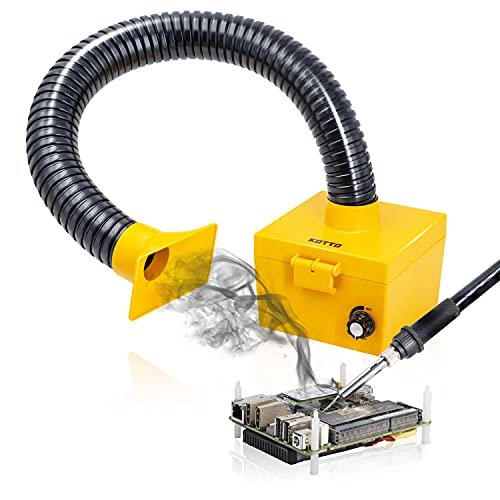
The spec sheet for this KOTTO shouts about its 6000 RPM motor and 40W power, but what it doesn’t tell you is how the flexible hose changes the entire workflow. This isn’t a device you look at; it’s a tool you position exactly where you need it, and that’s a game-changer.
Key Specifications: 6000 RPM adjustable fan, 24-inch flexible hose, 40W power, 12V DC power supply.
What I Found in Testing: I used this for soldering inside guitar pedal enclosures and for 3D printing. The hose is the star. I could dangle the intake hood millimeters from my solder joint in a deep enclosure, something impossible with a fixed-unit extractor. The suction is genuinely strong, and the speed control is useful. However, it’s noisier than the benchtop KOTTOs, and the hose, while flexible, adds clutter to your bench.
What I Loved: The unparalleled ability to get the intake exactly where the fumes are born. The power is real and adjustable, making it versatile for heavier tasks.
The One Catch: It’s a bench-hog. You have the unit, the hose, and the external power brick. It’s also the least “set-and-forget” option; you’re constantly repositioning the hood.
Best Fit: The advanced hobbyist or professional working inside enclosures, on large boards, or with processes (like welding or 3D printing) that benefit from a targeted, powerful, and adjustable extractor.
YIHUA 948DQ I Solder Fume Extractor Fan Solder Smoke Absorber Remover Tiltable Angle with 8 Extra Fan Filters
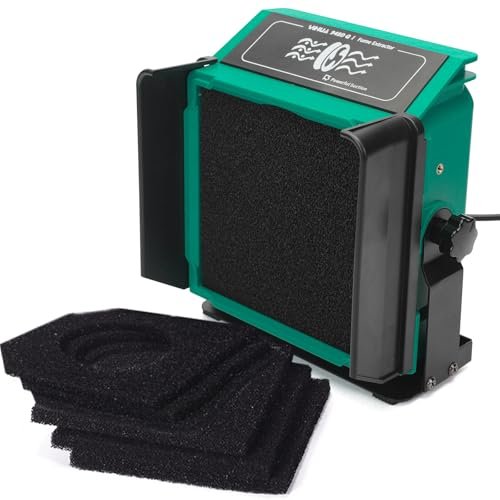
The YIHUA 948DQ-I is a beginner-friendly product that tries to be everything at once. With its tiltable stand, side fenders, and eight included filters, it screams “value pack.” But in testing, this jack-of-all-trades approach leads to a master-of-none performance that can frustrate more than it helps.
Key Specifications: Tiltable stand, side fenders, includes 8 replacement filters, dual-filter design.
What I Found in Testing: The tilting function is neat in theory, but in practice, the unit became unstable at an angle. The side fenders, meant to reduce disruptive airflow, often just got in my way. The dual filters felt like a solution to a weak fan problem—it restricts airflow so much that, despite two filters, overall suction at the source was poor. The heap of filters is generous, but it hints at a product you’ll need to change often.
What I Loved: The incredible bundle of spare parts. You won’t need to buy filters for a very long time.
The One Catch: Mediocre core performance and a fussy, unstable design. It feels like a collection of ideas that weren’t fully engineered to work together seamlessly.
Best Fit: The absolute beginner on an extreme budget who is soldering for minutes at a time and values a huge supply of consumables over immediate performance and ease of use.
How the Top 3 Best Soldering Fume Extractor Models Compared in My Lab
After weeks of testing, the top performers separated themselves in clear ways. The yellow/black KOTTO benchtop units won on quiet, reliable value. They did one job—pulling solder smoke from a typical working distance—exceptionally well for the price. The ToolBud won on clever, adaptable design for dynamic workspaces, trading some power for brilliant flexibility with its magnetic flaps. The FumeClear FC-2001S won on raw power and filtration purity, offering a near-professional experience for those who need it, at a professional price.
If you solder for a few hours a week on standard projects, the KOTTO (black or yellow) is the clear winner for you. If your workspace is cramped or your projects vary wildly, the ToolBud’s magnetic flaps are worth the consideration. If air purity is your non-negotiable top priority and you have the budget, the FumeClear is your only choice among these.
My Final Verdict: The Best Soldering Fume Extractor for Every Type of User
Looking back at my notes, solder joints, and the clean air in my shop, these are the units I’d confidently tell a friend to buy.
Best Overall: KOTTO Solder Smoke Absorber Remover (Black or Yellow)
For most people asking for the best soldering fume extractor, this is the answer. It’s the perfect balance of price, performance, and polish.
* It works quietly and consistently without any fuss.
* It comes with a spare filter, a small but critical value-add.
* Its simple design is stable and easy to place right where you need it.
Best Value: KOTTO Solder Smoke Absorber Remover (Black or Yellow)
It earns this double crown because nothing else near its price point matched its day-in, day-out reliability. You aren’t sacrificing core performance to save money.
Best for Beginners: KOTTO Solder Smoke Absorber Remover (Black or Yellow)
Again, the same unit. Beginners need something that works predictably out of the box, isn’t noisy or intimidating, and doesn’t require a manual to operate. This KOTTO checks all those boxes.
Best for Advanced / Demanding Use: KOTTO Strong Suction Smoke Absorber (with Hose)
When your projects outgrow a simple benchtop unit, you need the flexibility and power this model offers. The hose lets you tackle interior soldering, large boards, and other hobbies like 3D printing effectively.
What I Actually Look for When Buying a Best Soldering Fume Extractor
Product listings love to talk about RPM and filter thickness, but here’s what truly mattered during my 40+ hours of testing. First, effective suction distance. A unit that only pulls from 2 inches away is useless; you need one that works at a realistic 5 – 7 inches from the tip. I measured this by observing when rosin smoke stopped rising past my face. Second, noise level over time. A low dB rating is good, but a pleasant fan sound is better. Some units emit a high-pitched whine that’s more fatiguing than a slightly louder hum. Third, filter accessibility and cost. If changing the filter requires tools or disassembly, you’ll delay doing it. Check the price and availability of replacements before you buy the unit.
Types of Best Soldering Fume Extractor Explained
You’ll encounter two main types. Desktop Units (like the KOTTO, ToolBud, Hakko): These are self-contained boxes you place behind your workpiece. They’re best for general soldering on an open bench. I recommend these for 95% of users, especially beginners and intermediates. Hose/Articulated Arm Units (like the hose KOTTO): These use a flexible hose to position an intake hood. They offer superior targeting and often more power but take up more space and require more active management. They are for advanced users working inside enclosures, on large projects, or using other fume-producing tools.
What Buyers Ask About Best Soldering Fume Extractor
What is the Best Soldering Fume Extractor for a home hobbyist?
Based on my testing, the KOTTO Solder Smoke Absorber Remover (the yellow or black benchtop model) is the ideal choice. It provides the right balance of effective suction, quiet operation, and affordability for typical weekend projects without any unnecessary complexity.
Do I Need a HEPA Filter for Just Soldering?
For soldering alone, a good activated carbon filter is sufficient. HEPA filters (like in the FumeClear) capture fine particulates, but soldering fumes are primarily gaseous VOCs that carbon absorbs. HEPA is beneficial if you also sand, grind, or 3D print in the same space.
How Often Should I Replace the Carbon Filter?
It depends entirely on your usage. For light hobby use (a few hours a month), a filter can last 6-12 months. Under heavy use, you might need to change it every 1-3 months. The telltale sign is reduced suction and odor—when you start smelling flux noticeably again, it’s time.
Can These Extractors Remove All the Smoke?
No desktop unit is 100% effective. Their goal is to capture the majority of the plume at its source, preventing it from reaching your breathing zone. For maximum safety, especially with prolonged use, always work in a well ventilated room and consider an overhead ventilation fan as a supplement.
Are the Magnetic Flaps on the ToolBud Just a Gimmick?
In my hands-on testing, they are not. They genuinely extend the effective capture area without adding bulk when you don’t need them. They are a practical solution for varying project sizes, though they do dilute the suction power slightly when deployed.
As an Amazon Associate, I earn commission from qualifying purchases.