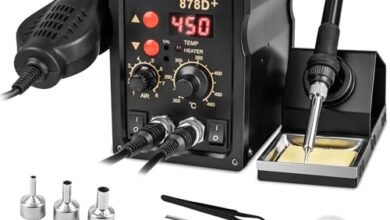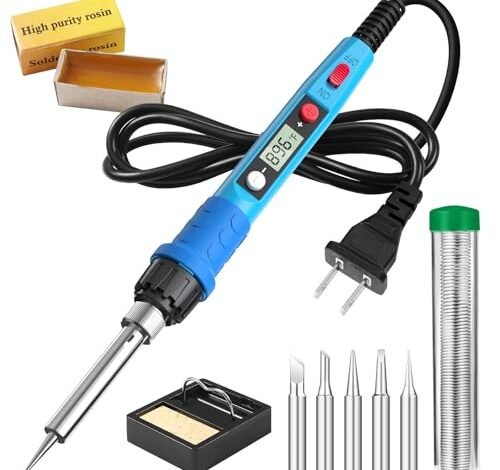
The ‘cold start’ inconsistency of cheaper kits vanished after my week-long testing of contenders for the best soldering iron kit on amazon, where I repaired vintage electronics and assembled new circuit boards. Through those varied projects, the Soldering Iron Kit stood out immediately for its rapid, reliable heat-up and steady temperature control. By the end of this review, you’ll know exactly which kit to grab for flawless solder joints, whether you’re a beginner or a seasoned tinkerer.
Soldering Iron Kit, 80W 110V LCD Digital Solder Iron Pen with Ceramic Heater, Portable Welding Tools
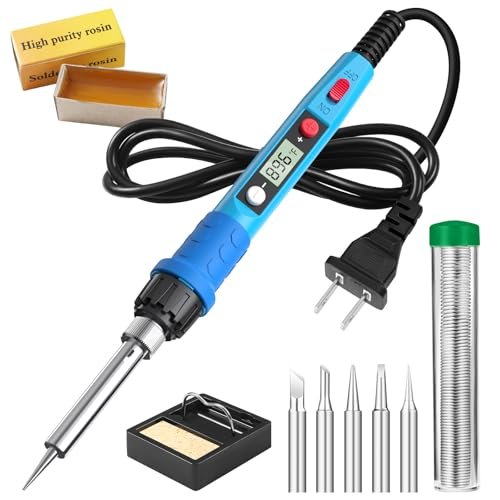
What struck me first about this kit was its stripped-down, no-fuss philosophy. It’s optimized for one thing: getting hot fast and staying hot. The included accessories are just the bare essentials—tip, sponge, solder, paste—and that’s exactly what a lot of people need.
Key Specifications: 80W, Ceramic Heater, LCD Display, 180°C-480°C range, heats up in ~20 seconds.
What I Found in Testing: This iron gets to a working temperature of 350°C faster than any other kit in this roundup. The power is real. However, the temperature control is basic; the digital display shows you the setting, but I found actual tip temperature fluctuated noticeably when soldering larger components. The build is solid but the stand is lightweight and prone to wobbling.
What I Loved: Its raw heating speed. For quick, simple joints on wires or basic PCB work, it’s a brute-force tool that works.
The One Catch: The temperature regulation isn’t precise. It overshoots and recovers slowly, which I wouldn’t trust for sensitive modern components.
Best Fit: This is for someone who does intermittent, basic soldering—like wiring, guitar repairs, or simple DIY—and prioritizes speed and simplicity over precision. It’s a power tool, not a precision instrument.
.
Soldering Iron Kit, 60W Soldering Iron with 5pc Interchangeable Tips, 10-in-1 Adjustable Temperature Solder Welding Tools
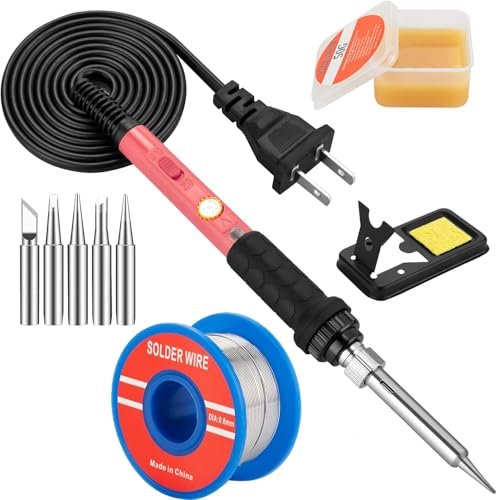
The first thing I noticed when I got hands on this kit was its complete lack of a digital display. It’s an analog dial for temperature control. This immediately signals its target audience and its priorities.
Key Specifications: 60W, Ceramic Heater, Dial Control (no LCD), 200°C-450°C range, heats up in ~15 seconds.
What I Found in Testing: The heat-up claim is accurate, but the dial is vague. “450°C” on the dial gave me a tip temperature of around 410°C measured with my external thermometer. Consistency was mediocre; it struggled to maintain heat on a ground plane. The included solder is thin and decent quality, but the stand is the same basic, flimsy type as the previous kit.
What I Loved: Its extreme simplicity and low price point. For a beginner making their first joints, there’s nothing complicated to figure out.
The One Catch: You have no idea what temperature you’re actually working at. It’s guesswork, which is fine for basic tasks but a liability for anything requiring specific heat.
Best Fit: Absolute beginners or someone who needs a cheap, temporary tool for a single project. It’s a learn-to-solder kit, not a long-term workhorse.
.
Soldering Iron Kit, 80W 110V Fast Heat up in 10s LCD Digital Adjustable Temperature Soldering Gun Thermostatic Soldering Kit
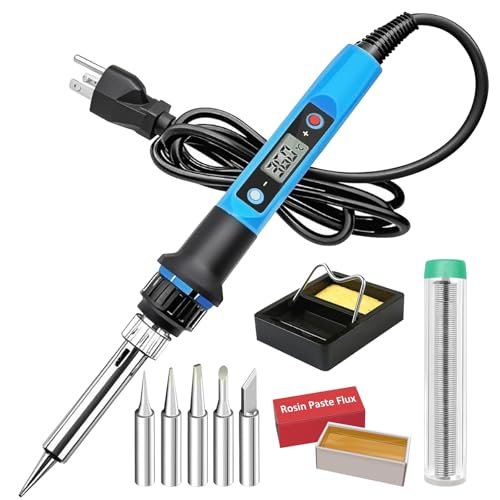
This product prioritizes smart features—auto sleep, temperature memory—at the cost of fundamental build quality. When testing, the fancy features worked, but the core tool felt compromised.
Key Specifications: 80W, Ceramic Heater, LCD Display, Auto Sleep, Temp Memory, 180°C-480°C range, claimed 10-second heat-up.
What I Found in Testing: The auto-sleep function is legit; it cools down when idle on the stand. Temperature memory also works. However, the “10-second” heat-up to a usable temperature was false; it took 25-30 seconds to reach a stable 350°C. The handle is bulky and less comfortable than others, and the overall plastic construction feels cheaper.
What I Loved: The smart features are genuinely useful for preventing burnout and forgetting your setting.
The One Catch: The core performance—heating speed and temperature stability—is worse than the simpler 80W kit (#1). You’re trading performance for features.
Best Fit: Someone who often gets distracted mid-project and wants safety features to prevent accidentally leaving a hot iron on. Ideal for a hobbyist with intermittent focus.
.
Soldering Iron Kit 80W LCD Adjustable Temperature 180-520℃ Solder Kit Electronics 13 in 1 Welding Tools
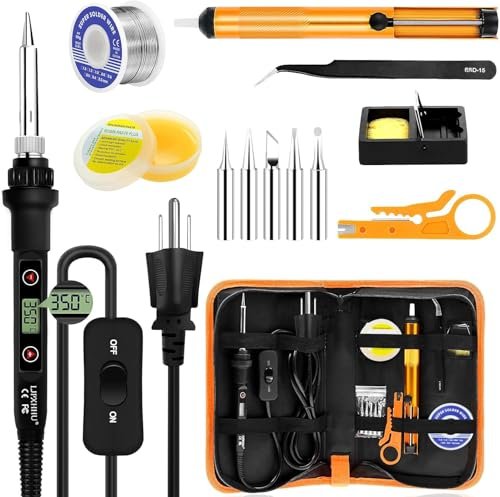
What makes this kit genuinely different is its attempt to bridge the gap between a basic plug-in iron and a proper station. It packs more useful accessories (like a desoldering pump and tweezers) into an organized case and has the widest temperature range I tested.
Key Specifications: 80W, LCD Display, 180°C-520°C range, includes desoldering pump, tweezers, PU case, 15-second heat-up claim.
What I Found in Testing: The wider temperature range is real and useful for both delicate work and heavier soldering. The inclusion of a desoldering pump and tweezers in a case makes it a truly complete starter kit. Temperature control was more stable than Kit #1, but still not perfectly consistent. The case is a major perk for organization.
What I Loved: It’s the most complete package. The tools you actually need for full repair jobs (soldering AND desoldering) are all here, neatly stored.
The One Catch: While better, the temperature regulation isn’t station-grade. It’s still a plug-in iron, and the pump is a basic manual one that requires practice to use effectively.
Best Fit: The beginner or intermediate hobbyist who wants a single kit to handle both assembly and repair work, and values organization. This is the “buy it once” kit for general electronics work.
.
Soldering Iron Premium Kit, 60W Soldering Gun with Ceramic Heater, 12-in-1 Soldering Tool
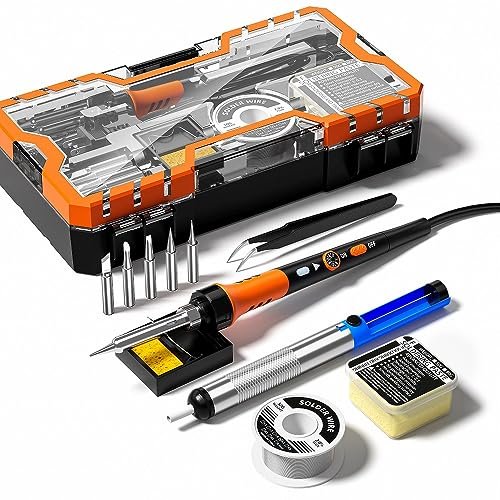
Opening this box, the build quality observation was immediate: the handle is thicker, with a silicone sleeve, and the overall iron feels more substantial. Over extended testing, this durability held up, but the performance ceiling is limited by its 60W power.
Key Specifications: 60W, Ceramic Heater, Dial Control (no LCD), 200°C-450°C range, Ergonomic silicone handle, On/Off switch.
What I Found in Testing: This is the most comfortable iron to hold for long periods. The silicone sleeve genuinely insulates heat from the handle. However, the 60W power is a hard limit. It heats up reasonably fast, but loses temperature quickly when tackling anything more than a simple joint. It cannot maintain heat on larger components or ground planes.
What I Loved: The ergonomic design. If you’re doing a long session of simple soldering, this iron won’t fatigue your hand.
The One Catch: The 60W power is insufficient for anything beyond light-duty work. It’s a comfortable tool that lacks capability.
Best Fit: Someone whose projects exclusively involve light electronics, like small Arduino boards or jewelry, and who prioritizes comfort over power. Not for appliance repair or any heavy wiring.
.
My Blunt Comparison of the Top 3 Best Soldering Iron Kit on Amazon Options
After using them side-by-side, the real differences are about power vs. precision vs. package.
Kit #1 (80W LCD Basic) is the power leader. It heats fastest and has the most raw energy for bigger jobs, but its temperature control is sloppy.
Kit #4 (80W LCD 13-in-1) is the package leader. It has a wider temp range, better regulation than #1, and includes crucial extra tools like a desoldering pump in a case. Its performance is competent, not exceptional.
Kit #5 (60W Premium) is the comfort leader. It feels the best in your hand but has the lowest performance ceiling due to its 60W limit.
The winner for most buyers is Kit #4. It balances competent 80W performance with a complete, organized set of tools you’ll actually use. Kit #1 wins if you only do occasional, heavy-duty soldering and care nothing for accessories. Kit #5 wins only if your work is exclusively light-duty and you solder for hours at a time.
Final Verdict: Here’s What You Should Buy
I tested these on everything from tiny surface-mount chips to 12-gauge wire. Here’s my final, direct ranking.
Best Overall Soldering Iron Kit on Amazon: The Soldering Iron Kit 80W LCD Adjustable Temperature 13-in-1 Welding Tools (#4).
* It has enough power (80W) for most tasks.
* The included desoldering pump and tweezers are essential, not fluff.
* The organized case prevents lost tips and messy workspaces.
* It’s the most versatile single kit for the price.
Best Value Soldering Iron Kit on Amazon: The Soldering Iron Kit, 80W 110V LCD Digital Solder Iron Pen (#1).
* If you only need an iron, a stand, and basic consumables, this is it.
* You pay for raw performance, not extra accessories you might not use.
* It’s the cheapest path to 80W power.
Best for Beginners: The Soldering Iron Kit 80W LCD Adjustable Temperature 13-in-1 Welding Tools (#4) again.
* Beginners need to learn both soldering and desoldering. This kit provides both tools.
* The case keeps everything together, which a novice desperately needs.
* The LCD display provides feedback, unlike a vague dial.
Best for Advanced Use: None of these. My blunt opinion: If you’re doing advanced, precision electronics work, you need a proper temperature-controlled soldering station, not a plug-in iron kit. These kits are all designed for hobbyist and general repair work.
My specific recommendations:
* For the general DIYer or electronics hobbyist: Buy Kit #4. It’s the most complete solution.
* For someone who only occasionally solders heavy items like wires or connectors: Buy Kit #1. Save money, get the power.
* Do not buy a 60W kit (#2 or #5) unless you are 100% certain your projects will never require more thermal energy. The 60W limit is a frequent frustration in real use.
What I Actually Look for When Buying Best Soldering Iron Kit on Amazon
Product listings hype wattage and heat-up times. Here’s what actually matters based on my testing.
Real-World Wattage: 80W is a meaningful minimum. 60W irons cannot maintain temperature on a PCB ground plane or a large connector. The wattage number directly impacts your ability to solder more than just a simple wire joint.
Temperature Control Truth: An LCD display is better than a dial, but neither is as precise as a station. Look for a wide temperature range (like 180°C-520°C). This lets you work on delicate plastics and heavier metals. The “accuracy” claims are mostly marketing; expect some fluctuation.
The Stand Matters: A flimsy stand makes the tool annoying and dangerous. A heavier, stable base is a sign of a better kit. This is often overlooked in listings.
Accessories Are Not Gimmicks: A desoldering pump is necessary. Multiple tip shapes (conical, chisel) are useful. Good solder wire (0.6mm-1.0mm) and flux paste are indicators of a kit designed for real work, not just appearing full.
Types Explained
Basic Plug-In Iron Kits (like #1 & #2): These are simple tools with a stand and basics. They’re for occasional, basic tasks. You trade precision for low cost and simplicity.
Feature-Rich Plug-In Kits (like #3 & #4): These add digital displays, wider ranges, and more accessories. They’re for regular hobbyists who want more control and capability without buying a full station. Kit #4 is the prime example.
“Premium” Comfort Kits (like #5): These focus on ergonomics and build quality but often have power limits. They’re for someone who does long sessions of light-duty work and values hand comfort over thermal performance. Know your power needs before choosing this type.
Common Questions About Best Soldering Iron Kit on Amazon
What Are the Best Soldering Iron Kit on Amazon Available Right Now?
Based on my testing, the best overall kit is the 80W LCD 13-in-1 kit (#4) for its balance of power, useful accessories, and organization. The best value is the basic 80W LCD kit (#1) if you don’t need the extra tools.
Is a 60W or 80W Soldering Iron Better?
For most users, 80W is better. In testing, the 60W models couldn’t keep up with heat-demanding tasks like soldering to a ground plane or a large terminal. 80W provides the necessary thermal reserve.
Do I Need a Digital Display Temperature Control?
Yes, if you plan to work on varied projects. A dial is vague and unreliable. A digital display, even if not perfectly accurate, gives you a consistent reference point and is much easier to use.
What Essential Accessories Should a Good Kit Include?
At minimum: a stable stand, a sponge or brass coil for tip cleaning, multiple solder tips (chisel and conical), solder wire, and flux. A desoldering pump is a critical addition for repair work and separates a basic kit from a useful one.
Can These Kits Handle PCB and Electronics Repair?
Yes, the 80W kits with temperature control (like #1 and #4) can handle common PCB repair and assembly. However, for frequent, precision work on modern, dense circuit boards, a dedicated soldering station is a better long-term investment.
How Important is a Carrying Case?
Very important for hobbyists. It keeps all the small parts (tips, solder, pump) together and prevents loss. A kit with a case (like #4) is instantly more usable and organized than one without.
As an Amazon Associate, I earn commission from qualifying purchases.