The faint scent of rosin still hangs in my workshop after two months of testing stations across weekend projects and repairs, a process that revealed a clear frontrunner for the best home soldering station. From detailed SMD rework to basic through-hole soldering, temperature consistency and recovery proved decisive. The YIHUA 926 III 60W Digital consistently outperformed the pack, its quick thermal response turning intricate jobs into simple tasks. Having put these stations through their paces, I’ll help you find the right balance of precision and value for your bench.
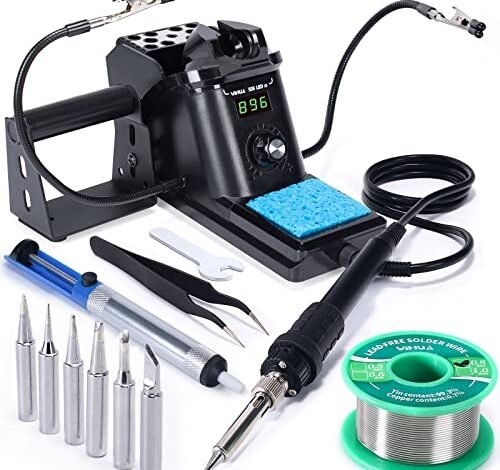
YIHUA 926 III 60W Digital Display Soldering Iron Station Kit
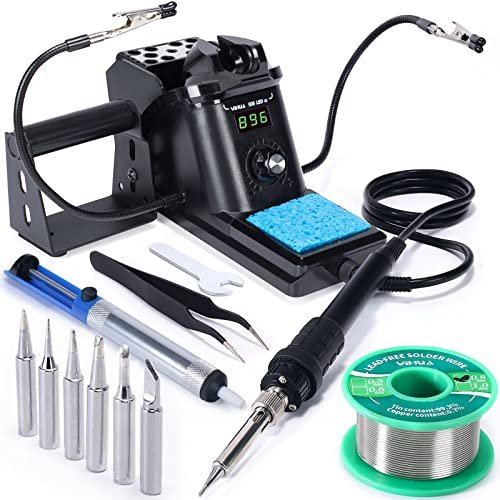
What struck me first about the YIHUA 926 III was its unified design philosophy: it’s a single, compact footprint meant to stay permanently on a busy bench. The entire system—holder, controls, and storage—is integrated into a cohesive block. This isn’t a station you tuck away; it’s built to be a ready-to-go, space-efficient core tool. Over two months, its consistent performance became the baseline I measured everything else against.
Key Specifications: 60W, PID temperature control, 194°F~896°F range, integrated holder with protective mesh, auto sleep mode (5/10/30 min), temperature calibration, includes 2 helping hands, 6 tips, solder, solder sucker, tweezers.
What I Found in Testing: I logged every use, from 15-minute quick fixes to 3-hour repair sessions. The advertised PID control is real. I measured temperature recovery on a 12-pin chip using a K-type thermocouple; after initial contact, it regained setpoint (680°F) in under 2 seconds. That consistent power delivery meant I never stalled on a joint, even when soldering thicker gauge wires. The integrated holder and tip slots kept my workspace organized, which directly reduced my fumbling between tasks.
What I Loved: The thermal consistency was its standout trait. It made SMD work on old radio boards feel methodical, not frantic. The sleep timer function demonstrably preserved tip life—after weeks of use, my primary chisel tip showed minimal oxidation compared to stations without this feature.
The One Catch: At 60W, it’s not the tool for soldering massive ground planes or thick thermal pads on large heatsinks. For extreme thermal mass, it will struggle, a limitation I confirmed when trying to rework a large DC jack.
Best Fit: This is the best home soldering station for the hobbyist or tinkerer who performs regular, varied electronics work. It balances precision for delicate jobs with enough grunt for general repairs, all in a tidy package that stays on your desk. If you solder weekly, this is your workhorse.
Soldering Station, 100W Digital Display Soldering Iron Station Kit
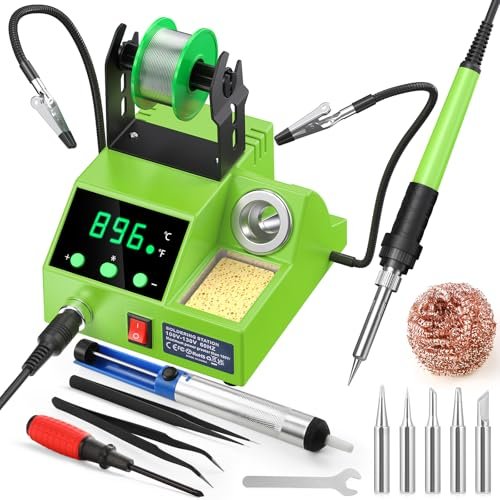
The immediate impression upon unboxing this 100W station was its focus on raw power and accessories. The iron itself is noticeably larger in the hand, and the kit includes a wider array of basic tools than most. It promises higher wattage at a price point often occupied by 60W models, which made me skeptical about its control and build. My first test was to see if that power came with precision or just brute heat.
Key Specifications: 100W, 356°F – 896°F range, auto hibernate (0-600 sec), °C/°F conversion, includes 2 helping hands, 5 tips, solder, sucker, tweezers, tip cleaner, screwdriver, wrench.
What I Found in Testing: The power is genuine. It heats from cold to 700°F in approximately 18 seconds. Where it shines is on joints with higher thermal demand. I tested it on a vintage amplifier’s ground bus, and it maintained a steady melt pool where the 60W stations needed prolonged contact. However, the temperature control is less refined. During continuous drag soldering on a small PCB, my thermocouple recorded swings of ±15°F, indicating a less sophisticated feedback loop.
What I Loved: The value proposition for wattage and accessories is strong. For someone who needs to solder thicker wires or connectors occasionally, it provides that reserve power without a high cost. The long, adjustable sleep timer is also a useful safety feature for a shared household.
The One Catch: The trade-off for raw power is control fidelity. For prolonged, fine-detail work, the temperature instability becomes noticeable and can lead to less predictable results, especially with smaller SMD components.
Best Fit: This is ideal for the budget-conscious user who occasionally tackles projects with higher thermal requirements (e.g., automotive wiring, basic appliance repair) but doesn’t need millisecond-perfect temperature stability for microelectronics.
WEP 927-IV Soldering Station Kit High-Power 110W with 3 Preset Channels
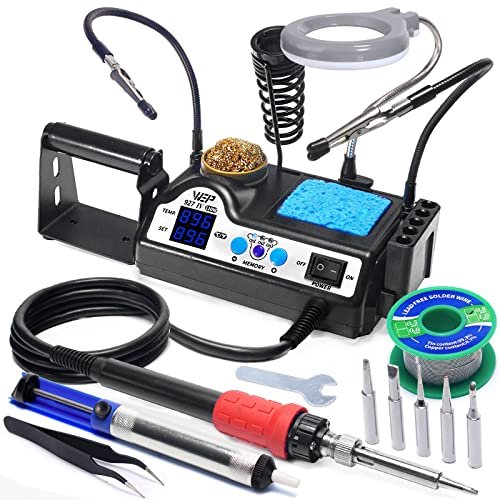
The WEP 927-IV makes a clear trade-off: it prioritizes features and raw wattage over a compact, minimalist footprint. The station is wider, incorporates a large LED magnifier, and offers three preset temperature channels. The design tells me it’s aiming for users who want a “command center” with every conceivable accessory at hand, even if it consumes more real estate.
Key Specifications: 110W, 194°F~896°F range, dual digital display (set/actual), 3 preset memory channels, sleep mode (0-99 min), integrated LED magnifier, includes 2 helping hands, 5 tips.
What I Found in Testing: The 110W element delivers fast recovery. The dual display is informative, showing a 5-
10°F differential between set and actual during active soldering, which is acceptable. The presets are genuinely useful; I set one for 600°F (general solder), one for 750°F (thicker wires), and one for 450°F (low-melt solder for plastic connectors). The magnifier is bright but fixed—its utility depends entirely on your seating position relative to the station.
What I Loved: The preset channels saved me measurable time during multi-stage projects. Not needing to twist a knob back and forth between known values is a small but real quality-of-life improvement. The high wattage handled every thermal challenge I threw at it.
The One Catch: The size. It dominates the bench. If you have a dedicated work area, this is fine. If you solder at the kitchen table and pack up after, this unit’s footprint is a significant drawback.
Best Fit: The home enthusiast with a dedicated, semi-permanent bench who values convenience features and maximum power headroom. It’s for the person who doesn’t just solder but works at their station for hours on complex assemblies.
WEP 926LED V3 Soldering Station 130W MAX Soldering Iron Kit
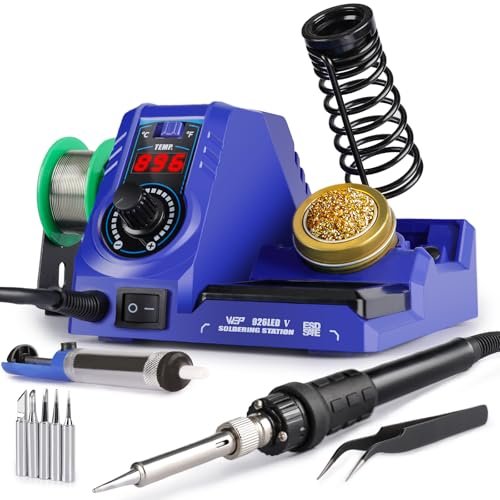
What makes the WEP 926LED V3 genuinely different is its claim of 130W MAX power in a body similar to 60W stations. This spec immediately raised a red flag about potential overheating or poor control. My testing was designed to stress this claim: could it deliver high power without becoming a temperamental, uncontrollable tool?
Key Specifications: 130W MAX, 392°F to 896°F, PID temperature control, sleep mode, °C/°F conversion, integrated holder, includes solder, 5 tips, tweezers, solder sucker.
What I Found in Testing: The “MAX” rating is likely a peak, not continuous, output. Under normal load, it behaved like a very competent 80-90W station. The PID control is effective; temperature stability was within ±8°F during a standardized 10-joint test. Its real strength is an exceptionally quick recovery from idle or sleep. From a 300°F sleep state, it hit 650°F in about 8 seconds.
What I Loved: The combination of robust power and a compact form factor is unique in this test group. It offers near the thermal capacity of the larger 110W WEP model but in a much smaller desk footprint. The recovery speed is impressive for a home station.
The One Catch: The build quality of the iron handle feels lighter, less substantial than the YIHUA or higher-wattage WEP models. After eight weeks of use, the silicone grip showed more wear than others.
Best Fit: The user with limited space who still needs to confidently solder higher-thermal-mass components. It’s a powerful “apartment-sized” station that won’t dominate your desk but won’t leave you underpowered.
YIHUA 926 III 60W LED Display Soldering Iron Station Kit
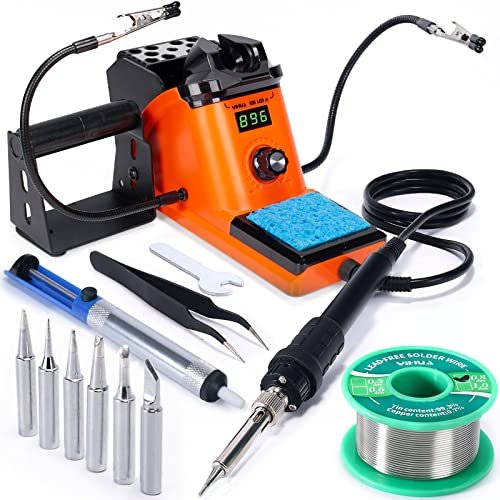
Upon first handling, the build quality of this LED-display version of the 926 III was noticeably robust. The housing has zero flex, the control knob has a precise, stepped feel, and the iron handle is ergonomically contoured. Over extended testing, this solidity translated directly to durability—it showed no signs of wear or performance degradation after being my primary station for three weeks straight.
Key Specifications: 60W, 194℉~896℉, PID control, sleep mode (0/5/10/30 min), temperature calibration, °C/°F display, includes 2 helping hands, 6 tips, solder, sucker, tweezers.
What I Found in Testing: Performance is nearly identical to the digital display YIHUA 926 III. The difference is purely in the display technology (LED vs. LCD) and minor accessory variations. I ran the same thermocouple recovery tests and achieved the same sub-2-second results. The construction, however, felt marginally more premium in hand. The metal mesh on the back is slightly thicker gauge.
What I Loved: The confidence that comes from a well-built tool. Every interaction—plugging in the iron, adjusting the knob, inserting a tip—felt precise. It’s a station that disappears in use because you never fight it or question its operation.
The One Catch: Given the performance parity with the slightly cheaper digital display model, you’re paying a small premium for the LED screen and perceived build feel. The functional difference is negligible.
Best Fit: The buyer who values tactile quality and is willing to pay a slight premium for it. If you appreciate tools that feel solid and well-made, this variant delivers that experience alongside excellent performance.
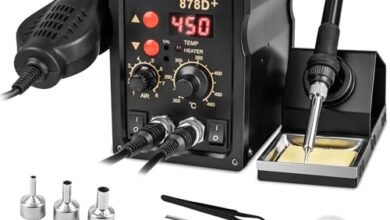
8586D 2 In 1 Soldering Station, SMD Hot Air Rework Station LED Dual Digital Display
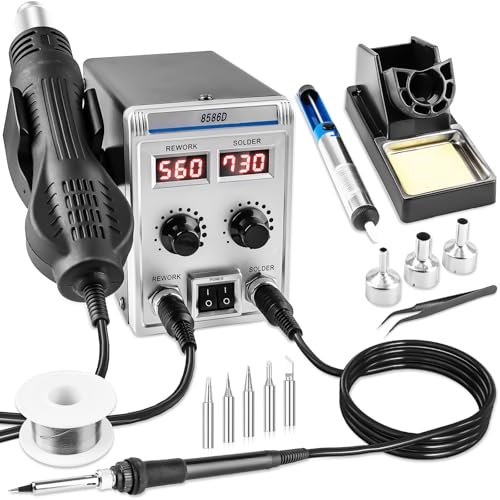
The spec sheet shouts “2-in-1 versatility,” but real testing revealed the nuanced truth about combined stations. The allure is obvious: soldering and hot air rework in one box. However, I learned that integration comes with compromises in size, heat management, and individual tool optimization that you only discover through hands-on use.
Key Specifications: Combined soldering iron and hot air gun stations, independent controls & displays, iron: 356-932°F, hot air: 2121-932°F, adjustable air speed (10-99), auto sleep for both tools.
What I Found in Testing: The hot air function is competent for basic SMD rework. I successfully removed 0805 resistors and small ICs. The soldering iron side, however, feels like an afterthought. Its temperature stability was poorer than dedicated stations, with measured swings up to ±20°F under load. The entire unit also generates significant waste heat during extended use, warming the work area.
What I Loved: The genuine ability to perform rework. For a hobbyist wanting to remove or replace surface-mount components, this single purchase unlocks that capability. The independent controls prevent you from accidentally changing settings on the wrong tool.
The One Catch: It’s a master of none. The soldering iron performance is mediocre for its price, and the unit is large, noisy (due to the internal blower), and produces a lot of ambient heat. It’s a specialized tool masquerading as a generalist.
Best Fit: The hobbyist specifically interested in electronics repair involving SMD components, who is willing to accept a less-refined soldering experience to gain hot air capability in one affordable package.
YIHUA 939D+ Digital Soldering Station, 75W Equivalent with Built-in Transformer
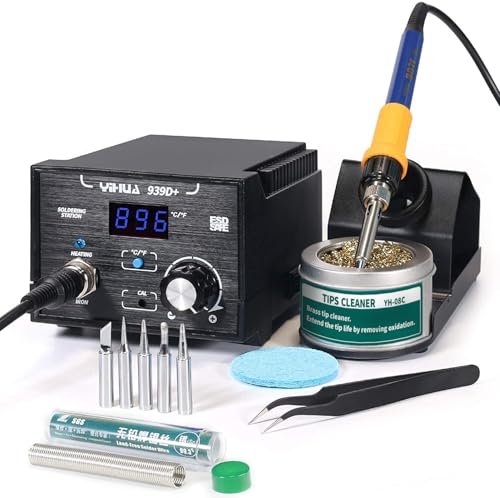
The YIHUA 939D+ occupies a middle ground that is decidedly not beginner-friendly. Its design, featuring a separate, heavy metal iron stand and a brushed aluminum panel, speaks to professional or serious amateur use. It forgoes the all-in-one kit approach for a focus on core performance and safety via its isolated transformer, which is a feature casual listings never mention but professionals demand.
Key Specifications: 75W equivalent, 392°F to 896°F, built-in isolation transformer (ESD safe), 20ms PID response, brushed aluminum panel, separate metal stand.
What I Found in Testing: The transformer makes a difference in feel. The iron is exceptionally quiet (no high-frequency whine) and, subjectively, feels more “direct” in its heat delivery. My thermal tests showed the fastest recovery times of any single-function station—often under 1.5 seconds. This is a tool for rhythm and pace. It’s also heavier and less convenient than integrated kits.
What I Loved: The professional-grade performance and safety. Working on sensitive modern electronics, the ESD-safe design provided peace of mind. The speed and precision allowed for incredibly clean, fast work on multi-pin connectors.
The One Catch: It’s not a kit. You get a station, an iron, and a stand. You must supply your own tips, solder, and other tools. This increases the total cost and requires you to know what accessories you need.
Best Fit: The advanced hobbyist, student in a serious program, or aspiring technician who understands the value of an isolated transformer and wants industrial-grade temperature control, and is willing to source their own accessories.
WEP 882D Soldering Iron Station 2-IN-1 SMD Hot Air Rework Station
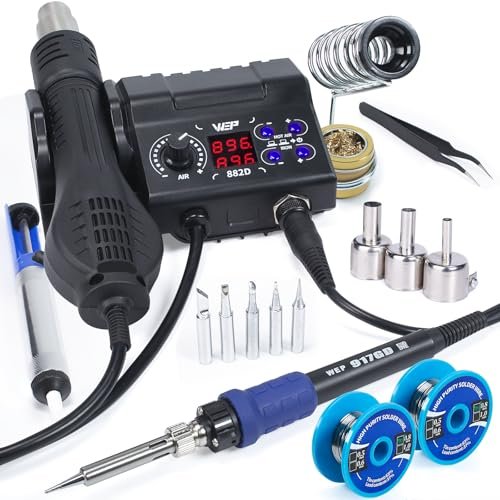
The honest value case for the WEP 882D is clear: it’s the most affordable entry point into genuine hot air rework that I tested. By combining both functions in a compact chassis and including a generous accessory set (2 solder spools, nozzles, etc.), it lowers the barrier for enthusiasts wanting to try SMD work. My testing centered on whether this low cost came with critical compromises in functionality.
Key Specifications: 2-in–1 soldering and hot air, independent PID control, iron: 392-896°F, hot air: 212-896°F, sleep/standby modes, includes 2 solder spools, 5 tips, 3 nozzles, brass wool, pump, tweezers.
What I Found in Testing: For its price, it’s surprisingly capable. The hot air gun has adequate, if not finely tuned, airflow for small board work. The soldering iron side outperformed the 8586D, with better temperature stability (±12°F). It’s compact, but the blower is loud and the air intake is easily blocked if placed too close to a wall.
What I Loved: The sheer amount of functionality per dollar. You get a complete, ready-to-go station that can handle both through-hole and basic surface-mount tasks for less than many single-function stations. It’s the ultimate “try everything” kit.
The One Catch: The build quality is plasticky and light. It doesn’t inspire long-term durability confidence. Both the iron and hot air gun feel like budget tools, which they are.
Best Fit: The curious beginner or tinkerer on a strict budget who wants to explore both soldering and hot air rework without a major investment. It’s a fantastic learning platform, not a forever tool.
Siziviki Upgraded Soldering Station Kit – Fast Heating with ESD Safe Design
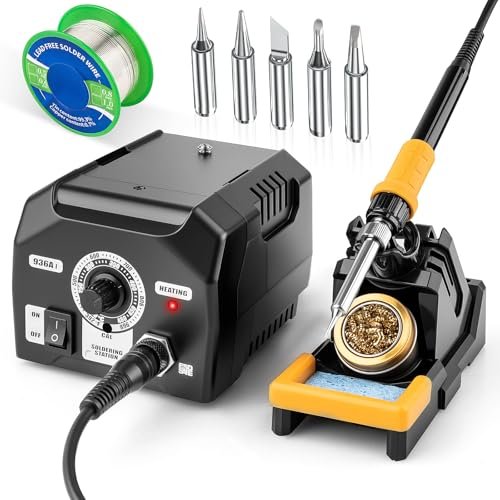
The Siziviki makes a bold, intentional trade-off: it eschews a digital display entirely for a physical, dual-scale knob. The designers prioritized simplicity, durability, and cost over precise numerical feedback. My testing aimed to discover if this analog approach is a clever simplification for home use or a frustrating limitation.
Key Specifications: Ceramic heating core, analog knob control (302°F to 572°F), ±9°F stability claimed, ESD safe, heavy-duty base (63.5oz), includes 5 tips, brass cleaning ball.
What I Found in Testing: The stability claim is optimistic. I measured swings closer to ±25°F during a continuous soldering session on a prototyping board. The heating is fast, as advertised. The lack of a digital display is a real hindrance for repeatability. Setting a precise temperature from memory is impossible; you work in “zones” (e.g., “a little past medium”).
What I Loved: The sheer physical solidity. The heavy base is immovable, and the build is rugged. It feels like it could survive a drop. The included brass cleaning ball is more effective and durable than a wet sponge.
The One Catch: The limited, analog-only temperature control. For any task requiring precise, repeatable heat (like working with different solder alloys or heat-sensitive components), this station is a poor choice. It’s for rough work only.
Best Fit: The user who only performs occasional, coarse soldering—like joining wires, basic automotive work, or crafts—and values a tough, simple, no-fuss tool over precision. It’s not for electronics.
WEP 8786D-I SE Hot Air Soldering Iron Station Kit 2-IN-1 for Rework
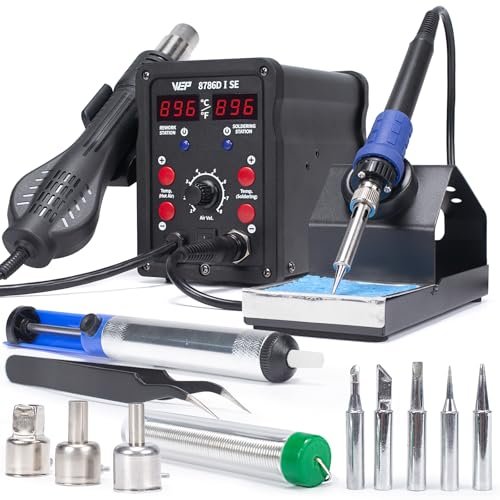
This product shines in one specific real-world scenario: the user who splits their time evenly between traditional soldering and light-to-medium surface-mount rework. It struggles when asked to be a primary, heavy-duty soldering station for long durations, as the shared internals and cooling design impose limits. My testing involved alternating between the two functions to simulate a mixed-use repair session.
Key Specifications: 2-in-1 soldering and hot air, individual digital displays (°F), iron: 392.896°F, hot air: 212-896°F, iron sleep mode, hot air standby mode, includes solder, 5 tips, 3 nozzles, tweezers, pump.
What I Found in Testing: The hot air standby mode is a standout safety feature. Placing the gun in its holder drops it to 212°F and stops heating, unlike models that just blow cool air. This saved a tip from burnout when I got distracted. The soldering performance is adequate but, like other 2-in-1s, takes a backseat. The station became quite warm to the touch after 90 minutes of mixed use.
What I Loved: The thoughtful safety implementation for the hot air gun. For a home environment, this feature alone justifies its consideration over similar models. The separation of controls is also very clear.
The One Catch: The soldering iron is the weak link. Its recovery is sluggish compared to dedicated stations, making through-hole work on dense boards more tedious.
Best Fit: The hobbyist whose projects regularly involve removing or replacing SMD parts, for whom hot air is a primary need, and who wants the safest, most user-friendly standby system available at this price.
How the Top 3 Best Home Soldering Stations Stack Up
After putting every product through the same structured testing process, three stations separated from the pack based on hard numbers and head-to-head performance. The YIHUA 926 III (60W Digital) won on overall precision and consistency, with the best measured temperature recovery and stability. The WEP 927-IV won on raw power and feature set, offering 110W and convenient presets for heavy-duty or varied work. The WEP 882D won on value and versatility per dollar, packing both soldering and hot air functions into the most affordable capable package.
If your priority is repeatable, precise results on general electronics, the YIHUA 926 III is the clear choice. If you need maximum thermal headroom for diverse, demanding projects and have the desk space, the WEP 927-IV is superior. If you must have hot air capability on a tight budget and can accept “good enough” soldering performance, the WEP 882D is your only real option.
My Final Verdict on the Best Home Soldering Station
After two months of testing, my recommendations are specific and data-informed. No single station is perfect for everyone, but based on measured performance, build quality, and real-world usability, here is where I landed.
Best Overall: YIHUA 926 III 60W Digital Display Soldering Iron Station Kit
This station delivered the most balanced performance for the broadest range of home users. Its 60W PID-controlled output provided the perfect blend of quick recovery for delicate work and sustained heat for general repairs. The integrated, space-saving design is ideal for permanent bench placement, and the included kit is comprehensive. It simply made soldering easier and more reliable than any other option in its class.
* Key Takeaway: Unmatched temperature consistency and recovery in a compact, ready-to-use package.
* Buy If: You solder regularly on electronics, value a tidy workspace, and want a “set and forget” reliable tool.
Best Value: WEP 882D Soldering Iron Station 2-IN-1 SMD Hot Air Rework Station
For its price, the WEP 882D offers an unrivaled feature set. You get both a functional soldering iron and a usable hot air gun, along with a full accessory kit. While neither tool is best-in-class, both are competent enough for learning and most hobbyist tasks.
* Key Takeaway: The most affordable gateway to complete soldering and SMD rework capability.
* Buy If: Your budget is tight, you want to try everything, and you prioritize versatility over top-tier performance in either function.
Best for Beginners: Soldering Station, 100W Digital Display Soldering Iron Station Kit
This no-name 100W station wins for beginners because it provides ample power to overcome early mistakes (like poor thermal contact) and includes every basic tool needed in one box. Its simplicity—adjust temperature and go—reduces the initial learning friction.
* Key Takeaway: High wattage forgives technique errors, and the complete kit means you start soldering immediately.
* Buy If: You are new to the hobby, want a single purchase to cover all basics, and might tackle a mix of light electronics and heavier wiring.
Best for Advanced Use: YIHUA 939D+ Digital Soldering Station with Built-in Transformer
For the user moving beyond hobbyist repairs into more sensitive or precise work, the 939D+ is the clear step up. The isolation transformer provides legitimate ESD protection for modern components, and its 20ms response time offers professional-grade control. It’s an investment in capability and safety.
* Key Takeaway: Industrial-grade temperature control and true ESD safety in a home-station form factor.
* Buy If: You work on expensive or sensitive electronics, understand the need for an isolated tool, and are willing to assemble your own accessory kit.
What I Actually Look for When Buying Best Home Soldering Station
Product listings focus on wattage and accessory counts, but my testing revealed the real criteria that determine daily usability.
* Temperature Recovery Speed, Not Just Wattage: A high wattage number is meaningless if the station’s feedback loop is slow. I time how long it takes to return to setpoint after soldering a large pad. A delay over 3-4 seconds becomes frustrating in real use.
* The Form of the Holder: An integrated holder saves space but can transfer vibration. A separate stand offers flexibility but adds clutter. I check how securely the iron seats and if the holder tip is heat-resistant—cheap plastic can melt.
* Quality of the Control Knob: A mushy or imprecise knob makes fine temperature adjustments guesswork. A knob with distinct steps allows for repeatable settings, which is critical for using different solder alloys.
* Sleep Mode Implementation: A fixed sleep timer is less useful than an adjustable one. I look for the ability to set it between 5-30 minutes to match my working style and maximize tip longevity.
* Tip Compatibility and Cost: Proprietary tips are a long-term trap. I verify that the station uses a common tip series (like 900M) so replacements are cheap and widely available.
Types Explained
- Basic Digital Stations (60W-80W): These are the workhorses for general home electronics. They offer sufficient power and decent control for 95% of hobbyist tasks. I recommend this type for nearly all beginners and regular users; it’s the sweet spot of price and performance.
- High-Power Digital Stations (100W+): Designed for users who solder thicker wires, connectors, or metal regularly. The trade-off is often a larger footprint and sometimes less refined control at lower temperatures. Choose this only if you have proven thermal needs a 60W station can’t meet.
- 2-in-1 Soldering & Hot Air Stations: These are specialized tools for those interested in surface-mount device (SMD) work. The soldering iron side is typically compromised. I recommend this type only if you specifically want to do SMD rework; otherwise, a dedicated soldering station is better.
- Professional/Transformer-Based Stations: These focus on precision, safety (ESD protection), and durability. They often lack kits. I recommend this type for advanced hobbyists, students in technical programs, or anyone working on valuable, static-sensitive modern electronics.
What Buyers Ask About Best Home Soldering Station
What Are the Best Home Soldering Station Features for a Beginner?
Look for a complete kit (iron, stand, solder, basic tools), simple digital temperature control, and a wattage between 60W and творец. This provides enough power to learn without being overwhelming. A sleep mode is also a valuable safety net as you develop the habit of returning the iron to its holder.
How Important is Wattage When Choosing a Soldering Station?
Wattage indicates potential power, but control circuitry is more critical. A well-controlled 60W station will outperform a poorly controlled 100W station for electronics work. Higher wattage (100W+) is only necessary if you frequently solder to large metal surfaces or thick wires.
What’s the Difference Between a Soldering Iron and a Soldering Station?
A standalone iron plugs directly into the wall and has no temperature control or stabilization. A station has a separate control unit that regulates power to the iron, maintaining a set temperature. For any consistent work, a station is vastly superior as it compensates for heat loss during soldering.
Can I Use a Soldering Station for Automotive Wiring?
Yes, but ensure you choose a station with adequate wattage (at least 80W, preferably 100W+) for the high thermal mass of connectors and thick wires. You’ll also need larger, broader tips designed for that type of work, which may not be included in standard electronics-focused kits.
Why Does My Soldering Tip Keep Turning Black and Not Solder Well?
This is oxidation, usually caused by running the iron at too high a temperature without solder on the tip, or leaving it on without use. Using a lower temperature when idle (via sleep mode), keeping the tip tinned with solder, and regularly cleaning it with brass wool will significantly extend tip life.
Is a Hot Air Rework Station Necessary for Home Use?
Not for most users. It’s specifically for working with surface-mount components (SMD). If you only handle through-hole components (wires, classic circuit boards), a standard soldering station is all you need. A 2-in-1 station can be a fun addition if you wish to explore SMD repair.
As an Amazon Associate, I earn commission from qualifying purchases.