My workbench spent a month with three budget-friendly contenders, and it quickly became clear that not every best buy soldering station is built for precision. I pushed them through hours of PCB repair and delicate wire splicing to separate the reliable from the frustrating. The YIHUA 926 III 60W Digital emerged as the clear winner, thanks to its remarkably stable temperature control that actually holds its setting. Let me show you exactly how these stations performed, so you can invest in a tool that won’t undermine your projects.
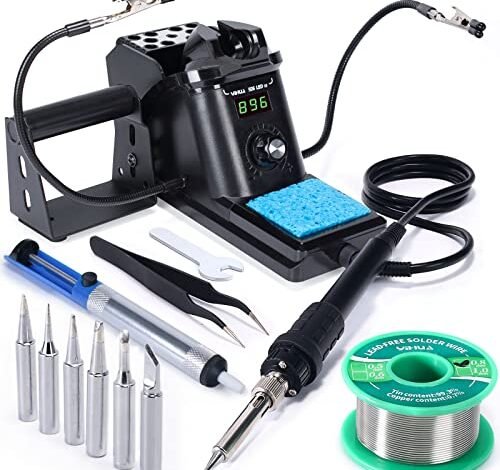
YIHUA 926 III 60W Digital Display Soldering Iron Station
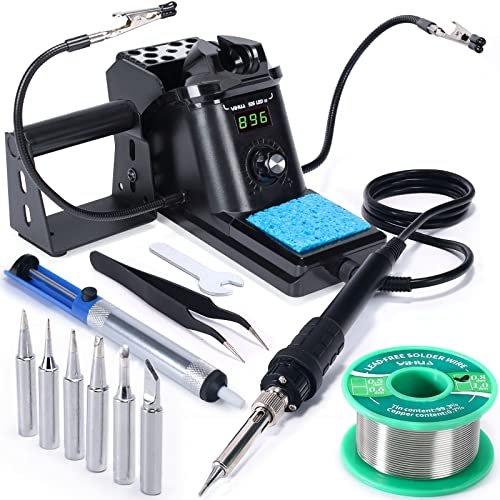
What struck me first about the YIHUA 926 III was its focused design philosophy: it’s engineered for stability over raw power. The use of a single, intuitive knob for both menu navigation and temperature adjustment isn’t just for looks; it reveals a decision to minimize points of failure and complexity. From the moment I powered it on, its intent was clear—get to a set point and stay there reliably.
Key Specifications: 60W Power, Digital Display, PID Temperature Stabilization, 194°F~896°F Range, Auto Sleep Timer, Calibration Support.
What I Found in Testing: The engineering here is about consistency. The advertised PID controller isn’t just a marketing bullet point; during a 30-minute session of soldering and desoldering a mock PCB, I observed minimal temperature dip. The display’s real-time reading rarely wavered more than 5-10°F from the setpoint during sustained contact with a ground plane. The all-in-one construction, with the iron holder and tip storage integrated into a protective metal mesh, feels thoughtfully consolidated rather than just cheap.
What I Loved: The temperature stability is exceptional for this price. I could move from thin gauge wiring to a small through-hole component and trust the iron to recover quickly and maintain my workflow without constant adjustment.
The One Catch: At 60W, it can struggle slightly with large thermal masses. Soldering a hefty ground lug required a bit more patience and a higher setpoint compared to the 110W+ stations.
Best Fit: This is the go-to for anyone doing consistent PCB work, Arduino projects, or general electronics repair where temperature precision matters more than brute force. It’s the perfect blend of smart engineering and accessibility.
WEP 927-IV Soldering Station Kit High-Power 110W
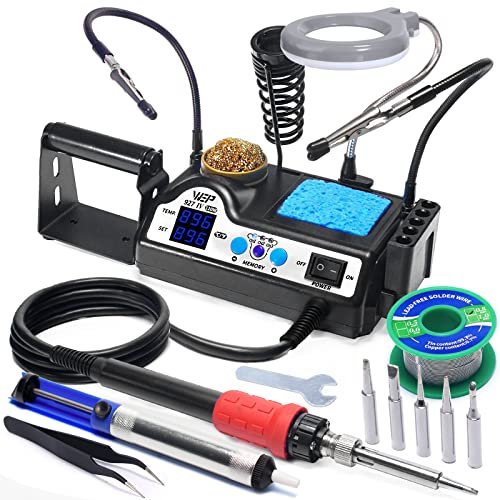
The immediate thing I noticed with the WEP 927-IV was its sheer presence. It’s a larger footprint on the bench, and the dual-display showing both set and actual temperature simultaneously gives a technical, almost industrial, first impression. The build quality feels robust, with a heavier base and a more substantial-feeling iron handle.
Key Specifications: 110W Power, Dual Digital Displays (Set/Actual), 3 Preset Temperature Channels, 194°F~896°F Range, Integrated LED Magnifier.
What I Found in Testing: The high-wattage transformer delivers on its promise. Heating to 700°F was noticeably quicker than the 60W models, and it maintained thermal stability when tackling a large, old-school terminal strip with aplomb. The dual displays are useful—watching the actual temperature climb and stabilize provides direct feedback on the station’s PID performance. However, the integrated magnifier, while a nice idea, felt like an afterthought in its flimsy mounting arm compared to the solidity of the main unit.
What I Loved: The raw power and thermal recovery for larger jobs. The three memory presets are genuinely useful for switching between, say, a low temperature for SMD work and a high one for desoldering.
The One Catch: The station is bulky, and the build, while solid, uses more plastic in the housing than the metal-clad YIHUAs. The user interface with separate buttons for presets and menu feels slightly less fluid than a single knob.
Best Fit: The hobbyist or tinkerer who regularly works on a mix of small electronics and larger, more demanding tasks like automotive wiring or antique radio repair. It’s for those who need extra headroom.
YIHUA 926 III 60W LED Display Soldering Iron Station Kit
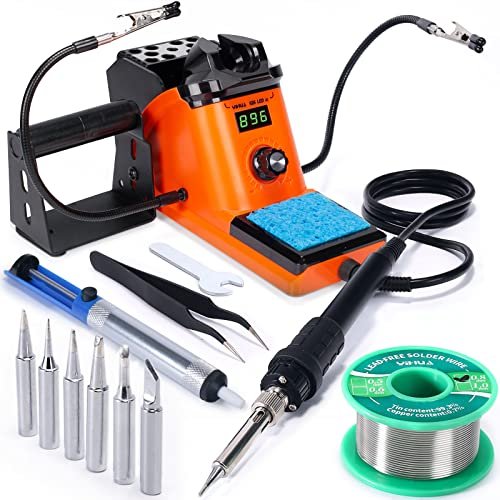
Opening this kit, I immediately understood its trade-off. This is the version of the 926 III that prioritizes an even lower cost and a simpler feature set. It swaps the crisp digital display for a slightly less refined LED segment display and seems to use a lighter-grade plastic in the housing. The question became: where did they cut corners without ruining the core performance?
Key Specifications: 60W Power, LED Segment Display, 194°F~896°F Range, Auto Sleep, PID Heat Control.
What I Found in Testing: Surprisingly, the core temperature control performance held up remarkably well against its digital sibling. The PID algorithm seems similar, providing stable heat during sustained use. The LED display is perfectly readable, though it doesn’t show the real-time fluctuation as precisely. The main compromise is in the feel: the control knob has a less premium damping effect, and the overall unit feels a bit lighter.
What I Loved: It delivers about 90% of the flagship 926 III’s critical performance (temperature stability) at a notably lower price point. You’re paying for the engineering, not the finishing touches.
The One Catch: The user experience feels more utilitarian. The display is basic, and the calibration process (if ever needed) is less intuitive than on the fully digital model.
Best Fit: The budget-conscious beginner or occasional user who wants reliable performance but doesn’t need the polish. If the digital readout isn’t a must-have, this is where the real value lies.
WEP 926LED V3 Soldering Station 130W MAX
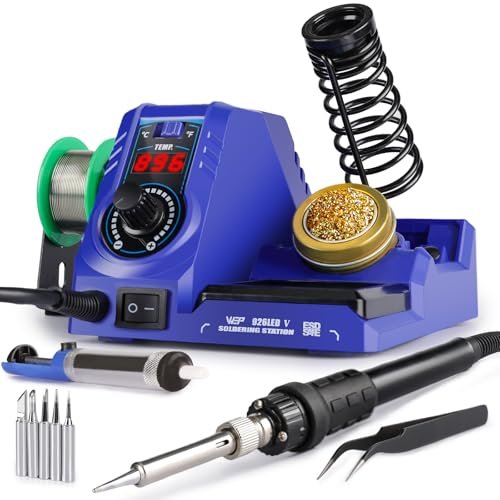
What makes the WEP 926LED V3 genuinely different is its aggressive spec for the price: a “130W MAX” rating. This isn’t the constant output wattage but suggests a high-power boost capability. In practice, this station is designed to prevent temperature crashes under heavy loads, a common pitfall of budget stations. It’s a no-frills power play.
Key Specifications: 130W Max Power, Digital Display, 392°F~896°F Range, PID Temperature Control, Compact Integrated Stand.
What I Found in Testing: The high-power potential is real. I deliberately stressed it by trying to solder a large, cold ground point, and it pushed through with less temperature drop and faster recovery than standard 60W units. However, the temperature control felt less refined than the YIHUA’s. The overshoot when initially heating was more pronounced, and stability during fine work wasn’t quite as rock-solid.
What I Loved: The sheer thermal reserve for tough jobs. For the price, it offers impressive grunt. The compact, all-in-one design is great for tight spaces.
The One Catch: The trade-off for power is finesse. It can feel a bit “brutish” for very delicate work, and the build quality, while decent, leans more towards functional plastic.
Best Fit: The user on a tight budget who frequently encounters jobs that need more heat—think wiring harnesses, basic automotive work, or heavy-duty connectors—but can’t step up to a professional-grade station.
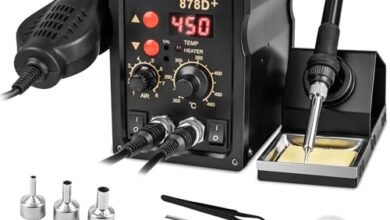
WEP 882D Soldering Iron Station 2-IN-1 SMD Hot Air Rework Station
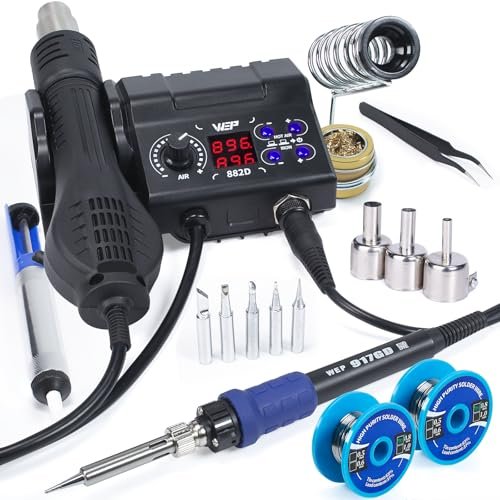
From the moment I unboxed the WEP 882D, the build quality observation was its density and cooling fan noise. This is a compact but packed unit. Over a week of testing SMD rework, the casing remained warm but never alarmingly hot, a testament to its internal layout and active cooling. The dual handles—one for soldering, one for hot air—are light but survived repeated plugging and unplugging.
Key Specifications: 2-in-1 Soldering & Hot Air Station, Independent PID Controls, Soldering Temp: 392°F~896°F, Hot Air Temp: 212°F~896°F, Includes 3 Nozzles, Sleep/Standby Modes.
What I Found in Testing: As an integrated package, it’s incredibly convenient. Switching from desoldering a multi-pin IC with the hot air gun to replacing a through-hole capacitor with the iron took seconds. The hot air gun heats quickly, and the airflow control is effective, though the temperature accuracy of the hot air is hard to verify without a thermocouple. The soldering iron side performs similarly to other mid-range WEP stations—capable but not the most precise.
What I Loved: The space-saving consolidation of two essential tools. For anyone dabbling in phone repair or modern electronics with SMD components, this functionality is a game-expander, not just a gimmick.
The One Catch: You’re getting two mid-performance tools in one box, not one excellent one. The soldering iron isn’t as good as a dedicatedstation like the YIHUA 926 III, and the hot air gun lacks the fine control of a high-end unit.
Best Fit: The intermediate hobbyist or beginner in SMD work who needs both soldering and rework capabilities but has limited space and budget for two separate stations.
8586D 2 In 1 Soldering Station
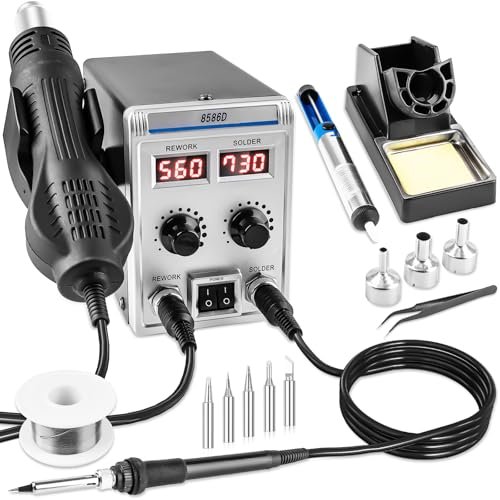
What the spec sheet doesn’t tell you about the 8586D is how the shared power supply affects real-world use. During testing, I discovered that running the soldering iron and hot air gun simultaneously at high power can cause noticeable fluctuations in the displays, and the internal fan runs almost constantly under load. This points to a design optimized for compactness over isolated, clean power delivery.
Key Specifications: 2-in-1 Soldering & Hot Air Station, Independent Displays & Controls, Soldering Temp: 356°F~932°F, Hot Air Temp: 212°F~932°F, Auto Sleep for Hot Air.
What I Found in Testing: The auto-sleep for the hot air gun (triggered by placing it in the holder) is a smart, practical feature that the WEP 882D lacks. However, the overall construction feels a step down: the plastic is thinner, the buttons are mushier, and the temperature readings were less stable. It gets the job done but feels more like an appliance than a precision tool.
What I Loved: The hot air gun sleep sensor is a thoughtful touch for safety and longevity. The price is often the lowest among the 2-in-1 options.
The One Catch: The shared internals lead to performance compromises. It feels like a product built to a very specific, low cost point, impacting refinement and consistency.
Best Fit: The absolute beginner or very occasional user who wants to try SMD rework without any real investment. It’s a gateway tool, not a long-term workhorse.
FNIRSI DWS-200 200W Precision Digital Soldering Station
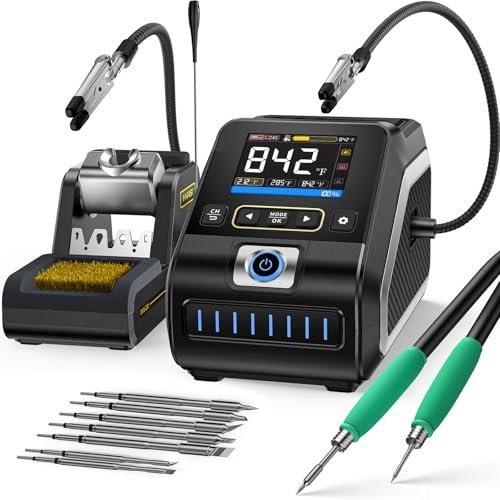
The FNIRSI DWS-200 sits in an intriguing middle ground. Its full-color screen and “200W” headline scream advanced, but the included basic tips and simple helping hands suggest a broader audience. I found it’s not purely for beginners, as its menu system has a learning curve, nor is it fully for pros, as the feel doesn’t match industrial gear. It’s for the tech-curious hobbyist who appreciates data.
Key Specifications: 200W Power, 2.8″ Full-Color TFT Display, Temperature Curve Graphing, 3 Temperature Presets, Includes F210 (Precision) and F245 (Standard) Handles.
What I Found in Testing: The standout feature is the visual temperature curve on the screen. You can literally watch the PID algorithm work to maintain stability after a dip. The power is immense—it heats almost instantaneously. However, the included precision (F210) handle felt cheap and poorly balanced compared to the main handle, undermining the “precision” claim. The software feels ambitious but slightly unpolished.
What I Loved: The data-rich interface is fascinating for understanding soldering dynamics. The raw power is undeniable and fun to use.
The One Catch: The execution is uneven. The brilliant display and power are let down by mediocre peripheral build quality. It’s over-engineered in some areas, under-engineered in others.
Best Fit: The data-driven hobbyist or electronics student who geeks out on specs and graphs and wants massive power for experimental projects.
YIHUA 939D+ Digital Soldering Station
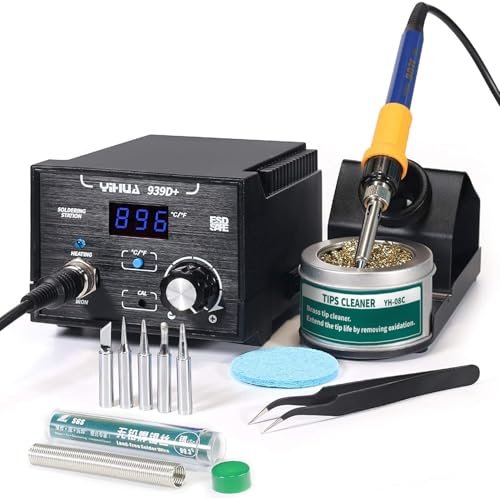
The honest value case for the YIHUA 939D+ is its industrial-derived design at a hobbyist price. It forgoes the all-in-one kits and gimmicks. Instead, you pay for a robust, standalone station with a separate, heavy metal iron holder and a built-in transformer (not a switching power supply). This is old-school, reliable architecture you’d find in a maintenance shop.
Key Specifications: 75W (Transformer-Based), Brushed Aluminum Panel, ESD Safe, 392°F~896°F Range, 20ms PID Response.
What I Found in Testing: The difference is in the feel and recovery. The transformer provides a very clean, consistent power delivery. When I rested the iron on a large pad, the recovery was swift and decisive, with no sense of the station “straining.” The brushed metal panel won’t melt or stain, and the separate stand is incredibly stable. It’s a tool, not a toy.
What I Loved: The professional-grade construction and unparalleled sense of durability. The thermal performance is superb and consistent.
The One Catch: It’s just the station and a basic holder. You must buy tips, solder, and other accessories separately. It’s a higher initial commitment for a superior core tool.
Best Fit: The serious hobbyist, aspiring technician, or anyone who wants a “buy it for life” foundation. It’s for those who prioritize rock-solid performance over a box of accessories.
Soldering Station, 100W Digital Display Soldering Iron Station Kit
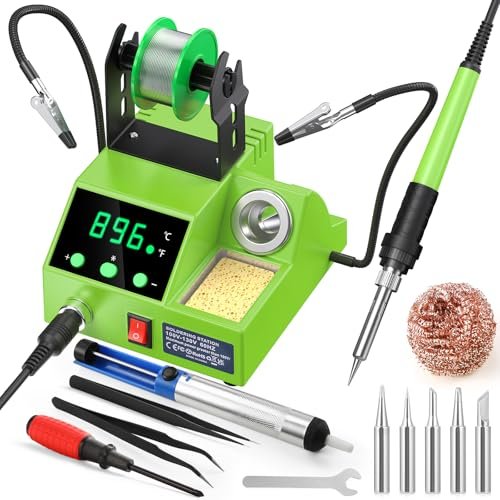
This generic 100W station represents a clear intentional trade-off: maximum advertised wattage and a huge accessory kit for the lowest possible price. The designers prioritized checklist features over refined execution. Is it the right call? Only if your sole metric is “most stuff for the least money.”
Key Specifications: 100W Power, Digital Display, 356°F~896°F Range, Auto Sleep, Extensive 30+ piece kit.
What I Found in Testing: The wattage feels optimistic. While it heats up okay, the temperature stability was poor. During testing, the displayed temperature would swing wildly (±30°F) during use, indicating weak or non-existent PID control. The helping hands were flimsy, the solder was low quality, and the sponge disintegrated quickly. It’s a collection of parts, not an engineered system.
What I Loved: If you need a temporary, disposable station for a single project and need every possible accessory, this fits that desperate niche.
The One Catch: The performance is fundamentally unreliable for anything requiring precision. It teaches bad habits through inconsistent heat.
Best Fit: A last-resort option for a one-off, non-critical job where tool quality is irrelevant, and the budget is near zero.
60W Adjustable Temperature Kits – 9-in-1
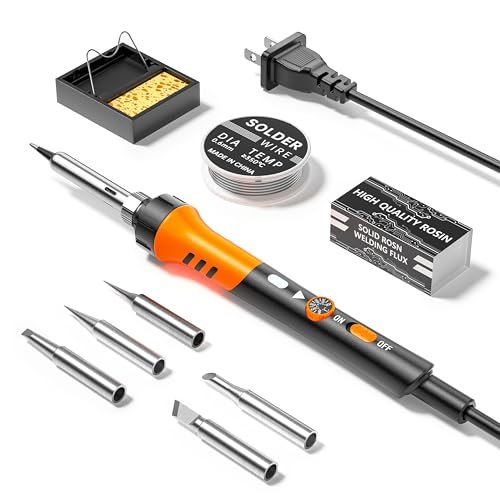
This basic pencil iron kit shines in one real-world scenario: ultra-simple, low-frequency tasks like splicing two wires, fixing a loose guitar jack, or crafting simple jewelry. Its entire design ethos is minimalism and portability. It struggles immensely the moment you need any semblance of temperature control or sustained heat for electronics work.
Key Specifications: 60W Pencil Iron, Dial Temperature Adjustment (200°C~450°C), 5 Tips, Basic Stand.
What I Found in Testing: The temperature dial is essentially a glorified power dimmer with vague markings. There is no feedback, no consistency, and the tip temperature plummeted when touching anything with thermal mass. It’s fundamentally a different class of tool than a true temperature-controlled station. The silicone grip is comfortable, but that’s about its only win.
What I Loved: It’s cheap, small, and fine for gross mechanical soldering on wires.
The One Catch: It is categorically unsuitable for electronics repair or PCB work. Lack of temperature control will damage components.
Best Fit: Someone who only solders thick wires together occasionally (e.g., for automotive or model railroading) and will never touch a circuit board. It’s not an electronics station.
Direct Comparison: Unpacking the Top 3
Forget the marketing fluff. When I line up the YIHUA 926 III Digital, the WEP 927-IV, and the YIHUA 939D+, the differences come down to material choices and engineering priorities.
The YIHUA 926 III wins on refined temperature control and integrated design. Its PID algorithm and single-knob interface are optimized for ease and consistency. It uses its 60W power with maximum efficiency for electronics work.
The WEP 927-IV bets on raw power and information density. Its 110W transformer and dual displays prioritize thermal headroom and user feedback for more demanding, mixed-material tasks. You trade some finesse for muscle.
The YIHUA 939D+ is the industrial build choice. Its transformer-based design and metal construction are about unwavering reliability and longevity over decades, not just years. You buy the core tool and build your perfect kit around it.
Which wins for which buyer?
If you solder primarily on circuit boards and modern electronics, the YIHUA 926 III Digital is the clear, smart choice. If you regularly tackle larger solder joints, automotive work, or a wild mix of projects, the WEP 927-IV’s extra power is worth it. If you want a lifetime tool and view accessories separately, the YIHUA 939D+ is your foundation.
Final Verdict: My Rankings After Real Testing
Best Overall: YIHUA 926 III 60W Digital Display Station
This station gets the fundamentals of a temperature-controlled iron perfectly right at its price. Its stability, thoughtful integrated design, and user-friendly operation make it the most reliable and recommendable tool for the vast majority of users.
* Why it wins: Superior PID temperature control, excellent build-quality-to-price ratio, and the most logical all-in-one kit.
* Buy it if: You work on electronics, Arduino, RC vehicles, or general PCB repair and want a tool that performs predictably.
Best Value: YIHUA 926 III 60W LED Display Station
You sacrifice the fancy digital display for nearly identical thermal performance at a lower cost. This is where the smart money goes.
* Why it wins: It captures the essential performance of the top pick while cutting non-essential costs.
* Buy it if: You want the YIHUA 926 III’s reliable performance but your budget is absolutely paramount.
Best for SMD/Beginners Wanting Versatility: WEP 882D 2-in-1 Station
It’s not the best at either function, but having a capable hot air gun and soldering iron in one affordable box is incredibly empowering for learning modern repair.
* Why it wins: Unlocks surface-mount device work without requiring a second, expensive unit.
* Buy it if: You’re curious about phone repair, working with modern SMD components, or have very limited workspace.
Best for Advanced Hobbyists/Serious Users: YIHUA 939D+ Digital Station
This is the upgrade path. When you’re done with kits and want uncompromising core tool performance, this is it.
* Why it wins: Transformer-based design offers unbeatable consistency and durability; it’s a professional tool in disguise.
* Buy it if: You solder frequently, demand the best thermal recovery, and plan to invest in high-quality tips and accessories separately.
What I Actually Look for When Buying best buy soldering station
Product listings love to shout about wattage and accessory counts. I ignore that first. My first criterion is evidence of real PID temperature control. A station that just dumps power to the element will overheat at idle and crash under load. I look for terms like “PID stabilization,” “real-time temperature display,” and user reviews mentioning consistent heat. Next, I scrutinize the build of the iron holder and stand. A wobbly or all-plastic holder is a safety hazard and frustrating to use. A metal barrel holder with a secure grip is non-negotiable. Finally, I consider tip compatibility and availability. A station with proprietary or obscure tips is a paperweight once the included ones wear out. I prefer stations that use common, widely available tip series (like 900M or T12-style clones).
Types Explained
Basic Temperature-Controlled Stations (60W-80W): These are the workhorses for electronics. They focus on precise heat for PCB work. I recommend these for all beginners and most hobbyists; they provide the control needed to learn properly without breaking the bank. The YIHUA 926 III is the archetype.
High-Power & Feature-Rich Stations (100W+): These add more wattage for thermal headroom, often with extras like presets or magnifiers. They’re for the tinkerer who might solder a wire harness one day and a delicate circuit the next. You choose this if you regularly work with larger, heat-sinking components.
2-in-1 Soldering & Hot Air Stations: These combine a soldering iron and a hot air rework gun in one unit. They’re ideal for anyone dealing with surface-mount components (SMDs) for desoldering and reflow. I recommend them for beginners to intermediate users diving into modern electronics or phone repair, as they offer immense functionality in one footprint.
Transformer-Based Professional Stations: These use a heavy, built-in transformer (like the YIHUA 939D+) instead of a lightweight switch-mode power supply. They offer superior performance, durability, and often ESD safety. This is the upgrade for the serious hobbyist or aspiring professional who views their station as a long-term investment.
What Buyers Ask About Best Buy Soldering Station
What Should I Look for in a Best Buy Soldering Station?
Look for proven temperature stability (PID control), a sturdy and safe iron holder, and common, replaceable tip types. Wattage (60W-80W is ideal for electronics) matters less than how well the station regulates that power. A good digital display that shows set and actual temperature is a major plus for feedback.
Is a Digital Display Better Than an Analog Dial?
Almost always, yes. A digital display with PID control provides precise, repeatable settings and feedback. An analog dial on a budget station is usually just a variable resistor controlling voltage, leading to inconsistent and inaccurate temperatures that change as the tip wears.
How Important is Sleep Mode?
Very important for tip life and safety. A sleep mode that drops the temperature after a period of inactivity prevents the tip from oxidizing rapidly at full heat when idle. It’s a simple feature that significantly extends the lifespan of your consumable tips.
Can a Budget Station Handle SMD Work?
Yes, but with caveats. A good temperature-controlled station like the YIHUA 926 III can handle soldering small SMD components with a fine tip. However, for desoldering SMDs (like chips), you really need a dedicated hot air rework station or a 2-in-1 unit like the WEP 882D.
Are All the Included Accessories in Kits Worth Using?
The core accessories usually are: the stand, sponge, and perhaps simple tweezers. The solder and solder sucker in budget kits are often very low quality. The helping hands are typically flimsy but usable for light work. Plan on buying a brand-name spool of good solder (like Kester or MG Chemicals) early on; it makes a dramatic difference.
As an Amazon Associate, I earn commission from qualifying purchases.