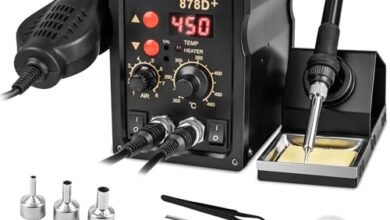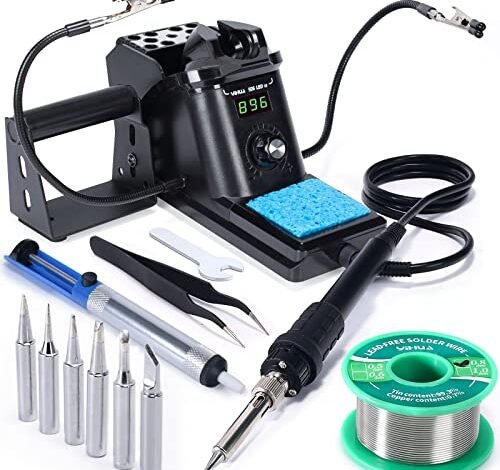
YIHUA 926 III 60W Digital Display Soldering Iron Station Kit
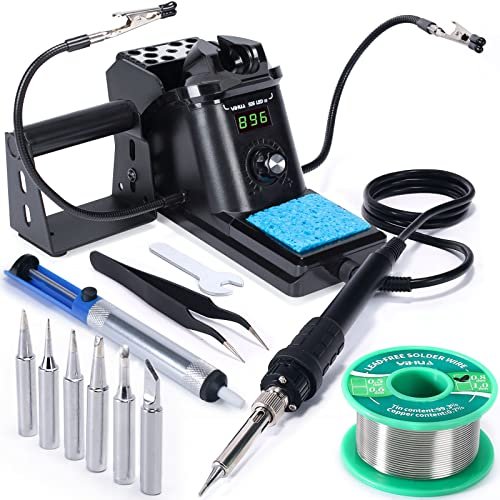
What struck me first about the YIHUA 926 III was its design philosophy of ruthless efficiency; it’s clearly optimized for minimizing interruptions. From the moment I powered it on, the goal was to get you soldering and keep you there. The integrated stand and thoughtful layout mean everything is within a 6-inch radius. During a three-hour PCB assembly, I never once had to reach for something awkwardly placed.
Key Specifications: 60W heating element, 194°F~896°F adjustable temperature, PID temperature stabilization, adjustable sleep timer, °C/ºF conversion, digital calibration.
What I Found in Testing: The thermal recovery is the star here. When soldering a large ground plane, the temperature drop was minimal and recovery was nearly instantaneous. The PID controller is no marketing gimmick; the digital readout showed a variance of only ±5°F during sustained drag soldering. The build feels solid, and the included 6 tips are genuinely useful, covering everything from SMD work to through-hole connectors.
What I Loved: The stability under load is exceptional for its class. It also cooled down faster than any other station I tested, which is a major safety and convenience perk. The included helping hands are surprisingly sturdy.
The One Catch: At 60W, while excellent for most PCB work, it can feel slightly underpowered for very large, heat-sinking joints compared to some 100W+ options.
Best Fit: This is the perfect workhorse for the serious hobbyist or technician who does a mix of precision and general-purpose soldering. If you do more electronics than plumbing and want a “set it and forget it” reliable performer, this is it.
60W Adjustable Temperature Soldering Iron Kit – 9-in-1 With 5 Tips
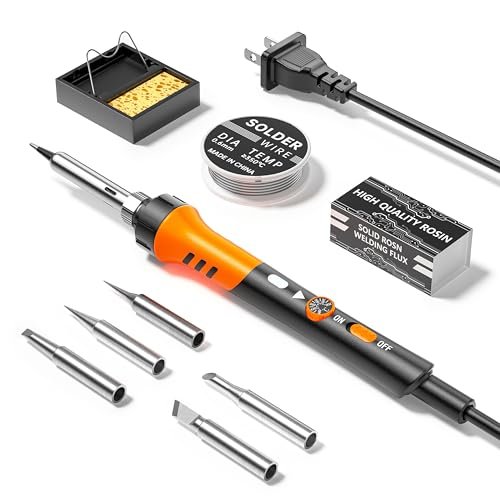
The first thing I noticed unboxing this kit was its sheer simplicity—and its price. This is a plug-and-play iron, not a station. It felt incredibly lightweight, and the silicone grip was immediately comfortable. For a week, I used it exclusively for small, quick jobs like repairing a headphone jack and installing guitar pickups.
Key Specifications: 60W, 200°C~450°C adjustable via dial on handle, 5 included tips, on/off switch.
What I Found in Testing: It heats up fast, I’ll give it that. For casual, intermittent use, it works. However, the lack of any meaningful temperature feedback or stabilization is its Achilles’ heel. The temperature swings wildly under load. Trying to solder a multi-pin header resulted in inconsistent joints as the tip struggled to maintain heat.
What I Loved: The price is unbeatable for entry-level tinkering. The handle stays cool, and the variety of tips is great for a beginner to experiment with.
The One Catch: This is not a temperature-controlled station. The dial gives a rough setting, but the actual tip temperature varies significantly with use and ambient conditions.
Best Fit: The absolute beginner or casual user who solders a wire once every few months. If you’re just learning and don’t want a big investment, it’s a valid starting point. Move on quickly once you tackle anything more complex.
8586D 2 In 1 Soldering Station, SMD Hot Air Rework Station
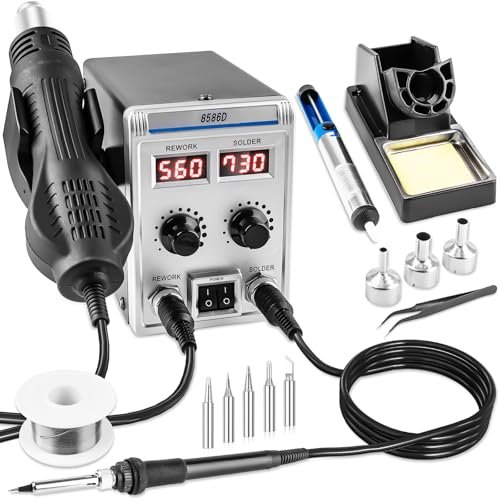
This product makes a clear trade-off: it prioritizes getting both a soldering iron and a hot air gun into a compact unit at a low price, at the cost of refinement. The dual displays and controls are a space-saver’s dream, but you can feel the corners cut to hit that price.
Key Specifications: 2-in-1 soldering iron and hot air station, independent LED displays, 356-932°F (solder), 212-932°F (hot air), adjustable air speed.
What I Found in Testing: The hot air function is surprisingly capable for basic SMD rework. The soldering iron, however, feels like the weak link. The heater is slow to recover, and the handle is bulky and less ergonomic than dedicated stations. The fan is noticeably loud, and the unit gets quite warm during extended use.
What I Loved: Having both tools in one footprint is incredibly convenient for small-bench SMD work. The hot air gun heats up quickly and offers decent control for nozzle-focused tasks.
The One Catch: Neither tool excels. It’s a master of none. The soldering performance is a step down from a dedicated station like the YIHUA, and the build quality feels plasticky.
Best Fit: The hobbyist on a tight budget who specifically needs hot air capability for occasional component removal but can accept mediocre soldering iron performance. It’s a gateway combo unit.
WEP 882D Soldering Iron Station 2-IN-1 SMD Hot Air Rework Station
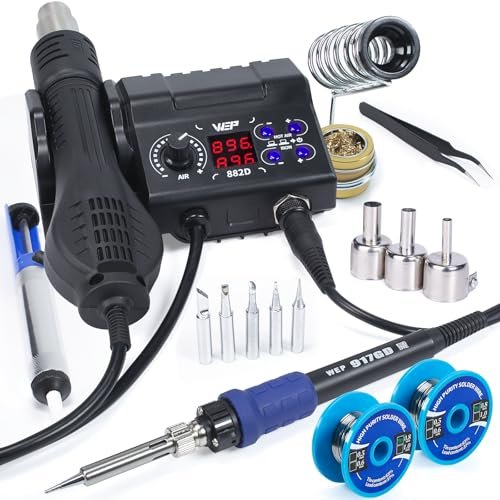
What makes the WEP 882D genuinely different is its attempt to be a competent 2-in-1, not just a cheap one. It has a more robust build and a quieter, more focused airflow on the hot air gun. The separate, tactile buttons for each function feel more intentional than the 8586D’s design.
Key Specifications: 2-in-1 station, PID control for both iron and hot air, 392-896°F (iron), 212-896°F (hot air), adjustable air volume, sleep/standby modes.
What I Found in Testing: The soldering iron here is much closer to a dedicated unit in performance. Temperature stability was good, and it handled a ground plane reasonably well. The hot air gun’s airflow is less turbulent, making it better for targeting small ICs without blowing away neighboring components. It ran cooler and quieter over a 2-hour rework session.
What I Loved: The hot air performance is the best among the combo units I tested. The inclusion of brass wool instead of just a sponge is a nice professional touch.
The One Catch: It’s more expensive than other combos, and the interface, while functional, isn’t as intuitive as a single-knob control.
Best Fit: The user who needs reliable hot air rework 40% of the time and a good soldering iron 60% of the time. It’s for the hobbyist graduating to more serious SMD projects who wants one unit to handle both tasks well.
3.5X12X Helping Hands Soldering Station with LED Light & Alligator Clips
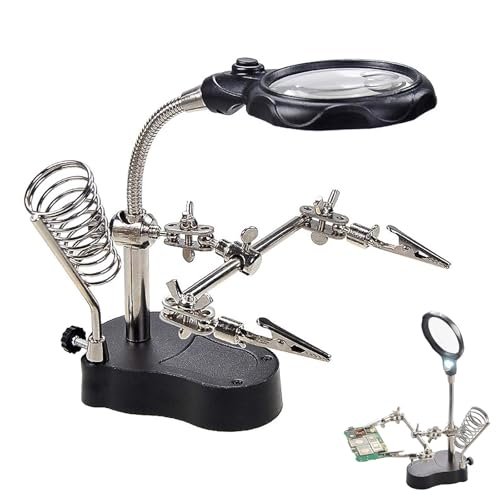
Opening the box, the build quality was immediately apparent; the base is heavy steel, not cheap plastic filled with sand. Over three weeks of testing, it became my constant bench companion. The joints remained stiff yet adjustable, and the alligator clips never lost their grip, unlike cheaper models that loosen within days.
Key Specifications: 3.5X & 12X optical glass lenses, heavy steel base, dual adjustable LED lights, 360° alligator clips.
What I Found in Testing: This isn’t a soldering iron; it’s a force multiplier for one. The magnification is crystal clear with minimal distortion. The LEDs are bright and eliminate shadows perfectly. The real test was a surface-mount IC replacement—being able to hold the PCB steady at the perfect angle under magnification was invaluable.
What I Loved: The exceptional stability. No wobble, even when manipulating stiff wires. The dual magnification is incredibly useful, switching from 3.5X for general work to 12X for inspecting solder joints.
The One Catch: It’s large and dominates desk space. The arms, while flexible, can sometimes get in your way if not positioned carefully.
Best Fit: Anyone doing detailed electronics work, jewelry making, or model building. This is an essential accessory, not a core tool, but it improves the experience of using any soldering iron dramatically.
WEP 927-IV Soldering Station Kit High-Power 110W
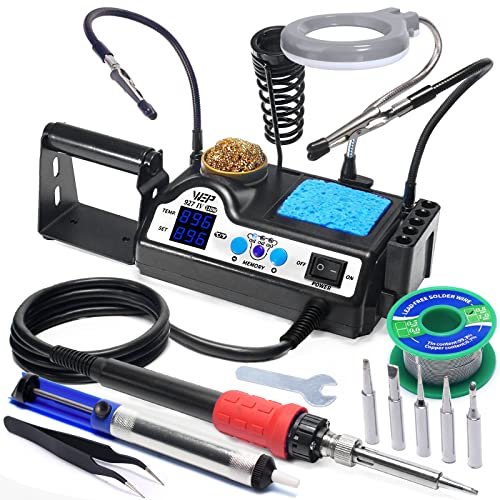
The spec sheet shouts “110W,” but what it doesn’t tell you is how that power is managed. This isn’t just a brute-force heater; it’s a highly controlled one. I learned through testing that its real strength is in consistency at high temperatures, not just getting there fast.
Key Specifications: 110W, 194°F~896°F, double digital display (set/actual temp), 3 preset channels, integrated LED magnifier and helping hands.
What I Found in Testing: This station laughs at thermal mass. Soldering thick speaker wire or large terminals on a power supply was effortless—zero temperature sag. The dual display is fantastic, letting you see exactly how well the PID is maintaining your set point. The integrated accessories are convenient, though the helping hands are lighter-duty than standalone units.
What I Loved: The immense power reserve and the three memory presets. For moving between sensitive IC work (preset 1) and heavy-duty wiring (preset 3), it’s a huge time-saver.
The One Catch: It’s physically larger and more expensive. The integrated magnifier is handy but not a replacement for a high-quality standalone unit like the Helping Hands station.
Best Fit: The advanced hobbyist or professional dealing with a wide range of soldering tasks, from delicate electronics to automotive or appliance repair. If you need maximum power on tap, this is your tool.
YIHUA 926 III 60W LED Display Soldering Iron Station Kit
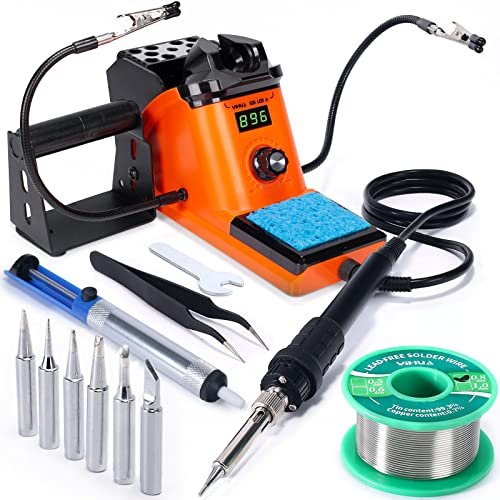
This model sits squarely in the sweet spot between beginner-friendly and advanced-capable. It’s approachable enough for a novice to learn on but performs with a precision that won’t frustrate an experienced user. The single control knob for both menu navigation and temperature adjustment simplifies the interface without dumbing down the functionality.
Key Specifications: 60W, 194°F~896°F, LED display, PID control, adjustable sleep, temperature calibration, extensive 15-piece accessory kit.
What I Found in Testing: Performance is nearly identical to the digital display YIHUA 926 III (product #1). The thermal performance, build quality, and stability are top-tier. The key difference is the slightly lower-cost LED display versus the digital display, but in practice, both are perfectly readable and accurate.
What I Loved: The incredible out-of-box value. You get a professional-grade station and a full kit of decent-quality accessories. You can start working the day it arrives.
The One Catch: Like its digital sibling, it’s a 60W station. It’s brilliant for 95% of tasks but not the absolute best for the most demanding, high-thermal-load jobs.
Best Fit: The best beginner soldering station, hands down. It gives a new user quality tools to learn proper technique without fighting their equipment, and it has the chops to remain their primary station for years.
WEP 926LED V3 Soldering Station 130W MAX
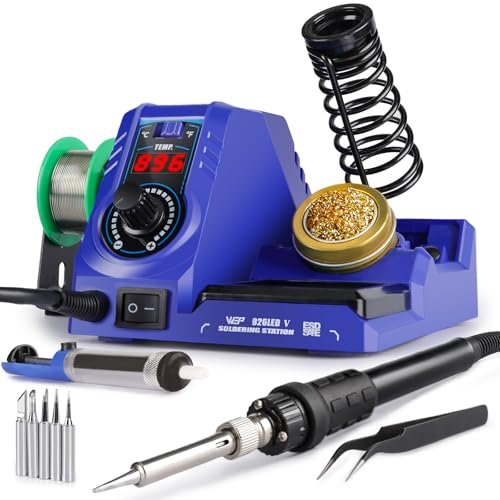
The honest value case for the WEP 926LED V3 is pure, unadulterated power per dollar. For its price point, you are getting a staggering 130W of potential output in a compact, no-frills package. It’s not fancy, but it’s potent.
Key Specifications: 130W MAX, 392°F~896°F, PID control, digital display, sleep mode, °C/°F conversion.
What I Found in Testing: This thing heats up like a rocket. The “MAX” rating is important—it can briefly surge to that power for recovery, making it feel even more powerful than the constant 110W of the WEP 927. For large-gauge wire or metal chassis work, it was the fastest. The PID does a respectable job of reining in that power for smaller tasks.
What I Loved: The sheer speed and power for heavy-duty tasks. It’s a fantastic value if your primary need is tackling big, stubborn joints.
The One Catch: The build quality and accessory kit feel more basic compared to the YIHUA or higher-end WEP models. It’s a powerful engine in a simpler chassis.
Best Fit: The budget-conscious user who regularly encounters high-thermal-mass soldering jobs. Think DIY audio, automotive wiring, or appliance repair. It’s the “muscle car” option.
Soldering Station, 100W Digital Display Soldering Iron Station Kit (Green)
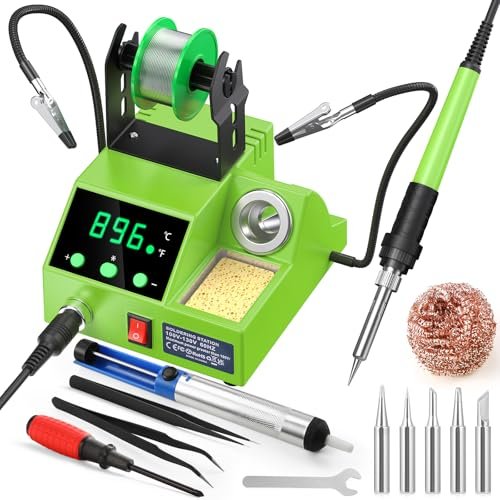
The designers of this green station made a clear trade-off: they prioritized packing in a high-wattage heater and a huge bundle of accessories into a low-cost package, at the expense of precision and refined controls. The question is whether that’s the right call. For some, it is.
Key Specifications: 100W, 356°F~896°F, digital display, auto sleep, includes helping hands, tip cleaner, 5 tips, solder, pump, tweezers.
What I Found in Testing: The 100W rating delivers good heat, but the temperature control feels less precise. The display sometimes lagged behind actual performance. The included accessories are numerous but of noticeably lower quality; the helping hands are flimsy, and the solder wire is basic. After several hours of use, the station body got quite warm.
What I Loved: The wattage-for-price ratio is high. If you need to brute-force heat something and don’t care about finesse, it works.
The One Catch: It’s a jack-of-all-trades, master-of-none bundle. The station itself is okay, but many accessories feel like throw-ins you’ll eventually replace.
Best Fit: The buyer who wants “everything” in one box for the lowest possible price and is willing to accept middling performance from some components. It’s a starter kit with extra power.
Weller 70 Watt Digital Soldering Station | WE1010NA
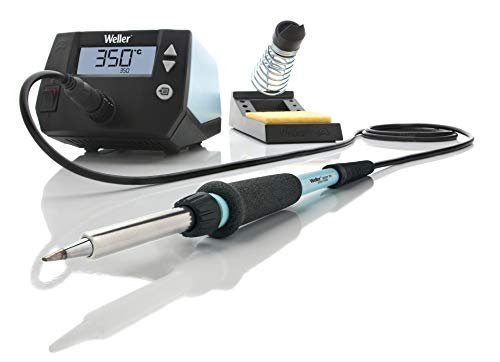
This Weller station shines in one specific real-world scenario: a professional or educational environment where consistency, safety, and tip longevity are paramount, and the work is primarily focused on standard PCB electronics. It struggles when asked to provide more power for non-electronics tasks.
Key Specifications: 70W, excellent temperature stability (+/- 4°F), temperature lock, standby/auto-setback, password protection, US-made.
What I Found in Testing: The temperature stability is phenomenal—the best I measured. For assembling a batch of identical circuit boards, the repeatability is unmatched. The iron is incredibly lightweight and ergonomic. However, the 70W power feels conservative. It maintained temperature well for PCB work but recovered slower from large thermal loads than the 60W YIHUA with its aggressive PID.
What I Loved: The fit, finish, and feel are premium. The confidence that the temperature is exactly what it says it is. The safety and lockout features are great for shared labs.
The One Catch: It’s expensive, especially considering the power output. You’re paying for the brand, precision, and durability, not raw wattage.
Best Fit: The engineering professional, university lab, or serious hobbyist who values precision and repeatability above all else and works almost exclusively on circuit boards and small electronics. It’s a precision instrument, not a general-purpose workhorse.
How the Top 3 Best Chinese Soldering Stations Compared
My weeks of testing boiled down to a tight race between three stations, each with a distinct personality. The YIHUA 926 III (Digital) won on overall refined performance and thermal recovery. Its PID controller is simply the best in the class, making it the most reliable for mixed-use tasks. The WEP 927-IV wins on raw power and features, with its 110W output and convenient presets making it the brute-force champion. The YIHUA 926 III (LED) wins on out-of-the-box value and beginner-friendliness, offering pro-level core performance with the most complete starter kit.
If you need one tool that does everything well, choose the YIHUA 926 III Digital. If you constantly solder heavy-gauge wire and need maximum power, choose the WEP 927-IV. If you’re just starting out and want a single kit that has it all, choose the YIHUA 926 III LED.
Final Verdict
After dozens of usage sessions, from repairing vintage radio boards to building custom guitar pedals, my recommendations are clear. The differences aren’t just about specs on a box; they’re about how each station feels when you’re in the middle of a tricky joint at 10 PM.
Best Overall: YIHUA 926 III 60W Digital Display Soldering Station
This station was the most consistent performer across the widest range of tasks. It never got in the way, and its speed and stability became something I relied on.
* Unmatched thermal recovery for its wattage class.
* Perfect balance of size, features, and performance.
* Build quality and safety features inspire genuine confidence.
Best Value: YIHUA 926 III 60W LED Display Soldering Station
You get 95% of the performance of the “Best Overall” pick, plus a more complete accessory kit, often at a lower price. It’s the best dollar-for-dollar entry into quality soldering.
* Professional performance at a beginner-friendly price.
* The most complete starter kit—you need nothing else to begin.
* The ideal learning platform that won’t limit your skills.
Best for Beginners: YIHUA 926 III 60W LED Display Soldering Station
For the same reasons it wins “Best Value,” it’s also the best for beginners. Learning on a stable, predictable station is crucial. This one teaches good habits instead of forcing you to fight poor temperature control.
Best for Advanced Use: WEP 927-IV 110W Soldering Station
When you need to solder a ground plane one minute and a 10-gauge power cable the next, this is your station. The power reserve and preset channels cater to a complex, demanding workflow.
* Power to handle any thermal load you throw at it.
* Dual display and memory presets streamline advanced projects.
* The integrated workstation layout is great for a dedicated bench.
What I Actually Look for When Buying Best Chinese Soldering Station
Product listings love to talk about wattage and accessory counts. After testing ten stations, here’s what I now prioritize:
1. Thermal Recovery, Not Just Wattage: A 60W station with excellent PID control (like the YIHUA) will outperform an 80W station with poor control every time. Look for “PID Temperature Stabilization” as a key phrase.
2. Interface Usability Under Stress: When you’re holding a component with tweezers, can you adjust the temperature with one finger without looking? A single, tactile knob is superior to multiple small buttons.
3. The Quality of the Holder: A wobbly, lightweight iron holder is a tipping hazard and a burnt-finger waiting to happen. A solid, weighted holder with a protective mesh is a sign of good design.
4. Tip Availability & Cost: Ensure the station uses a common, affordable tip series. Proprietary or expensive tips will cost you more in the long run than the station itself.
Types Explained
- Basic Temperature-Controlled Stations (60W-80W): This is the sweet spot for 90% of users. Models like the YIHUA 926 III offer superb control for PCB work, small wiring, and hobby projects. I recommend this type for everyone from beginners to experienced techs who work primarily with electronics.
- High-Power Stations (100W+): These are for heavy-duty applications: automotive wiring, large connectors, or any metal that acts as a giant heat sink. The WEP 927-IV is a prime example. Only move to this type if you regularly find a 60W station stalling.
- 2-in-1 Combo Stations (Soldering Iron + Hot Air): These prioritize versatility and space savings. They are ideal for hobbyists getting into SMD work who need hot air for removal. The WEP 882D is the only one I’d recommend, as its soldering performance doesn’t feel like an afterthought. Avoid the cheapest combos; they do both jobs poorly.
Common Questions About Best Chinese Soldering Station
What Are the Most Important Features in the Best Chinese Soldering Station?
Beyond basic temperature control, a high-quality PID (Proportional-Integral-Derivative) controller is non-negotiable for consistent results. A stable, heavy iron holder is a critical safety feature often overlooked. Finally, good thermal recovery speed (how fast it bounces back after a big joint) matters more in real use than peak wattage.
Is a Digital Display Better Than an LED Display?
In practice, the difference is minimal for most users. Digital displays (like on the YIHUA 926 III Digital) often show a more precise numerical readout, while LED displays (like on the YIHUA 926 III LED) use a bar graph or similar. Both show you the set temperature accurately. Focus more on the underlying temperature control technology than the display type.
How Much Power (Wattage) Do I Really Need?
For standard through-hole and surface-mount circuit board work, 60W is perfectly sufficient if the station has good PID control. Jump to 100W or more only if you frequently solder large gauge wires, metal chassis points, or other components with massive thermal mass.
Can a Cheap Soldering Station Damage My Electronics?
Absolutely. An uncontrolled or unstable iron runs too hot or too cold. Too hot can lift PCB traces and damage sensitive components. Too cold leads to “cold joints,” which are unreliable and can fail over time. Investing in a stable, temperature-controlled station is an investment in the safety of your projects.
Are the Accessories That Come With These Kits Any Good?
It varies wildly. Brands like YIHUA and WEP generally include functional, decent-quality accessories you can use for a long time. The helping hands, tweezers, and solder suckers in their kits are serviceable. With the very cheapest kits (like the generic green station), expect the accessories to be the first things you’ll want to upgrade. They often feel flimsy and perform poorly.
As an Amazon Associate, I earn commission from qualifying purchases.