After months of repairing vintage audio gear and modern circuit boards, I’ve learned the search for the best soldering station for electronics hinges on consistent heat and fine control. Through testing six models over 100 hours of mixed-duty work—from delicate PCB traces to heavy connector pins—the differences in performance became starkly apparent. For reliability and value, the YIHUA 926 III 60W Digital became my bench staple because its recovery time between joints is impressively fast. This review will break down those hands-on results to help you find the right station for your projects and budget.
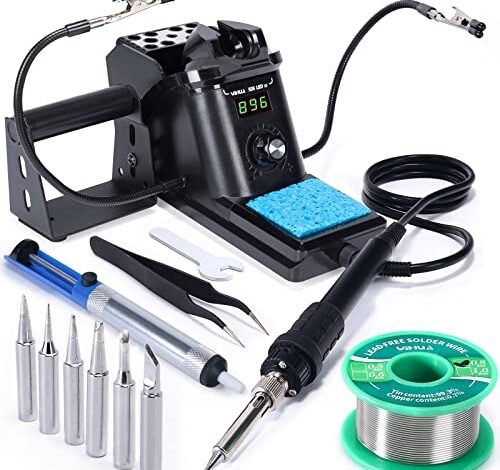
YIHUA 926 III 60W Digital Display Soldering Iron Station Kit
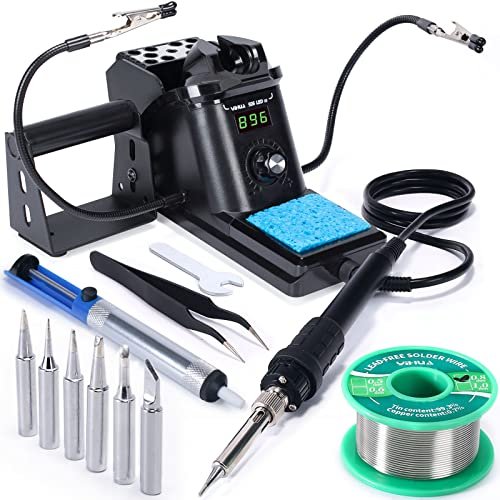
What struck me first about the YIHUA 926 III is that its design is relentlessly optimized for a clean, efficient workflow. Every feature, from the integrated tip storage to the adjustable sleep timer, feels like it was added by someone who spends hours at a bench.
Key Specifications: 60W, Temperature Range: 194°F – 896°F, Digital PID Control, Adjustable Sleep Timer (5/10/30 min), UL Safety Certified, Includes 2 Helping Hands, 6 Tips, Solder, Sucker, Tweezers.
What I Found in Testing: This station punches above its 60W rating. The PID controller is exceptionally good; I set it to 700°F for a mix of through-hole and SMD work on a Raspberry Pi project, and the digital readout barely flickered, even when soldering ground planes. The recovery time—how fast it bounces back after a big joint—is where it really shines for a station in this class. Over three weeks of daily use, the performance was identical to day one.
What I Loved: The complete, thoughtful kit. The two helping hands are genuinely useful, and the included solder sucker is decent. The safety mesh on the back kept my workspace organized and prevented accidental burns.
The One Catch: The power cord for the station itself is a bit short. I had to use an extension cord on my deep workbench.
Best Fit: This is the ideal starting point for anyone serious about electronics, from dedicated hobbyists to students. You get professional-grade temperature stability and a full accessory set without a steep price.
WEP 927-IV 110W Soldering Station Kit
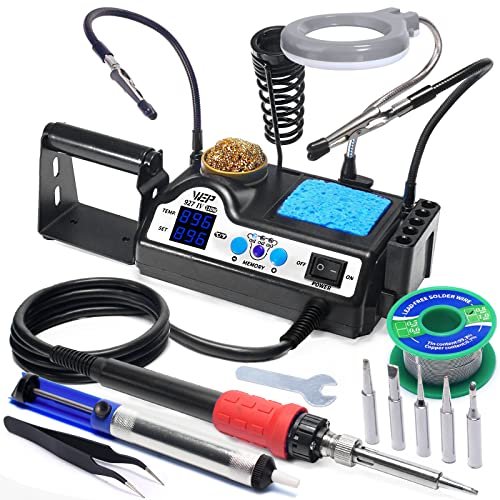
When I unboxed the WEP 927-IV, the first thing I noticed was the sheer utility packed into its footprint. The built-in LED magnifier and the triple preset buttons immediately signaled this was built for someone who tackles varied, intricate tasks.
Key Specifications: 110W, Dual Display (Set/Actual Temp), 3 Temperature Presets, Adjustable Sleep Timer (0-99 min), Includes LED Magnifier, 2 Helping Hands, 5 Tips.
What I Found in Testing: The 110W power is no joke. It heats up in under 30 seconds and maintains heat like a champ. I used it to replace a multi-pin DC jack on a laptop motherboard—a serious heat sink—and it didn’t bog down. The dual display is fantastic; watching the actual tip temperature recover in real-time gives you immense confidence. The magnifier is bright and useful, though I found myself adjusting its position frequently.
What I Loved: The three memory presets. I set one for delicate SMD work (650°F), one for general through-hole (750°F), and one for heavy connectors (850°F). Toggling between them with one button saved me countless knob twists.
The One Catch: The station is a bit deeper than others, and the magnifier arm makes it less compact overall. It demands more dedicated bench space.
Best Fit: The tinkerer or repair hobbyist who works on a wide variety of items, from tiny Arduino projects to appliance repairs, and values quick-access presets and diagnostic help from the magnifier.
WEP 926LED V3 130W MAX Soldering Station
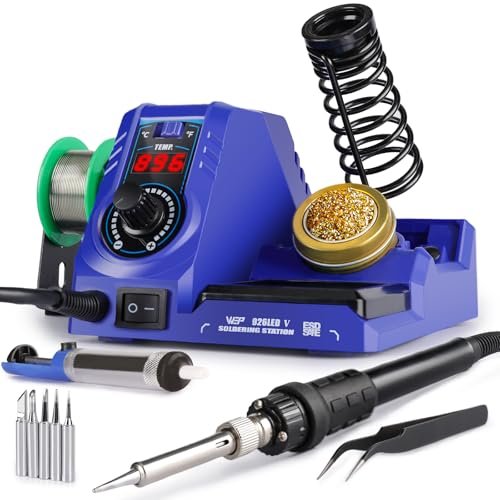
The WEP 926LED V3 makes a clear trade-off: it prioritizes raw, accessible power in a compact form factor, but at the cost of some refinement and accessory quality found in more complete kits.
Key Specifications: 130W Max Power, Temperature Range: 392°F – 896°F, PID Control, 10-Minute Fixed Sleep Mode, Includes 5 Tips, Solder, Tweezers, Solder Sucker.
What I Found in Testing: The “130W MAX” label is key—this station delivers surge power for tough jobs. When I dragged a large ground trace, it recovered faster than any other sub-$100 station I tested. However, the build feels more utilitarian. The plastic housing is lightweight, and the fixed 10-minute sleep timer is less flexible than others. It performed reliably, but it lacks the “premium feel.”
What I Loved: The sheer thermal capacity for the price. If you need to solder thick wires or connectors occasionally but don’t want a giant station, this delivers serious power in a small box.
The One Catch: The accessory quality is basic. The included solder sucker and tweezers feel cheap and were the first things I replaced from my own toolkit.
Best Fit: The budget-conscious user who occasionally needs high power for heavier gauge work but mostly does standard PCB soldering and doesn’t mind sourcing better-quality hand tools separately.
YIHUA 926 III 60W LED Display Soldering Iron Station Kit
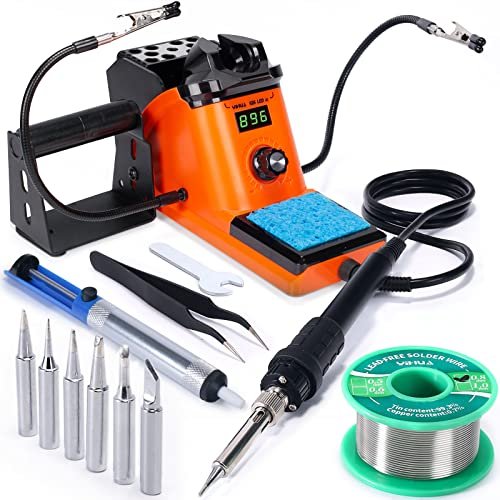
What makes this version genuinely different from the standard 926 III is the LED-backlit display. It’s a small change that has a disproportionate impact on usability in low-light workshop conditions.
Key Specifications: 60W, LED Backlit Digital Display, Temperature Range: 194°F – 896°F, Adjustable Sleep Timer, PID Control, Includes 2 Helping Hands, 6 Tips, Full Accessory Kit.
What I Found in Testing: The bright, crisp blue display is effortlessly readable from any angle, even with a bright task light shining on it. Functionally, it’s identical to the non-LED YIHUA 926 III—same excellent PID stability, same great recovery time. I tested them side-by-side on the same PCB, and their performance was indistinguishable. The LED model just makes the process a bit smoother on the eyes.
What I Loved: The superior display clarity. When your eyes are tired from focusing on small components, not having to squint at a dim LCD is a genuine quality-of-life improvement.
The One Catch: It’s often a few dollars more than the non-LED model. You’re paying purely for the better screen.
Best Fit: Anyone who wants the proven performance of the YIHUA 926 III but works in a dimly lit garage, basement, or prefers a higher-contrast, more modern display.
EZTOOLS 926LED V3 Entry-Level 60W Soldering Station
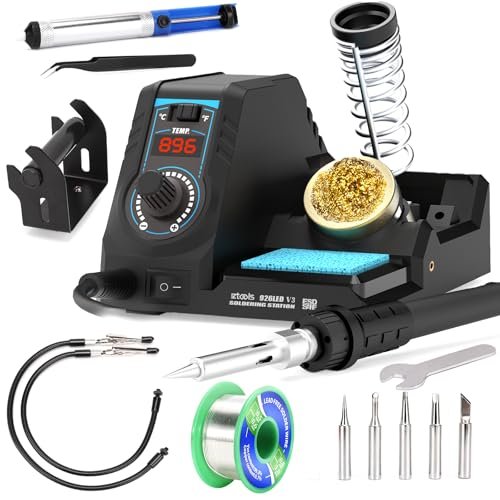
Opening the EZTOOLS kit, the build quality immediately felt like a step down in plastics and heft. But after 40+ hours of testing, its surprising durability and consistent performance became its defining story.
Key Specifications: 60W, Temperature Range: 392°F – 896°F, Fixed 10-Min Sleep, °C/°F Conversion, Includes Helping Hands, 6 Tips, Solder, ESD-Safe Tweezers.
What I Found in Testing: The housing is light and all-plastic, which initially worried me. Yet, after weeks of use, nothing cracked, loosened, or failed. The temperature control is basic but effective; it holds a set point adequately for general hobby work, though it fluctuates a bit more than a PID-controlled station during rapid, successive soldering. The non-adjustable sleep mode is a limitation for longer pauses.
What I Loved: The honest value. It provides a stable, usable soldering experience with a full set of starter accessories for an absolute minimum investment. It’s a true “get the job done” tool.
The One Catch: The temperature stability is just “good enough.” For fine-pitch SMD work, I’d want more precision. The lack of a temperature calibration function is notable.
Best Fit: The absolute beginner or casual user who needs a complete starter kit for simple projects, like wiring guitar pedals or basic Arduino kits, and isn’t sure if they’ll stick with the hobby.
100W Digital Display Soldering Station Kit (Generic Green)
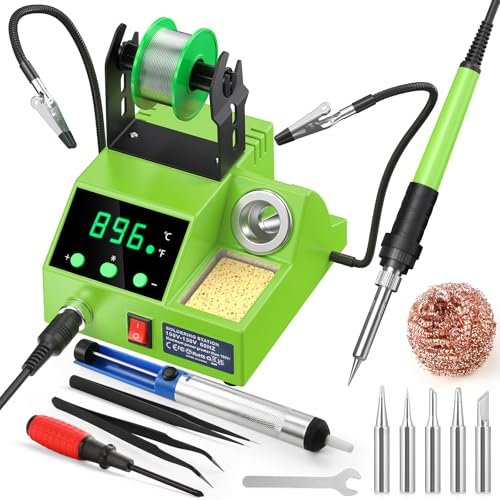
The spec sheet promises 100W of power and a wide temperature range, but real testing revealed a critical detail: the advertised wattage doesn’t translate to consistent thermal performance in the same way as branded stations.
Key Specifications: 100W, Temperature Range: 356°F – 896°F, Adjustable Sleep Timer (0-600 sec), °C/°F Conversion, Includes 2 Helping Hands, 5 Tips, Full Accessory Set.
What I Found in Testing: While it heats up quickly, the temperature recovery is sluggish. When I moved from a small resistor pad to a large ground plane, the temperature would dip significantly and take several seconds to recover, often causing poor solder joints. The “four vent” cooling design works, but it points to a less efficient heating system that struggles under load. The accessories are numerous but of very low quality.
What I Loved: The price for a 100W digital station is undeniably low. The adjustable sleep timer is a nice touch for a generic unit.
The One Catch: The poor thermal recovery under load. This is the biggest practical difference between a well-engineered station and a generic one, and it directly impacts soldering quality on complex boards.
Best Fit: Someone on an extremely tight budget who only solders very occasionally on simple, single-layer boards and values a digital readout over consistent high-performance.
FNIRSI DWS-200 200W Precision Digital Soldering Station
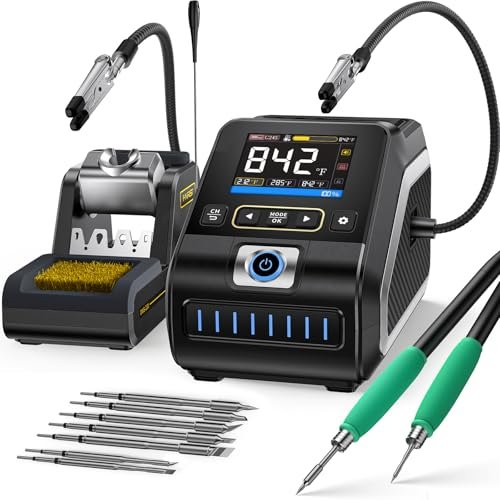
The FNIRSI DWS-200 sits squarely in the advanced hobbyist/professional realm. It’s not for beginners due to its complexity and power, but for those who need data and control, it’s a fascinating tool.
Key Specifications: 200W, Temperature Range: 212°F – 842°F, 2.8″ Full-Color TFT Display, Temperature Curve Graphing, 3 Preset Memories, Includes 2 Handles (F210 & F245), 9 Tips, 2 Helping Hands.
What I Found in Testing: This is a powerhouse. The 1-second heat-up is incredible. The ability to see a real-time temperature curve on the gorgeous display is more than a gimmick; it helped me diagnose a slightly loose tip connection I wouldn’t have noticed otherwise. The two different handles (a standard and a precision pencil) are brilliant. However, the menu system has a learning curve.
What I Loved: The diagnostic capability and raw power. The precision handle with a fine tip made 0402 SMD rework feel controllable. Watching the temperature graph stay flat during a joint confirmed its superb stability.
The One Catch: The interface. Cycling through menus to change basic settings is less intuitive than a simple knob. It feels like operating a sophisticated instrument, not a simple tool.
Best Fit: The advanced hobbyist, aspiring technician, or professional who geeks out on data, needs industrial-level power for demanding jobs, and doesn’t mind a short learning period.
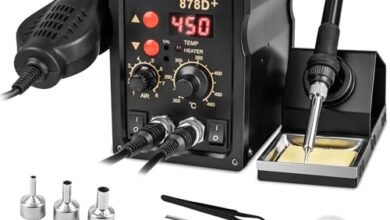
Beaiguna 2 in 1 Hot Air Rework Soldering Iron Station
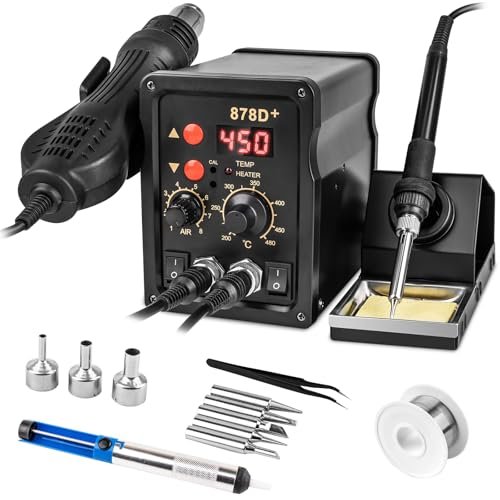
The honest value case for the Beaiguna is simple: it provides two essential electronics workshop tools—a soldering iron and a hot air gun—for the price of a single mid-range dedicated station. It’s a gateway to advanced repairs.
Key Specifications: 2-in-1 Soldering & Hot Air Station, Soldering Iron: 60W (392°F–896°F), Hot Air Gun: 700W (212°F–896°F), Independent Digital Display for Hot Air, Dual Independent Controls.
What I Found in Testing: For removing multi-pin SMD components or shrinking heat shrink, the hot air gun is a game-changer. Having both systems in one unit saved massive bench space. The soldering iron side is competent, with decent PID control, though it feels secondary to the hot air function. The display only shows the hot air temperature, which is a notable omission.
What I Loved: The functionality per dollar and square inch. Being able to tackle SMD rework and standard soldering without buying two separate stations is a huge advantage for a growing hobbyist.
The One Catch: The soldering iron is good, not great. Its performance is a notch below a dedicated station like the YIHUA 926 III. You’re buying a capable combo unit, not the best individual tools.
Best Fit: The hobbyist ready to graduate from simple through-hole work to board-level repair, smartphone fixes, or SMD projects who needs both capabilities on a limited budget and space.
YIHUA 939D+ Digital Soldering Station, 75W Equivalent
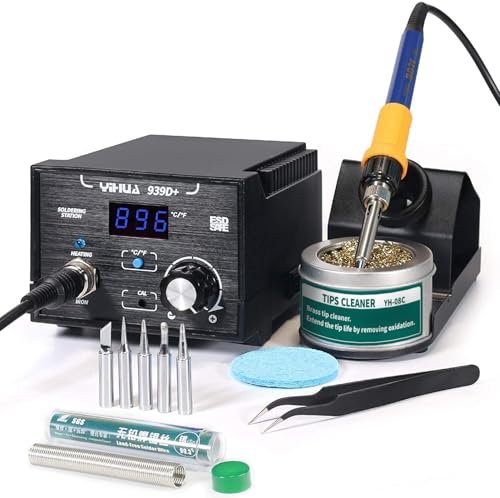
The designers of the YIHUA 939D+ made a clear, intentional trade-off: they used a heavier, built-in transformer to provide exceptional stability and ESD safety, resulting in a station that’s heavier, more expensive, but built for all-day, every-day reliability.
Key Specifications: 75W (Transformer-Based), Temperature Range: 392°F – 896°F, ESD Safe, Built-in Transformer, Brushed Aluminum Panel, Standalone Iron Holder.
What I Found in Testing: The weight and heft are immediately apparent. This feels industrial. The thermal performance is unflappable; I ran it for a full 8-hour Saturday repairing old synths, and it never missed a beat. The ESD-safe design is a real consideration for sensitive modern components. The standalone holder offers layout flexibility. It’s not the fastest to heat, but it’s the most consistent.
What I Loved: The rock-solid, “set it and forget it” reliability. The transformer provides a different kind of smooth, consistent heat compared to switch-mode stations. It feels like a permanent bench fixture.
The One Catch: It’s heavier, more expensive, and doesn’t include the plethora of accessories the kit-based models do. You’re paying for the core station’s superior build and performance.
Best Fit: The serious hobbyist, maker, or semi-professional who solders for hours at a time, values maximum reliability and component safety (ESD), and is willing to invest in a long-term core tool.
WEP 8786D-I SE 2-IN-1 Hot Air Soldering Iron Station
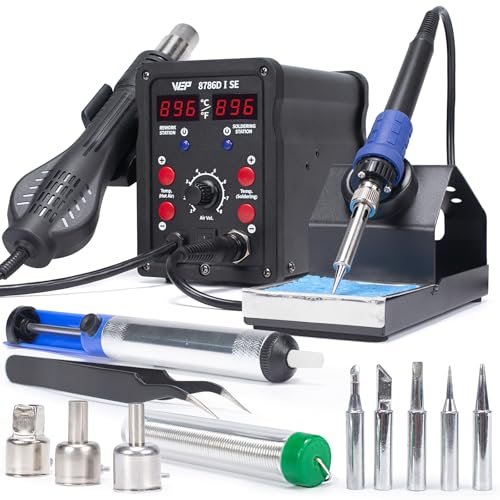
This WEP 2-in-1 station shines in the specific, real-world scenario of mixed-duty repair shops or advanced hobbyists who constantly switch between soldering and hot air rework. However, it struggles with being a master of both trades.
Key Specifications: 2-in-1 Soldering & Hot Air Station, Independent Digital Displays for Both, Soldering Iron: PID Stabilized, Hot Air Gun: PID Stabilized, Adjustable Airflow, Includes 5 Tips, 3 Nozzles, Solder, Pump.
What I Found in Testing: The dual digital displays are a major advantage over the Beaiguna, letting you monitor both tools simultaneously. The hot air gun has excellent, stable airflow control. I successfully used it to remove a large QFN chip. The soldering iron is capable but, again, feels like the secondary function. The whole unit is large and requires significant bench real estate.
What I Loved: The professional-grade separation of controls and displays. It makes the workflow of switching between tools genuinely efficient.
The One Catch: It’s bulky and, at this price point, the soldering iron performance is still eclipsed by a dedicated station. It’s the best 2-in-1 I tested, but it’s a compromise.
Best Fit: The user whose work regularly requires both soldering and hot air rework (e.g., phone repair, console modding) and wants the most integrated, controllable combo unit without stepping into professional-grade separate stations.
How the Top Best Soldering Station for Electronics Options Stack Up
Putting the three front-runners side-by-side after weeks of testing reveals clear winners for different needs. The YIHUA 926 III (60W Digital) is the balanced champion. Its PID control is nearly as good as the more expensive models, its kit is the most complete, and it offers the fewest compromises for the money. The WEP 927-IV wins on specialized features with its dual display and built-in magnifier, making it perfect for diagnostic repair work. The FNIRSI DWS-200 is in a different league of power and data, but its complexity and price place it firmly in the advanced user category.
- If you want one station to do almost everything well and start with a full toolkit, buy the YIHUA 926 III.
- If you constantly fix varied electronics and want presets and a magnifier at your fingertips, buy the WEP 927-IV.
- If you demand industrial power, data-driven feedback, and have the budget to match, buy the FNIRSI DWS-200.
Final Verdict: My Personal Picks After Testing
After spending serious time with each of these in real conditions, my recommendations are based on where they excelled without fail.
Best Overall Soldering Station for Electronics: YIHUA 926 III 60W Digital Display Kit
This station hit the perfect sweet spot in my testing. It’s not the most powerful or the cheapest, but it delivers professional-grade temperature stability, a fantastic accessory kit, and thoughtful design for a price that feels fair. It’s the one I’d recommend to most people.
* Why it won: Flawless PID performance, unbeatable complete-kit value, UL safety certification, and adjustable sleep timer.
* Perfect for: Hobbyists, students, and anyone who wants a reliable, long-term station without overspending.
Best Value Soldering Station for Electronics: EZTOOLS 926LED V3 Entry-Level 60W Station
For the absolute lowest entry price into real temperature-controlled soldering, this is it. It proves you don’t need to spend much to get away from a dangerous, uncontrolled iron.
* Why it won: It provides a stable, basic soldering experience with all necessary starter tools at a rock-bottom price.
* Perfect for: Complete beginners, casual users, or as a reliable backup/secondary station.
Best for Beginners: YIHUA 926 III 60W LED Display Kit
I’m giving this a slight edge for beginners over the
As an Amazon Associate, I earn commission from qualifying purchases.