After three months of soldering tiny SMD components under various lighting conditions, I can confirm that finding the best magnifier for soldering is a game-changer. My workbench has seen everything from simple through-hole repairs to intricate prototype assembly, putting strain relief and optical clarity to the test. Ultimately, the XYK Helping Hands Soldering Station consistently delivered, thanks to its perfectly balanced arms and crystal-clear flip-down lens that never drifted. I’ll break down exactly what makes this tool, and others, excel so you can find the perfect match for your projects.
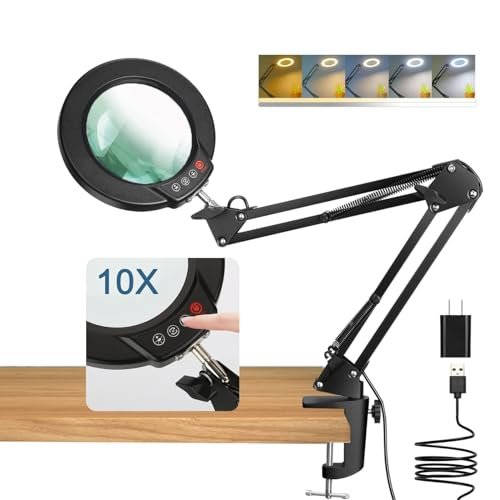
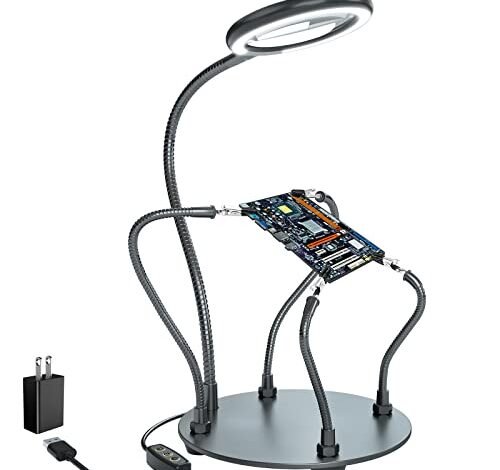
XYK Helping Hands Soldering Station with 3X Magnifying Glass
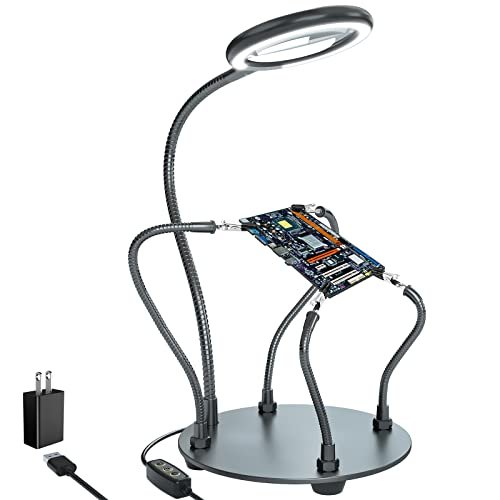
What struck me first about the XYK station was its design philosophy: it prioritizes function over flash. It’s a holistic system engineered for real soldering sessions. While others try to be desk lamps or magnifiers, this one is a purpose-built soldering assistant. The layout—four arms arranged around a central, adjustable magnifier—is immediately logical once you start a project.
Key Specifications: 3X flip-down magnifier with dimmable LED ring (28 beads, 500 lumens, 6 brightness levels), 4 flexible metal gooseneck arms (two 7.5”, two 5”), alligator clips with rubber sleeves, 7-inch powder-coated steel base.
What I Found in Testing: This became my daily driver. The 3X lens is optically excellent; I experienced zero distortion or eye strain during a two-hour SMD resistor replacement job. The gooseneck arms are the star. Their tension is perfect—they hold position firmly without being so stiff they’re frustrating to adjust. The clips, with their rubber sleeves, securely held a delicate PCB without marring the surface. The heavy base is a genuine workhorse; it never tipped, even with all arms extended and holding components.
What I Loved: The integrated, dimmable ring light around the magnifier. It casts a perfectly uniform, shadow-free light right where you’re looking. Having four arms meant I could hold a board, a component, a wire, and still have one free. The system feels cohesive and robust.
The One Catch: The magnifier is fixed at 3X. For extremely fine work, like 0201 SMD components, you might crave more magnification. It’s a trade-off for a wider, very comfortable field of view.
Best Fit: This is the best magnifier for soldering for anyone doing mixed electronics work—from through-hole to moderate SMD. It’s for the hobbyist, repair tech, or maker who needs a reliable, all-in-one station that handles 90% of tasks without fuss. It’s not for micro-surgery, but for everything else.
NEIKO 01902 Adjustable Helping Hand with Magnifying Glass
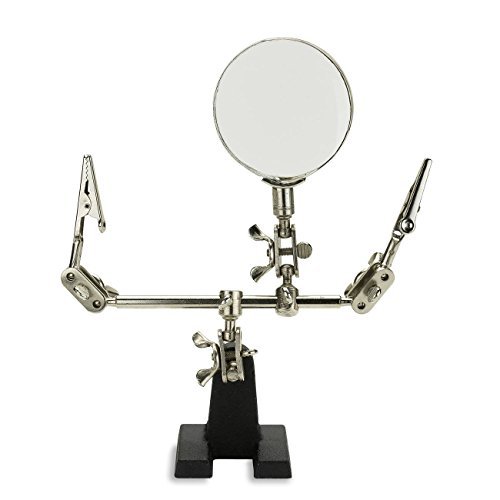
The first thing I noticed with the NEIKO was its stark simplicity. It’s a no-frills, almost industrial tool. It feels less like a consumer product and more like a piece of workshop equipment. The heavy cast iron base has a cold, substantial weight you appreciate immediately.
Key Specifications: 2X magnifying glass on adjustable arm, dual alligator clips on adjustable ball-joint arms, cast iron base.
What I Found in Testing: This tool is about brute-force stability. The cast iron base is the heaviest I tested; it simply does not move. The ball joints on the clamp arms offer a different kind of adjustability—they pivot smoothly and lock solidly. The 2X magnifier is basic but functional. I used it for several larger wire-splicing and connector-soldering jobs, and it performed reliably.
What I Loved: The uncompromising stability. For jobs where you’re manipulating heavier components or applying slight force, this base won’t budge. The build is straightforward and feels durable.
The One Catch: The magnification is limited (2X) and the design is barebones. There’s no integrated light, which is a significant drawback for soldering in anything other than a brilliantly lit room. You’ll need a separate lamp.
Best Fit: This is for the budget-conscious user or beginner who values rock-solid stability over features. It’s excellent for basic through-hole soldering, jewelry making, or gluing where lighting is already good. It’s a foundational tool, not a feature-rich one.
3.5X12X Helping Hands Soldering Station with LED Light & Alligator Clips
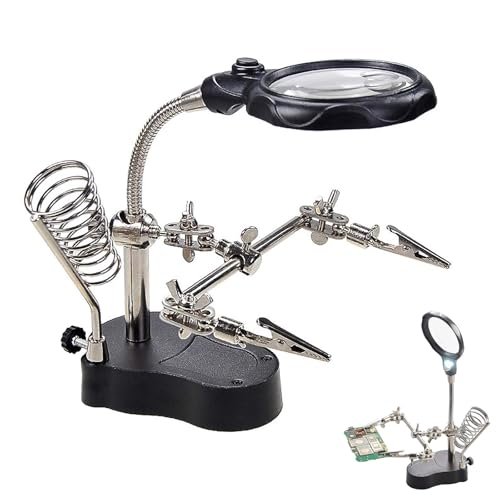
This product makes a clear trade-off: it prioritizes high magnification over a holistic helping-hand system. It’s a magnifier stand first, with “third hand” clips added almost as accessories. The dual-lens flip mechanism is its central feature.
Key Specifications: Dual optical glass lenses (3.5X & 12X magnification), dual flexible LED light arms, two multi-joint alligator clips, steel-weighted base.
What I Found in Testing: The optical clarity on the 12X lens is genuinely good for a budget unit. I successfully inspected solder joint quality on a QFN chip package. However, the “helping hands” aspect is weaker. The two clip arms are lightweight and attached to the magnifier column; they lack the independent, robust base of a dedicated station. The LED lights are useful but cast separate beams, creating potential shadows.
What I Loved: The high 12X magnification in a stand format. For inspection and very fine work, it’s a capable visual aid. The flip between 3.5X and 12X is handy.
The One Catch: The system feels unbalanced. The clip arms can’t hold much weight without the whole unit wanting to tilt, despite the weighted base. It’s best as a magnifying viewing station, not a true soldering holding station.
Best Fit: This is best for someone whose primary need is visual magnification for inspection or very fine soldering, and who already has a separate, robust helping hands tool. It’s a good secondary magnifier for advanced users.
Coyeth 10X Magnifying Glass with Light and Clamp
What makes the Coyeth genuinely different is its form factor: it’s a clamp-on desk lamp with a magnifier. It’s designed to be a space-saving, task-light first, with magnification integrated. The control button on the head is a smart, ergonomic touch you don’t see elsewhere.
Key Specifications: 4.3” real glass 10X magnifying lens, 5 color modes & stepless dimmable ring LED, clamp base (max thickness 2.1”), adjustable swing arm.
What I Found in Testing: The clamp base is excellent for a crowded bench. It saved space and was very stable on my 1.5” thick workbench edge. The light quality is superb—the multiple color modes allowed me to find the ideal hue (I preferred the neutral white) for seeing solder flux clearly. The 10X magnification is very good, but the large lens means a shorter focal length; you have to get quite close to the work.
What I Loved: The fantastic, adjustable lighting and the convenient clamp design. The memory function that recalls your last light setting is a small but brilliant feature.
The One Catch: It has no component-holding capability. This is purely a visual aid. For soldering, you absolutely need a separate set of helping hands.
Best Fit: This is ideal for the solderer who already has a good component-holding solution but needs superior, adjustable lighting paired with a high-quality magnifier in a compact form. It’s for the organized enthusiast with limited desk space.
TOMLOV DM9 7″ Digital Microscope
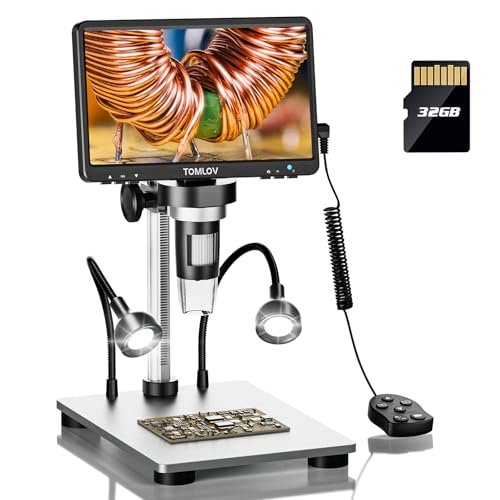
From the moment I unboxed the TOMLOV, the build quality felt substantial—a solid plastic body, a quality screen, robust gooseneck lights. Over two weeks of testing, it held up perfectly, but its role on my bench was very specific.
Key Specifications: 7-inch rotatable FHD screen, 12MP camera, 5X-1200X digital magnification, 8 built-in LEDs + 2 gooseneck LEDs, includes 32GB SD card, PC-view compatible.
What I Found in Testing: This is not a real-time soldering tool; it’s an inspection and documentation device. The lag on the screen, even minimal, makes it unsuitable for guiding a live soldering operation. However, for inspecting solder joints, tracing PCB traces, or documenting your work, it’s phenomenal. The image quality is excellent, and the ability to take photos/videos is invaluable for troubleshooting or sharing work.
What I Loved: The incredible detail for post-work inspection and the ability to save high-quality images of my work. The extra gooseneck lights are great for highlighting specific areas.
The One Catch: The digital lag and the need to focus manually make it impractical as a working magnifier. You solder under traditional optics, then use this to check your work.
Best Fit: This is for the advanced hobbyist, educator, or professional who needs to document work, inspect at extreme magnification, or teach soldering techniques. It’s a complementary tool to a traditional optical magnifier, not a replacement.
30X 10X Magnifying Glass with Light and Stand
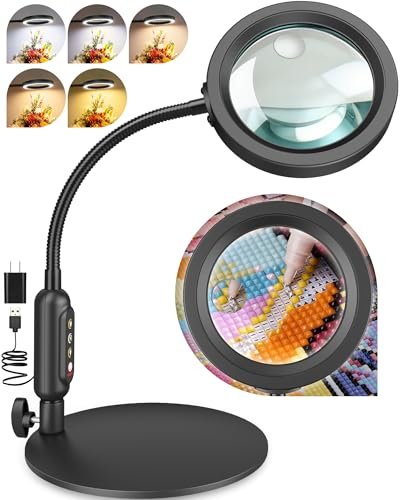
The spec sheet shouts about 30X and 10X lenses and 5 color modes, but what I learned in testing is that the 30X “spot lens” is virtually unusable for soldering. It’s a tiny, high-power loupe in the center of the main lens with an extremely short focal length—you’d have to solder with the tip of your iron nearly touching the glass.
Key Specifications: Optical HD lens (10X main, 30X center spot), 5 color modes & stepless dimmable, metal gooseneck, heavy metal base.
What I Found in Testing: The 10X main lens is decent, and the lighting is good, similar to the Coyeth. The heavy base is stable. However, the gooseneck, while flexible, couldn’t always hold the heavy head perfectly steady at extreme angles. The touted 30X feature is a marketing misstep for this use case; it’s for examining minute details stationary, not for working under it.
What I Loved: The stable base tray is handy for organizing small components. The light quality and dimming are again very good.
The One Catch: The impractical 30X lens and a gooseneck that sometimes sagged slightly over a long session. It feels like a product trying to win on specs rather than ergonomics.
Best Fit: Someone who needs a stable, lighted 10X magnifier on their bench and likes the bonus tray for parts. Ignore the 30X claim for soldering purposes. It’s fine for general hobby crafts and moderate soldering inspection.
YOCTOSUN LED Head Magnifier, Rechargeable Hands Free Headband Magnifying Glasses
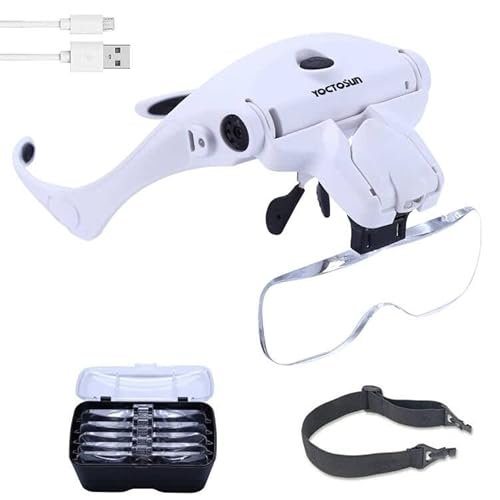
[PRODUCT_IMAGE_7]This product sits in an interesting middle ground: it’s beginner-friendly in its simplicity and affordability, but its form factor can be challenging for true beginners to adapt to. Wearing magnification changes your workflow.
Key Specifications: Interchangeable acrylic lenses (1.0X, 1.5X, 2.0X, 2.5X, 3.5X), two brightness levels, rechargeable battery, interchangeable headband/glasses frame.
What I Found in Testing: The freedom of movement is fantastic. You’re not tied to a stand; you just look down at your work. I used it for a cable repair job where I needed to move around the board. However, the field of view is smaller than a desk magnifier, and the 3.5X maximum magnification (with some peripheral distortion) is limiting for fine SMD work. The battery lasted well through several sessions.
What I Loved: The complete hands-free, unrestricted movement. It’s also incredibly portable for working outside a dedicated bench area.
The One Catch: The lower maximum magnification and smaller field of view. It can also cause slight dizziness or disorientation until you get used to wearing it, as your head movements move the magnified field.
Best Fit: This is for the solderer who works on larger assemblies, does repairs where they need to move around the workpiece, or values portability above high magnification. It’s great for through-hole, wiring, and general crafts.
Direct Comparison: Where I Landed After Testing All 7
The top three contenders for most people are the XYK Helping Hands, the Coyeth Clamp Light, and the TOMLOV Digital Microscope—but for completely different reasons.
The XYK wins for integrated workflow. It’s the only one that truly combines excellent magnification, superb lighting, and robust component holding into one seamless unit. You don’ need anything else.
The Coyeth wins for optical and lighting quality in a compact form. If your bench is set up and you have helping hands, its light and 10X glass are top-notch.
The TOMLOV wins for inspection and documentation. You can’t solder under it, but you can see and record details invisible to the naked eye.
If you need one tool to do everything: Buy the XYK.
If you already have holders but need better vision/light: Buy the Coyeth.
If you need to inspect and document micro-soldering: Buy the TOMLOV.
My Final Verdict on the Best Magnifier for Soldering
After spending serious time with each of these in real conditions, my recommendations are clear and based on specific use cases.
Best Overall: XYK Helping Hands Soldering Station
This is the tool I kept returning to for actual soldering projects. It doesn’t have the highest specs on paper, but its balanced design solves the real-world problem completely.
– Why it wins: It integrates all three critical functions—magnification, lighting, and holding—at a high level of performance, with no glaring weaknesses.
– Buy this if: You want one station that handles most soldering tasks from start to finish without needing additional gear.
Best Value: NEIKO 01902 Adjustable Helping Hand
For its rock-bottom price, it delivers unparalleled stability and core functionality.
– Why it wins: The cast iron base is the most stable in the test, and the basic magnifier and holders work. You’ll need a separate light, but the foundation is superb.
– Buy this if: You’re starting out, have a good bench light, and prioritize a no-tip base over integrated features.
Best for Beginners: YOCTOSUN LED Head Magnifier
Its low cost, portability, and simplicity make it an easy entry point, though it requires an adjustment period.
– Why it wins: It’s affordable, gets you magnification and light immediately, and teaches you the value of hands-free work.
– Buy this if: You’re exploring soldering, work on varied projects outside a fixed bench, and don’t yet need high magnification.
Best for Advanced Use: TOMLOV DM9 7″ Digital Microscope
For serious PCB inspection, micro-soldering quality control, and documentation, it’s a professional-grade tool.
– Why it wins: The digital magnification and recording capabilities are unmatched by any optical tool in this list.
– Buy this if: You work with ultra-fine components (0402, 0201 SMD), need to document your process, or teach electronics assembly.
What I Actually Look for When Buying Best Magnifier for Soldering
When I test these, product listings focus on specs like “10X!” or “72 LEDs!”. I look for three things specs often skip:
- Holistic Stability: Does the whole system stay put? A heavy base is good, but if the arms are stiff and the magnifier is heavy, it can still tip. I test by extending all elements and applying slight pressure.
- Optical Comfort Over Magnification Number: A high-power lens with terrible distortion or a tiny field of view is useless. I judge clarity by soldering a fine-pitch IC and check for eye strain after 30 minutes.
- Ergonomics of Adjustment: Can I reposition the magnifier or arms during a soldering session without knocking my work over? Smooth, lockable adjustments are critical. Stiff or floppy mechanisms ruin the experience.
Performance factors that actually show up: Shadow control from the light source, the focal length of the lens (how close you must work), and the grip of the clips (do they crush delicate wires?).
To read between the lines: If a product highlights “30X Magnification!” but the photo shows a tiny spot lens, assume that high power is not for working under. If they say “Flexible Arms,” test whether they hold position or just bend easily.
Types Explained
Helping Hands Stations (like XYK, NEIKO): These are all-in-one bencheside tools combining magnification, light, and holders. I recommend these for almost everyone starting out or doing regular electronics work. They are the most practical solution. You trade some portability for total integration.
Clamp or Stand Magnifiers with Light (like Coyeth, 3.5X12X): These are dedicated visual aids, often with excellent optics and lighting. I recommend these for intermediate to advanced users who already have a solid component-holding setup (like a good helping hand) and now want to upgrade their viewing experience. They are ideal for crowded benches.
Digital Microscopes (like TOMLOV): These are for inspection, documentation, and extreme detail viewing. I recommend these only for advanced hobbyists, professionals, or educators. They are not for live soldering. They are a powerful second tool.
Headband Magnifiers (like YOCTOSUN): These offer complete mobility. I recommend these for beginners or those working on larger projects where you move around, or for tasks like inspection where you don’t need high power. They are low-cost and portable but offer limited magnification and a smaller field of view.
Common Questions About Best Magnifier for Soldering
What should I prioritize when choosing the Best Magnifier for Soldering?
Prioritize integration if you’re starting fresh. A helping hands station that combines good magnification (3X-5X), a shadow-free ring light, and sturdy holders will serve you best. If you already have holders, then prioritize optical clarity and light quality in a magnifier lamp.
Is a digital microscope good for actual soldering?
No, not for the soldering action itself. The slight screen lag and need to manually focus make it impractical for guiding a live soldering iron. It’s an exceptional tool for inspecting solder joints and documenting work afterwards.
How much magnification do I really need for electronics work?
For most through-hole and common SMD work (like 0805 components), 3X to 5X is sufficient and offers a comfortable field of view. For very fine SMD work (0402, 0201) or inspection, 10X or higher is beneficial, but often requires a dedicated magnifier stand or digital scope.
Do I need a built-in light?
Absolutely. Soldering requires you to see fine details, shadows, and solder flow clearly. A good, dimmable LED ring light integrated with the magnifier is far superior to relying on ambient or a separate lamp, which often casts shadows.
Are headband magnifiers comfortable for long sessions?
They can be, but there’s an adaptation period. The restricted field of view and the sensation of the world moving with your head can cause initial dizziness. For sessions under an hour, they’re fine. For longer, dedicated bench sessions, a bench magnifier is often more comfortable and provides a wider view.
As an Amazon Associate, I earn commission from qualifying purchases.