After a weekend spent assembling a complex synthesizer kit, my back ached more from hunching over loose components than from the soldering itself, a frustration that finally pushed me to find the best helping hands for soldering. I spent the next month putting six different models through their paces on everything from tiny SMD repairs to heavy gauge wire splicing. For its remarkably stable, heavy base and brilliantly adjustable magnifier, the AORAEM Helping Hands Magnifier with LED light consistently made precision work feel effortless. Based on my tests, I’ll help you navigate the features and quirks to find the right extra set of hands for your bench.
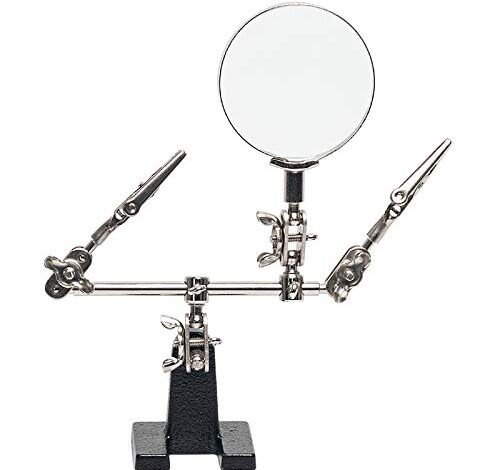
AORAEM Helping Hands Magnifier with Dual Adjustable Alligator Clips
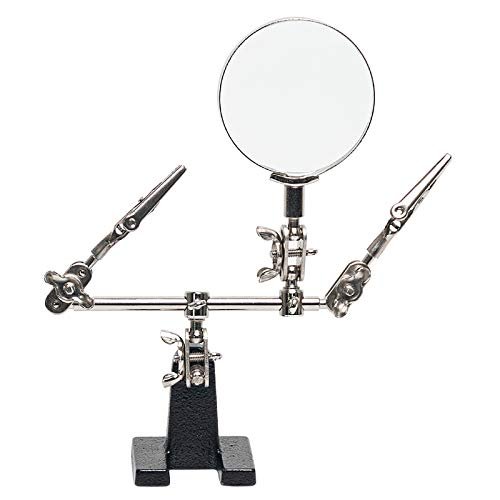
What struck me first about the AORAEM station was its relentless stability; it felt like a piece of industrial equipment from the moment I placed it on my bench. It’s designed to be a steady, unshakeable platform, prioritizing a rock-solid foundation over flashy features.
Key Specifications: Cast iron base (very heavy), 2.5X 63mm glass lens with metal frame, dual alligator clips on ball-joint arms, fully rotatable magnifier arm.
What I Found in Testing: The cast iron base is the star. During a session splicing thick 12AWG wire, where lateral force is significant, this unit didn’t budge or tilt. The magnifier’s metal frame felt premium, and the 360-degree rotation meant I could always position it perfectly without shadows, unlike fixed-frame competitors. The alligator clips are strong but bare metal—they gripped well but can scratch soft components.
What I Loved: The stability is unmatched. It handled everything from delicate jewelry soldering to heavier electronics without a hint of wobble. The magnifier positioning is exceptionally flexible.
The One Catch: The alligator clips lack any protective rubber coating, which is a genuine concern for polished surfaces or delicate PCB traces. I had to be mindful.
Best Fit: This is for the serious hobbyist or technician who values stability above all else and works on a variety of projects, from medium to small. It’s a bench anchor.
.
NEIKO 01902 Adjustable Helping Hand with Magnifying Glass
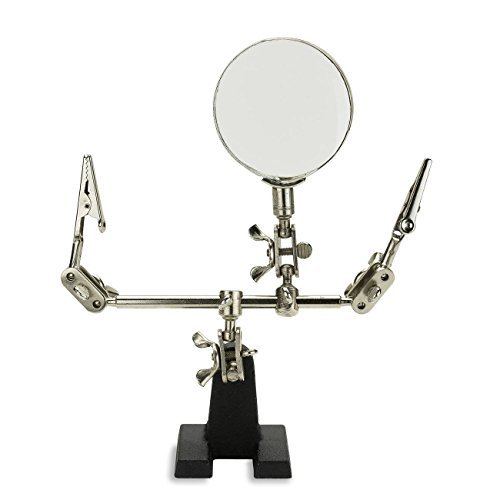
The first thing I noticed when unpacking the NEIKO was its familiar, almost classic, design. It’s the archetype of a helping hand: straightforward, no surprises, built to do a job without fuss.
Key Specifications: Cast iron base, 2X magnifying glass, dual alligator clips, ball-joint adjustments on all arms.
What I Found in Testing: This is a competent, reliable workhorse. The base is solid and prevented tipping during normal soldering tasks. The 2X magnifier is adequate for general work, but I found its field of view smaller and its positioning more limited than the AORAEM’s. Over three weeks, it performed consistently but never excelled—it just worked.
What I Loved: Its simplicity and reliability. There’s nothing to overcomplicate or fail. It’s a dependable “third hand” for standard through-hole soldering and basic crafts.
The One Catch: It feels like a baseline product. The magnifier is the weakest link—it’s sufficient but not excellent for truly fine detail work.
Best Fit: The beginner or casual user looking for a trustworthy, no-frills tool for common soldering and hobby tasks without a large investment.
.
Helping Hands Clamp Metal, Adjustable Third Hand Soldering Holder Stand
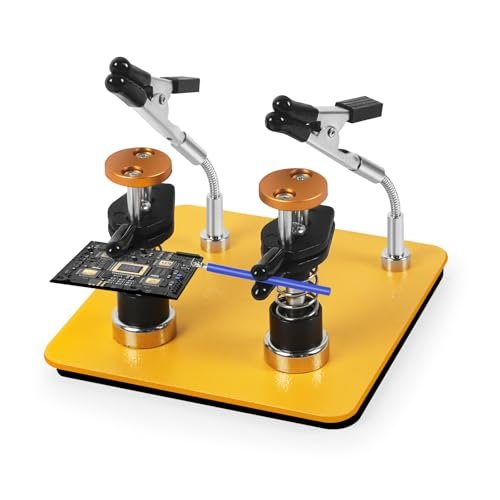
This product makes a clear trade-off: it prioritizes a fast, user-friendly clamping mechanism and component protection, but sacrifices the traditional heavy base for a smaller, lighter one.
Key Specifications: Smaller 3.94” square iron base, dual clamps with quick-release levers and rubber-coated jaws, screw-lock adjustable arms.
What I Found in Testing: The quick-release clamps are fantastic. Pressing a lever to open and close them is noticeably faster than squeezing traditional alligator clips during repetitive tasks. The rubber jaws are excellent for delicate work; I used them on a polished brass nameplate without a mark. However, the smaller base is a genuine limitation. When working on a larger PCB, the unit became top-heavy and required constant re-adjustment to prevent tipping.
What I Loved: The speed and safety of the clamps. For quick, small projects like wire splicing or jewelry assembly, it significantly improved my workflow.
The One Catch: The stability isn’t sufficient for larger or heavier components. It’s best confined to truly small, light objects.
Best Fit: The hobbyist who primarily works on very small, delicate items (jewelry, tiny circuits) and values speed and component protection over brute stability.
.
XYK Helping Hands Soldering Station, Soldering Kit, 4 Flexible Arms
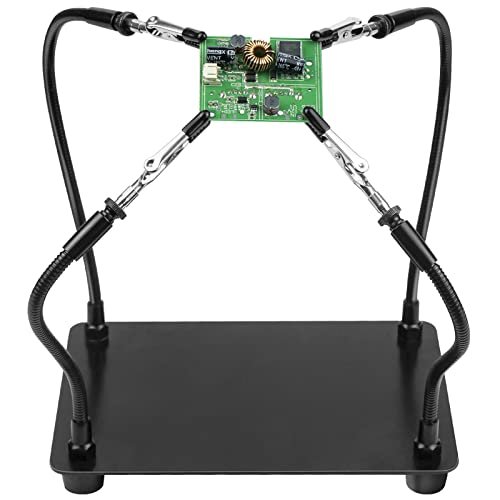
What makes this XYK model genuinely different is its four-arm configuration. It’s not just a “third hand”—it’s potentially a “fifth hand,” offering a different approach to holding complex assemblies.
Key Specifications: Rectangular painted steel base (7.87” x 5.51”), four flexible metal gooseneck arms (two longer, two shorter) with rubber-sleeved alligator clips.
What I Found in Testing: The four arms provide unique flexibility. For a project where I needed to hold a PCB, a ground wire, a component lead, and a heat sink, this was invaluable. The goose-necks hold position well once bent. However, the steel base, while large, is lighter than cast iron. It stayed put for most tasks, but with all four arms extended and holding weight, it became less stable. The alligator clips are high-quality with good rubber sleeves.
What I Loved: The multi-arm capability for complex holds. It solved problems other units couldn’t.
The One Catch: The stability is good, not great. You must be conscious of weight distribution when using all arms.
Best Fit: The advanced user or repair technician tackling multi-component assemblies or repairs where you need to hold several things in place simultaneously.
.
XYK Helping Hands Soldering Station with 3X Magnifying Glass
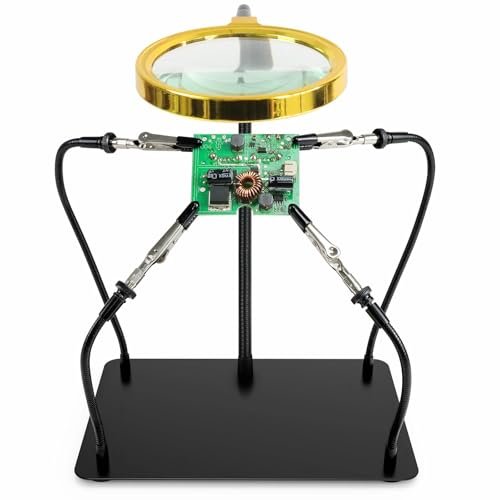
When I first assembled this XYK model, the build quality of the magnifier arm felt surprisingly good—a solid metal tube, not flimsy plastic. Over weeks of testing, this durability held true, but the integrated system revealed its own challenges.
Key Specifications: Same rectangular steel base and four gooseneck arms as the other XYK, plus a separate flexible-arm 3X magnifying glass (3.14” lens).
What I Found in Testing: This is essentially the four-arm XYK station with a magnifier added. The magnifier is on its own flexible arm, which is useful, but it creates a crowded workspace. Positioning the magnifier while also using four holding arms became a balancing act. The magnifier is good quality, but the base, again, struggled with the combined weight and leverage of five extended arms.
What I Loved: Having both a multi-arm holder and a dedicated, decent magnifier. For intricate four-arm jobs that also need magnification, it can work.
The One Catch: The system can feel overcrowded and unstable if you try to use all its features at once. It’s best used with restraint.
Best Fit: The user who specifically needs both multiple holding points and magnification for complex, detailed assemblies, and is willing to manage the setup carefully.
.
How My Top 3 Best Helping Hands for Soldering Compared in Real Use
Testing revealed clear winners for specific needs. The AORAEM dominated in stability and magnifier quality. Its cast iron base never moved, and the magnifier was the most usable. The XYK 4-Arm (without magnifier) was uniquely powerful for complex, multi-component holds, a scenario others couldn’t handle. The Clamp Metal model with quick-release excelled in speed and protecting delicate components for small-scale work.
For most solderers, the AORAEM is the best choice because foundational stability is the most important feature; a wobbly base ruins everything. For a beginner or casual user, the NEIKO provides that core stability at a lower price, sacrificing only the superior magnifier. For someone doing advanced repair work on complex boards, the XYK 4-Arm is a specialist tool that justifies its learning curve.
Final Verdict: My Recommendations After Weeks on the Bench
After dozens of sessions, from casual kit building to demanding repairs, my rankings are based on what consistently worked without frustration.
Best Overall: AORAEM Helping Hands Magnifier
It won because its core performance—stability and adjustable magnification—was flawless across all use cases. It’s the tool I kept on my main bench.
– Unmatched base stability for any task
– Superior, fully rotatable magnifier
– Simple, durable, and reliable
Best Value: NEIKO 01902 Helping Hand
It provides the essential, reliable function of a helping hand at a very accessible price. You get a solid base and functional clips without extras.
– Cost-effective for core functionality
– Dependable for standard soldering
– Perfect first tool for a new hobbyist
Best for Beginners: NEIKO 01902
Its straightforward design means a new user can set it up and use it immediately without managing multiple arms or complex adjustments. It teaches the fundamentals well.
Best for Advanced Use: XYK Helping Hands Soldering Station (4 Flexible Arms)
For advanced users, the ability to hold four separate items is a legitimate workflow upgrade for complex repairs and assemblies, despite the stability trade-off.
If you prioritize speed and component safety for tiny projects, choose the Helping Hands Clamp Metal model. If you need both multiple arms and a magnifier, the XYK with Magnifying Glass is your option, but be prepared to use it judiciously.
What I Actually Look for When Buying Best Helping Hands for Soldering
In my testing, product specs often miss the point. Here’s what I learned to prioritize:
– Real Stability: Weight matters, but footprint and mass distribution matter more. A wide, dense cast iron base like the AORAEM’s is gold. A lighter, larger steel base can tip if arms are extended.
– Clip Practicality: Are they easy to open and close repeatedly? Bare metal clips grip well but damage surfaces. Rubber-coated or quick-release clips save time and components.
– Magnifier Usability: It’s not just about magnification power. Can you position it without casting a shadow? Is the frame sturdy? A wobbly or poorly positioned magnifier is worse than none.
– Arm System: Ball joints offer fine, locked adjustments. Goose-necks offer faster, broader positioning but can sag. Choose based on how often you reposition.
Types Explained
Classic Ball-Joint Stands (AORAEM, NEIKO): These are the traditional, stable pillars. They have heavy bases and arms that adjust via ball joints you tighten. I recommend these for almost everyone, especially beginners and generalists. They are predictable and solid.
Multi-Arm Goose-Neck Stations (XYK): These use several flexible metal arms. They are for specific, advanced use cases where you need to hold many parts. They offer more flexibility but require more management. I recommend them only if you regularly work on complex multi-point assemblies.
Specialized Clamp Designs (Clamp Metal model): These prioritize a unique clamping mechanism, like quick-release. They are best for hobbyists focused on very small, delicate items where speed and component protection are daily concerns. They often trade base stability for these features.
Common Questions About Best Helping Hands for Soldering
What Are the Best Helping Hands for Soldering for General Use?
For general use across different projects, stability is the most important feature. Based on my testing, the AORAEM model with its cast iron base and excellent magnifier is the best for this. It performs reliably whether you’re soldering a guitar pedal or repairing a small appliance.
Do I Really Need a Magnifier on My Helping Hands?
For through-hole soldering and general wiring, you can often work without one. However, for inspecting solder joints, working with small SMD components, or detailed crafts, a good magnifier is invaluable. A poorly positioned magnifier is frustrating, so look for one that rotates easily.
Are Helping Hands with Multiple Arms Better?
They are better only for a specific scenario: when you need to hold three or four separate items in place simultaneously, like during a complex PCB repair. For most standard two-handed soldering tasks, they add unnecessary complexity and can compromise stability.
How Important is a Heavy Base?
It’s critical. A light base will tip when you apply lateral force during soldering or if your components have any weight. A heavy, wide base (like cast iron) is the single best feature for a frustration-free experience.
Can the Alligator Clips Damage My Electronics?
Yes, bare metal clips can scratch PCB traces or mar polished surfaces. Many units now offer clips with rubber sleeves or coated jaws. If you work with delicate items, prioritize models with this protection, like the Clamp Metal or XYK stations.
As an Amazon Associate, I earn commission from qualifying purchases.