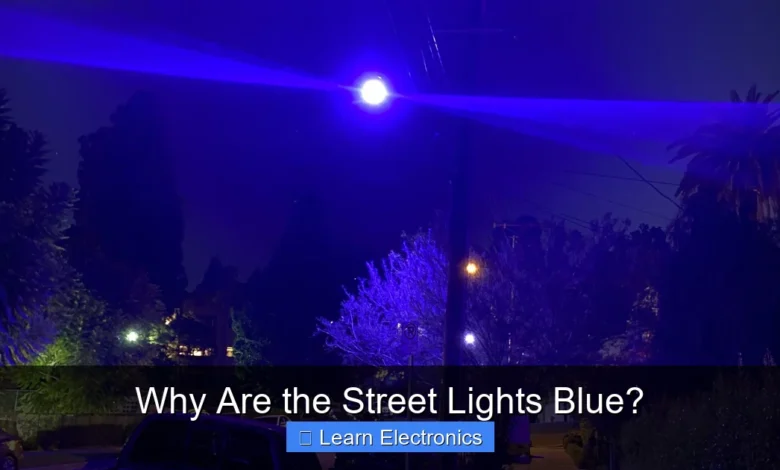
Why Are the Street Lights Blue? This increasingly common phenomenon is typically a tell-tale sign of either a dying high-pressure sodium (HPS) lamp, which shifts spectrum as it fails, or the intentional use of modern, high-color-temperature LED lighting. The perceived blue hue often sparks curiosity, but it represents distinct underlying causes related to different street lighting technologies.
Understanding this visual shift requires a brief look into the electronics and physics of how streetlights illuminate our nights. This method of lighting is undergoing a significant transition, moving from older discharge lamps to more energy-efficient solid-state solutions, each with its own spectral characteristics.
Quick Answers to Common Questions
Why do some street lights look blue, anyway?
Those noticeably blue-hued street lights are often High-Intensity Discharge (HID) lamps, specifically metal halide lights, that are nearing the end of their lifespan or have a manufacturing defect. This change in color temperature, making them appear blue, is a common sign of an aging bulb!
Is the blue light from street lights bad for your eyes?
While prolonged exposure to strong blue light can be a concern, the occasional blue street light typically isn’t harmful in the grand scheme. Their bluer tint usually signifies a lamp degrading, not a new technology intentionally designed for increased blue light output, which helps answer “Why Are the Street Lights Blue?”
Are all new street lights going to be blue now?
Not at all! In fact, most modern street lights are shifting towards LED technology, which offers a range of color temperatures, often aiming for warmer white light that’s less harsh and more energy-efficient than the older, sometimes blue-tinged lamps you might see.
📑 Table of Contents
- The Mystery Unveiled: Decoding the “Blue” Phenomenon
- High-Pressure Sodium Lamps: The Accidental Blue
- The Rise of LEDs: Intentional Blue-Rich White Light
- Why Are the Street Lights Blue? Intentional vs. Accidental
- Understanding Light Color Temperature: A Deeper Dive
- The Future of Street Lighting and Community Impact
The Mystery Unveiled: Decoding the “Blue” Phenomenon
The sight of blue-tinted street lights often leads to questions and sometimes even urban legends. However, the reasons are grounded in straightforward scientific principles and technological advancements in street illumination. There isn’t a single cause, but rather two primary scenarios that contribute to this distinct bluish glow, each originating from different eras of lighting technology.
The HPS Lamp Failure Mode
For decades, High-Pressure Sodium (HPS) lamps were the workhorse of street lighting, renowned for their distinctive orange-yellow glow and efficiency. These lamps produce light by passing an electric arc through vaporized sodium metal within an arc tube. Over time, as an HPS lamp nears the end of its operational life, the voltage required to maintain the arc increases. This rising voltage can cause the lamp’s arc to narrow and concentrate, altering the spectral output. As the sodium atoms become less excited or the gas mixture changes due to internal degradation, the orange-yellow spectrum weakens, allowing other spectral lines, particularly those from mercury (often used as a starting gas or impurity), to become more prominent, resulting in a noticeable shift towards a blue or purplish-blue color.
White LEDs and Color Temperature
The other, increasingly common reason for blue street lights stems from the widespread adoption of modern Light Emitting Diode (LED) technology. Unlike HPS lamps, LED street lights are intentionally designed to emit a specific color temperature. Many municipalities are opting for “cool white” or “daylight” LEDs, which have a higher color temperature (e.g., 4000K to 6500K on the Kelvin scale). These LEDs are engineered to produce light that appears crisp, bright white, but with a significant blue component in their spectrum. This approach is chosen for its perceived benefits in visibility, security, and energy efficiency, representing a deliberate design choice rather than a sign of failure.
Evolution of Street Lighting Technology
The transition from traditional discharge lamps to LEDs marks a significant evolution in lighting technology. Early streetlights relied on incandescent bulbs, then gave way to more efficient mercury vapor and later high-pressure sodium lamps. Each advancement brought improvements in lumen output, lifespan, and energy consumption. LEDs represent the latest leap, offering unprecedented control over light quality, directionality, and energy savings, driving many cities to upgrade their entire infrastructure, which naturally leads to changes in the visual landscape of our streets.
High-Pressure Sodium Lamps: The Accidental Blue
Delving deeper into the HPS lamp’s failure mode reveals a fascinating aspect of light physics. These lamps are a type of High-Intensity Discharge (HID) lamp, which means they produce light by creating an electrical arc between two electrodes within a sealed, transparent (or translucent) arc tube filled with various gases, including sodium vapor.
How HPS Lamps Work
Under normal operation, an HPS lamp generates light when electricity ionizes the sodium vapor, causing it to glow with its characteristic golden-yellow hue. This light is particularly effective at penetrating fog and dust, making it a popular choice for street illumination for decades. The exact color is determined by the specific spectral lines of sodium, primarily in the yellow-orange part of the visible spectrum.
The Arc Tube’s Decline
As an HPS lamp ages, several factors contribute to its eventual failure and color shift. The arc tube itself can degrade, and the internal gases can become contaminated or depleted. The voltage required to sustain the arc gradually increases. When the ballast (the component that regulates voltage and current to the lamp) can no longer supply the ever-increasing voltage demand, the lamp starts to cycle on and off, or the arc itself becomes unstable and constricts. This constriction intensifies the pressure and temperature within the arc tube locally, causing the spectral emission to broaden and shift. Components like mercury, which produce blue and green light, might become more dominant in the spectrum as the sodium emission weakens or changes, leading to the lamp appearing blue or purple before it eventually dies completely. This phenomenon is a clear indicator that the lamp is at the end of its useful life and requires replacement.
Energy Efficiency vs. Light Quality
While HPS lamps were once considered very energy efficient compared to incandescent or mercury vapor lamps, their light quality has limitations. The monochromatic nature of their yellow-orange light provides poor color rendition, meaning objects don’t appear in their true colors. This trade-off was accepted for their efficiency and long lifespan relative to previous technologies, but it’s a key area where modern LED lighting offers superior performance.
The Rise of LEDs: Intentional Blue-Rich White Light
The widespread adoption of LED technology has revolutionized street lighting, offering unprecedented levels of efficiency, control, and diverse light qualities. When you see modern streetlights emitting a crisp, bright white light that often has a noticeable blue tint, you are typically witnessing the deliberate application of high color temperature LEDs.
Understanding LED Color Temperature
Light color temperature is measured in Kelvin (K) and describes the warmth or coolness of light. Lower Kelvin values (e.g., 2700K-3000K) correspond to “warm white” light, which has a yellowish-reddish hue, similar to incandescent bulbs. Higher Kelvin values (e.g., 4000K-6500K) produce “cool white” or “daylight” light, which appears whiter and contains a greater proportion of blue light in its spectrum. This is a fundamental characteristic of LED design, not a sign of malfunction.
The Advantages of LED Street Lights
Cities and municipalities are rapidly replacing older HPS and metal halide lamps with LEDs due to a compelling array of benefits:
- Energy Efficiency: LEDs consume significantly less electricity, leading to substantial cost savings and reduced carbon footprints.
- Longevity: LEDs have a much longer lifespan, often exceeding 50,000 to 100,000 hours, which drastically reduces maintenance costs.
- Directional Light: Unlike omnidirectional HID lamps, LEDs can direct light precisely where it’s needed, minimizing light spill and glare.
- Improved Visibility and Safety: Higher CCT LEDs (those with a blue tint) can enhance contrast and make objects appear clearer, potentially improving visibility for drivers and pedestrians.
- Instant On/Off and Dimmability: LEDs provide instant illumination and can be easily dimmed or controlled by smart city systems.
The Blue Light Spectrum: Benefits and Concerns
While the blue component of high CCT LED street lights offers advantages in visual acuity and perceived brightness, it has also sparked discussions and concerns. The human eye is more sensitive to blue light, which can enhance daytime vision and alertness. However, excessive exposure to blue-rich light at night has been linked to potential disruption of circadian rhythms and increased light pollution. As a result, many communities are now carefully considering the optimal color temperature for their street lighting, sometimes opting for slightly warmer LEDs (e.g., 3000K or 3500K) to balance visibility with environmental and health considerations.
Why Are the Street Lights Blue? Intentional vs. Accidental
Distinguishing between the two main reasons for the blue appearance of street lights is crucial for understanding this modern urban phenomenon. It’s not just about what we see, but why we see it, revealing much about the lifecycle of lighting technology and municipal planning.
Distinguishing Between Failure and Design: Understanding Why Are the Street Lights Blue?
You can often tell the difference by observing the consistency and context. If an entire section of new street lights emits a uniform, bright white light with a bluish cast, it’s almost certainly a deliberate choice of high-CCT LED lighting. This reflects a modern infrastructure upgrade. Conversely, if only isolated lamps within an older, predominantly orange-yellow HPS installation appear patchy blue or purple, especially if they are flickering or cycling on and off, it’s a strong indicator of an HPS lamp nearing its end of life due to internal failure. The latter suggests a lamp needing replacement, whereas the former signifies a purposeful shift in lighting strategy.
The Role of Municipal Decisions
City planners and public works departments play a pivotal role in determining the type and color temperature of street lighting. Their decisions are influenced by various factors, including budget, energy efficiency goals, public safety, local regulations regarding light pollution, and aesthetic preferences. The move towards LED technology is often driven by long-term cost savings and environmental initiatives, leading to the adoption of a specific CCT that best serves their community’s needs and policy objectives. This approach reflects a conscious decision to embrace modern, efficient lighting solutions.
Public Perception and Light Pollution
The transition to blue-rich white LEDs has not been without its critics. Concerns include increased glare, potential impacts on human health (especially sleep cycles), and detrimental effects on nocturnal wildlife due to increased sky glow. These issues have prompted many communities to reconsider their lighting specifications, leading to a trend towards slightly warmer CCT LEDs (e.g., 3000K or 3500K) or the implementation of smart lighting systems that can dynamically adjust brightness and color temperature. This practice demonstrates an evolving understanding of urban lighting’s broader ecological and social implications.
Understanding Light Color Temperature: A Deeper Dive
To fully appreciate the diversity in street light colors, particularly the blue hues, it’s essential to grasp the concept of Correlated Color Temperature (CCT), measured in Kelvin. This metric is a cornerstone in the field of lighting design and electronics, influencing everything from visual comfort to energy use.
The Kelvin Scale Explained
The Kelvin scale quantifies the color appearance of light. It’s based on the theoretical concept of a “black body radiator” heating up; as it gets hotter, its emitted light shifts from red to orange, yellow, white, and eventually blue.
- Warm White (2700K – 3000K): Has a soft, yellowish glow, often associated with traditional incandescent bulbs and considered relaxing.
- Neutral White (3500K – 4000K): A balanced white, often found in offices and commercial spaces, offering good clarity without being overly cool.
- Cool White / Daylight (5000K – 6500K): Appears very bright and crisp, with a noticeable bluish tint. This range is common in modern LED streetlights, industrial settings, and task lighting where high visibility is paramount.
The blue component is more dominant at higher Kelvin temperatures, making the light appear “cooler.”
Different Light Temperatures and Their Applications
The choice of light temperature is not arbitrary; it serves specific purposes. Warm white light is often preferred for residential areas and historical districts for its aesthetic appeal and minimal disruption. Neutral white strikes a balance, offering good visibility. Cool white and daylight temperatures are often chosen for major roadways, intersections, and public spaces where maximum alertness and visibility are desired, as the blue-rich light can enhance contrast and reaction times. This technique leverages specific light spectra for desired outcomes.
Practical Implications for Urban Environments
The Kelvin value of street lighting has significant practical implications beyond just aesthetics. It affects how drivers perceive obstacles, how pedestrians feel about safety, and even the behavior of local wildlife. Municipalities weigh these factors carefully. For instance, studies suggest that higher CCT lights might be more effective for surveillance cameras, but warmer lights might be better for preserving dark skies and reducing light trespass into homes. Balancing these considerations is a complex task for urban planners, showcasing the intersection of electronics, urban planning, and public well-being.
The Future of Street Lighting and Community Impact
The evolution of street lighting is ongoing, driven by technological innovation and a deeper understanding of light’s impact on human health and the environment. The prevalence of blue-tinted lights, whether accidental or intentional, is part of this broader narrative.
Smart Lighting Systems
The next frontier in street lighting involves smart systems that integrate LEDs with sensors, communication networks, and adaptive controls. These systems can automatically adjust brightness based on real-time conditions (e.g., traffic flow, weather), dimming lights when not needed and brightening them during peak activity. Some advanced systems can even alter their color temperature, offering warmer light during quiet hours and cooler, brighter light when maximum visibility is required. This represents a significant leap from the static lighting of previous generations.
Minimizing Environmental Impact
Concerns about light pollution and its effects on nocturnal ecosystems have led to movements like the “Dark Sky Initiative.” Modern street lighting design now emphasizes full cut-off fixtures that direct light downwards, preventing upward light spill into the night sky. Additionally, careful selection of CCT—often favoring warmer tones for environmental sensitivity—and intelligent dimming strategies are becoming standard practices to reduce the ecological footprint of urban illumination. This approach reflects a commitment to responsible urban development.
Ensuring Safety and Visibility
Ultimately, the primary purpose of street lighting remains to ensure public safety and visibility. While the discussion around “blue” lights includes environmental and health aspects, the core requirement is to provide adequate illumination for drivers, pedestrians, and public spaces. Future developments aim to achieve this balance through highly efficient, adaptable LED systems that can deliver targeted, high-quality light while minimizing negative externalities. This continues to be the driving force behind the ongoing changes in urban lighting landscapes.
| Technology | Typical Color | Lifespan (Hours) | Energy Efficiency (Lumens/Watt) | Common Failure Mode | CCT Range (Kelvin) |
|---|---|---|---|---|---|
| High-Pressure Sodium (HPS) | Orange-Yellow | 24,000 – 40,000 | 80 – 140 | Color shift (blue/purple), cycling, eventual burnout | 2100K – 2200K |
| Metal Halide (MH) | White (greenish tint) | 10,000 – 20,000 | 65 – 115 | Color shift (green/blue), dimming, sudden failure | 3000K – 4500K |
| LED (Light Emitting Diode) | Warm White to Cool White | 50,000 – 100,000+ | 100 – 180+ | Lumen depreciation, partial array failure, driver failure | 2700K – 6500K |
In conclusion, the presence of blue street lights across our urban landscapes is a dynamic story of technological progression and functional change. Whether signaling the impending demise of an old high-pressure sodium lamp or illuminating our streets with the deliberate, energy-efficient glow of modern LED technology, these lights offer a visible indicator of infrastructure evolution. As cities continue to modernize their lighting systems, the trend towards cooler, brighter, and more controllable LED solutions will likely continue, even as municipalities carefully balance efficiency with environmental and health considerations. The next time you see a blue street light, you’ll know it’s not just a random occurrence, but a clear sign of the intricate electronics and thoughtful design behind our nightly illumination.
Frequently Asked Questions
Why are some street lights appearing blue or purple?
Many modern street lights use LED technology, which inherently produces blue light that is then coated with a phosphor to create white light. When this phosphor coating degrades or fails, the underlying blue light becomes visible, causing the fixture to appear blue or even purple. This is generally a sign of a defective or aging component.
Are these blue street lights intentional for specific purposes?
No, the blue or purple hue in street lights is typically not an intentional design choice for illumination. Standard street lighting aims for a white or amber light for optimal visibility and safety. The blue appearance usually indicates a malfunction rather than a deliberate aesthetic or functional decision.
What is the specific technical reason for street lights turning blue?
The specific technical reason involves the degradation of the phosphor coating on white LED components. White LEDs are created by using a blue LED chip and covering it with a yellow phosphor material that converts some of the blue light to yellow, resulting in a broad spectrum that appears white. When this coating breaks down, the primary blue light from the LED chip is no longer adequately converted and shines through.
Should I report a blue street light in my area?
Yes, it is generally recommended to report blue street lights to your local municipality or power company. Since the blue color indicates a failing or defective fixture, reporting it allows them to identify and replace the unit. A failing light may not provide adequate illumination, potentially impacting visibility and safety.
As an Amazon Associate, I earn commission from qualifying purchases.