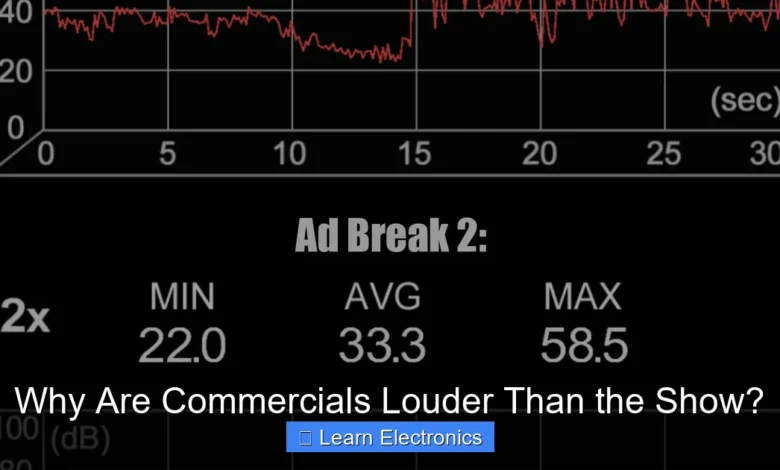
Why Are Commercials Louder Than the Show? The perception of increased volume during advertisements is primarily due to sophisticated audio engineering techniques like dynamic range compression and the normalization of perceived loudness, rather than a simple increase in raw decibel peaks. This practice is primarily designed to make ads cut through the surrounding programming, ensuring their message is heard clearly by viewers. Understanding this phenomenon requires delving into the science of sound and the strategies behind broadcast audio.
Quick Answers to Common Questions
Am I imagining things, or are commercials actually louder than the show?
You’re definitely not imagining it! “Why Are Commercials Louder Than the Show?” has been a common complaint because ads were often mixed to sound much louder and more attention-grabbing than the main program.
So, why do they make commercials so much louder? Is it intentional?
Yes, it often was intentional! Advertisers aimed to cut through the noise and grab your attention during breaks, using audio compression and mixing techniques to make their spots sound consistently loud and impactful.
Is there anything being done about why commercials are louder than the show?
Good news! In the US, the CALM Act was passed to address this very issue. It helps regulate commercial loudness, requiring broadcasters to keep ad volumes more in line with the surrounding programming for a smoother viewing experience.
📑 Table of Contents
The Science of Sound: Loudness vs. Peak Volume
To truly grasp why commercial breaks often feel significantly louder, it’s essential to differentiate between peak volume and perceived loudness. Most people intuitively associate “louder” with a higher number on a volume dial, but in audio engineering, the reality is more nuanced. A short, sharp burst of sound might register a high peak decibel (dB) level, but if it lacks sustained energy, it won’t be perceived as consistently loud. Conversely, a sound with a lower peak but a much more consistent, dense sound profile can feel much more impactful and ‘louder’ to the human ear.
Peak vs. Perceived Loudness (LUFS)
Traditional volume meters measure peak levels, indicating the absolute highest point a sound wave reaches. However, human hearing doesn’t process sound in this instantaneous way. Our perception of loudness is an integration over time and across frequencies. This is where the concept of Loudness Units Full Scale (LUFS) or Loudness Units (LU) comes into play. LUFS is a standardized unit that measures perceived loudness, taking into account how the human ear responds to different frequencies and durations of sound. Audio engineers use LUFS to ensure a consistent listening experience across various content, aiming for a specific “target loudness.”
When content is mastered to a specific LUFS target, it means that its average perceived loudness will be consistent. The goal is to prevent listeners from constantly adjusting their volume controls. While TV shows and movies aim for a broader dynamic range, allowing for quiet dialogue and dramatic explosions, commercials are often engineered to maintain a very consistent, high perceived loudness level throughout their short duration.
The Role of Dynamic Range
Dynamic range refers to the difference between the quietest and loudest parts of an audio signal. TV shows and films often utilize a wide dynamic range to create dramatic effect. A hushed conversation can be followed by an intense action sequence, with a significant difference in volume levels. This wide range contributes to a more immersive and realistic viewing experience.
Commercials, however, typically employ a very narrow dynamic range. Advertisers want every single word and sound effect in their 15-30 second spot to be crystal clear and command attention. They don’t have time for subtle buildups or quiet moments. By reducing the dynamic range, engineers effectively bring up the level of the quieter sounds, making the overall average loudness much higher, even if the absolute peak decibel level doesn’t exceed that of the surrounding program. This technique is central to the answer for Why Are Commercials Louder Than the Show? from a technical standpoint.
The Broadcaster’s Arsenal: Dynamic Range Compression
The primary audio engineering technique responsible for the heightened perceived loudness of commercials is dynamic range compression. This process is a fundamental tool in audio production, used to reduce the difference between the loudest and quietest parts of an audio signal, thereby making the overall sound more uniform and often, louder.
How Compression Works
An audio compressor works by automatically turning down the volume of sounds that exceed a certain threshold and, often, simultaneously boosting the volume of the entire signal. Imagine a human fader operator constantly adjusting the volume to keep it within a tight range. A compressor does this electronically and extremely quickly.
- Threshold: The level at which the compressor starts to act.
- Ratio: How much the sound is turned down once it exceeds the threshold (e.g., a 4:1 ratio means for every 4 dB the sound goes over the threshold, it’s only allowed to increase by 1 dB).
- Attack/Release: How quickly the compressor reacts to a sound crossing the threshold (attack) and how quickly it stops compressing once the sound falls below the threshold (release).
- Make-up Gain: After reducing the peaks, the entire signal is often boosted in volume, which is where the significant increase in overall perceived loudness comes from.
By heavily compressing commercials, audio engineers can ensure that every element – dialogue, music, sound effects – is consistently loud and clear, grabbing attention from the first second to the last. This extreme form of audio leveling makes ads sound “in your face” compared to the more nuanced audio mix of a typical TV program.
The Goal: Cutting Through the Noise
The strategic application of heavy compression in advertising is a deliberate choice driven by commercial objectives. Advertisers want to maximize the impact of their brief window of airtime. They know that viewers might be distracted, talking, or even leaving the room during commercial breaks. A consistently loud and dynamically narrow sound profile ensures that the advertisement stands out, catches the ear, and delivers its message effectively, even if the viewer isn’t actively paying full attention.
This technique creates a sense of urgency and importance, compelling viewers to listen. While some might find this intrusive, from a purely marketing perspective, this approach is highly effective in achieving maximum auditory presence in a competitive soundscape. It’s a key part of the answer to Why Are Commercials Louder Than the Show? from a strategic perspective.
Regulatory Landscape and Consumer Protection
The issue of overly loud commercials has been a long-standing point of frustration for television viewers worldwide. This widespread annoyance eventually led to legislative action and the establishment of industry standards aimed at mitigating the problem.
The CALM Act and International Standards
In the United States, public outcry led to the passage of the Commercial Advertisement Loudness Mitigation (CALM) Act in 2010. This law mandated that television commercials must have the same average loudness as the programs they accompany. The CALM Act specifically adopts the Advanced Television Systems Committee (ATSC) A/85 Recommended Practice, which utilizes the LUFS measurement standard.
Similar regulations and recommended practices exist in other parts of the world. For instance, the European Broadcasting Union (EBU) has its R 128 recommendation, which also uses LUFS to standardize broadcast loudness. These standards aim to ensure that broadcasters maintain a consistent loudness level across all content, including commercials, preventing the jarring volume spikes that once plagued viewers.
Challenges and Perceived Loopholes
Despite the CALM Act and similar regulations, many viewers still perceive commercials as being louder. Several factors contribute to this persistent perception:
- Reference Loudness: The CALM Act requires commercials to match the average loudness of the program they accompany. If a show’s quiet moments bring down its average loudness, a commercial with a consistently high, but compliant, average loudness can still feel louder.
- Speech vs. Music/SFX: The human ear is particularly sensitive to speech frequencies. If a commercial has a very dense and prominent speech track throughout, even if its overall LUFS is compliant, it might sound more “in your face” than a dramatic scene with sparse dialogue and a wide dynamic range.
- Home Audio Setups: Viewer perception can also be influenced by their home audio system. Some soundbars or TV speakers might process audio in a way that accentuates the compressed, dense sound of commercials.
- The “Loudness War” in Advertising: While regulations provide a ceiling, advertisers and audio engineers still push the boundaries of what sounds maximally impactful within those limits. They meticulously craft every second to be as attention-grabbing as possible.
Therefore, while regulatory bodies have made significant strides, the technical intricacies of audio perception and the strategic goals of advertisers mean that the sensation of “louder commercials” remains a common experience for many.
The Psychological Impact and Advertising Strategy
Beyond the technical reasons, the strategic intent behind crafting loud commercials plays a significant role in their design. Advertisers leverage psychological principles to ensure their messages resonate, even if briefly, with viewers.
Grabbing Attention
In a world saturated with media, capturing and holding viewer attention is paramount. A sudden increase in perceived loudness acts as an auditory jolt, momentarily disrupting the passive viewing experience and directing focus towards the screen. This initial attention grab is crucial for advertisers who have only a few seconds to make an impression.
The high average loudness also helps commercials stand out in noisy environments or when viewers are engaged in other activities. Whether someone is in another room or simply talking during a break, the increased auditory presence of a commercial makes it harder to ignore completely. This aggressive sound design is a calculated move to break through the apathy often associated with commercial breaks.
The Repetition Factor and Message Reinforcement
Commercials are often designed for repeated viewing. By making them consistently loud and clear, advertisers ensure that their brand name, jingle, or key message is delivered with maximum clarity every single time. The narrow dynamic range means that no part of the message gets lost in background noise or quiet moments, contributing to better recall.
This approach reinforces the message through sheer auditory presence, contributing to brand recognition and recall. Even if viewers consciously dislike the loudness, the message might still seep into their subconscious, affecting future purchasing decisions. This psychological aspect underscores the persistent use of these audio techniques, regardless of viewer annoyance.
| Content Type | Typical Target Loudness (LUFS) | Dynamic Range (dB) | Primary Goal |
|---|---|---|---|
| Feature Film (Cinema Mix) | -27 to -24 | 15-20+ | Immersive cinematic experience, emotional impact |
| TV Show (Drama/Comedy) | -24 | 8-12 | Balanced narrative, clear dialogue, dramatic range |
| Television Commercial | -24 to -23 (post-CALM) | 2-5 | Maximum auditory presence, attention-grabbing |
| Streaming Service (Film/TV) | -24 (often -27 for films) | 8-15+ | Consistent experience across devices |
| Music (Radio/Pop Mix) | -9 to -6 | 2-4 | Maximized loudness for competitive playback |
What Can You Do? Practical Tips and Future Outlook
While broadcasters and advertisers adhere to regulations, the perception of loud commercials persists. Fortunately, there are several steps you can take to improve your viewing experience.
Engaging Your TV’s Settings
Many modern televisions and audio receivers come equipped with features designed to combat inconsistent volume levels:
- Automatic Volume Leveling/Loudness Management: Look for settings like “Auto Volume,” “Volume Leveling,” “Dynamic Volume,” or “Night Mode” in your TV’s audio menu. These features attempt to automatically reduce the dynamic range of incoming audio, keeping overall volume more consistent. While they can sometimes flatten the sound of regular programming, they are effective at taming overly loud commercials.
- Dynamic Range Compression (DRC) Settings: Some home theater receivers offer explicit DRC settings. Activating this can help.
- Soundbar/AV Receiver Features: If you use external audio equipment, check its specific settings. Many soundbars and AV receivers have their own versions of loudness leveling or dialogue enhancement that can help create a more uniform listening experience.
Experimenting with these settings can significantly reduce the jarring effect of commercial breaks without requiring constant manual volume adjustments.
The Future of Broadcast Audio
As technology evolves, so too do the standards and capabilities of broadcast audio. The shift towards object-based audio formats like Dolby Atmos and DTS:X in home entertainment offers new possibilities for personalized listening. While primarily focused on immersive sound, these technologies could eventually provide more granular control over different audio elements, potentially allowing viewers to customize their experience and, perhaps, dampen the prominence of commercials.
Furthermore, increased consumer awareness and continued regulatory pressure will likely lead to even more stringent adherence to loudness standards and potentially the development of new technologies that balance advertiser needs with viewer comfort. The ongoing debate around Why Are Commercials Louder Than the Show? continues to shape how content is mixed and delivered in the digital age.
Conclusion
The phenomenon of commercials sounding louder than the programs they interrupt is not a figment of our imagination, nor is it typically a violation of peak volume limits. Instead, it is a deliberate and sophisticated application of audio engineering principles, primarily dynamic range compression, designed to maximize the perceived loudness and impact of advertising messages within strict time constraints. While regulations like the CALM Act have certainly curbed the most egregious abuses, the clever manipulation of perceived loudness through narrow dynamic range ensures that advertisements continue to command attention.
Understanding the interplay between peak volume, perceived loudness (LUFS), and dynamic range compression sheds light on this persistent issue. As viewers, we can utilize our TV’s built-in audio settings to mitigate the jarring effect, while the industry continues to evolve its standards and technologies. Ultimately, the quest for auditory dominance in advertising ensures that the battle for our attention, and our ears, will likely continue for the foreseeable future.
Frequently Asked Questions
Why do commercials seem louder than the program I’m watching?
Commercials often use dynamic range compression, which makes the quietest parts louder and the loudest parts less dynamic. While the peak volume might be the same as the show, this compression raises the average loudness, making the entire advertisement feel more impactful and attention-grabbing. Your brain perceives this consistent, higher average volume as “louder.”
Is there a technical reason why commercials are louder?
Yes, the primary technical reason is audio compression, specifically dynamic range compression. This process reduces the difference between the loudest and quietest sounds in the commercial, making everything consistently loud. This manipulation ensures the advertisement cuts through background noise and maintains high audibility, even if viewers are not paying full attention.
What regulations are in place to prevent commercials from being louder?
In the United States, the CALM Act (Commercial Advertisement Loudness Mitigation Act) was passed in 2010. This law requires broadcasters and pay-TV providers to ensure the average loudness of commercials doesn’t exceed the average loudness of the programming they accompany. Similar regulations exist in other countries to address this common complaint.
Does the CALM Act actually work to stop commercials being louder?
The CALM Act has had some success in reducing peak loudness, preventing extremely jarring volume spikes. However, its effectiveness is debated, as commercials still often *feel* louder due to dynamic range compression and the focus on average loudness. This issue often persists, especially on streaming services not covered by the act.
Are networks intentionally making commercials louder to grab my attention?
Yes, broadcasters and advertisers often use perceived loudness as a tactic to capture and hold viewer attention. In a competitive media landscape, a consistently loud commercial is designed to cut through background noise and prevent channel surfing, ensuring their message is heard and stands out during ad breaks. It’s a deliberate psychological strategy.
How can I reduce the perceived loudness of commercials?
You can try manually adjusting your TV’s volume during ad breaks, though this can be inconvenient. Many modern televisions and audio receivers also have built-in “dynamic range compression” or “night mode” settings that can help normalize volume levels. Enabling these features might reduce the dramatic swings between show content and commercials.
As an Amazon Associate, I earn commission from qualifying purchases.