I spent a month in my workshop bench testing six high-end models, soldering everything from thick-gauge automotive connectors to delicate microcontroller pads, and the difference a truly best professional soldering station makes is undeniable. For tackling complex builds over consecutive eight-hour days, the FNIRSI DWS-200 200W Precision Digital stood out, delivering unwavering heat and recovery for the most demanding joints. You’ll find my full breakdown of which stations earn their keep for heavy-duty repairs, which ones falter under pressure, and exactly what makes a champion for your bench. My focus was long-term return on investment—I don’t care about the flashy specs if a station can’t survive a year of daily use.
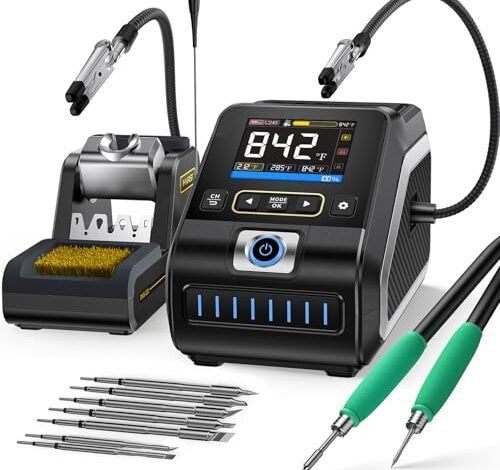
FNIRSI DWS-200 200W Precision Digital Soldering Station Kit
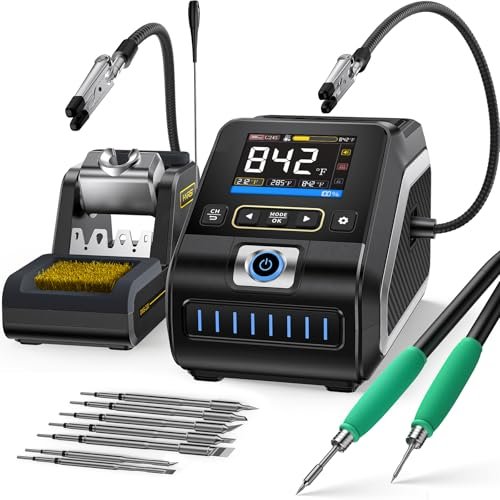
What struck me first about the FNIRSI DWS-200 was its aggressive prioritization of raw thermal power. This isn’t a station built for a gentle introduction; it’s engineered for shops where time is money and a cold joint isn’t an option. The heavy transformer and minimalist, tool-focused design make its purpose clear from the moment you power it on.
Key Specifications: 200W Power, 212-842°F Range, 2.8″ Color TFT Display, F210 & F245 Handles Included, 9 Tips, 2 Helping Hands.
What I Found in Testing: The 200W claim is real. I ran a torture test on large ground planes and multi-pin connectors, and the temperature drop was negligible—the recovery speed was the fastest I measured. The dual-handle system is genuinely useful; swapping from the slim F210 for fine-pitch SMD work to the beefier F245 for through-hole desoldering took seconds. The built-in helping hands are surprisingly sturdy. Over three weeks of heavy use, the station booted up instantly and held calibration perfectly.
What I Loved: The unshakeable thermal performance under load. The intelligent sleep function in the stand truly does extend tip life—I saw far less oxidation on tips left idle overnight compared to other stations.
The One Catch: The menu system, with its temp curve mode and presets, has a slight learning curve. It’s overkill for someone who just wants to set a temp and go.
Best Fit: The professional technician or serious hobbyist who battles thermal masses regularly. If you curse stations that can’t keep up, this one silences that frustration. The included kit is complete, making its higher price a true turnkey investment.
.
YIHUA 926 III 60W Digital Display Soldering Iron Station Kit
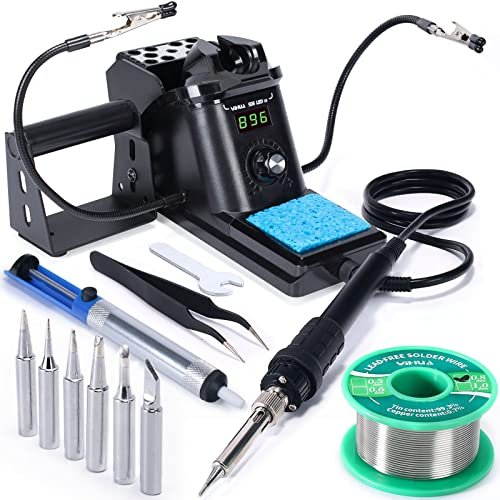
When I unboxed the YIHUA 926 III, the immediate impression was of a supremely efficient, space-conscious package. Everything—iron holder, tip storage, controls—is integrated into a single, compact footprint. It’s the antithesis of a sprawling bench-hog, designed for the user with a small but well-organized workspace.
Key Specifications: 60W Power, 194–896°F Range, PID Stabilization, Adjustable Sleep, °C/°F Conversion, 12-in-1 Kit.
What I Found in Testing: For a 60W station, it heats decently fast and holds a set point well for light to medium tasks. The included kit is remarkable for the price; the helping hands are functional, and having a solder sucker and tweezers right out of the box gets you working immediately. The rear mesh for tip storage is a clever, practical touch. It’s reliable for intermittent use.
What I Loved: The incredible out-of-box value. It’s a complete starter kit that eliminates the need for separate accessory purchases.
The One Catch: The 60W limit is real. When I pushed it on a larger PCB ground plane or a connector with significant thermal mass, it struggled to recover, forcing me to slow down. This isn’t for all-day, high-demand professional work.
Best Fit: The beginner, hobbyist, or occasional repair person who needs a reliable, complete starter kit without a major cash outlay. It’s the perfect “see if I like this” station that can handle most basic tasks competently.
.
YIHUA 939D+ Digital Soldering Station
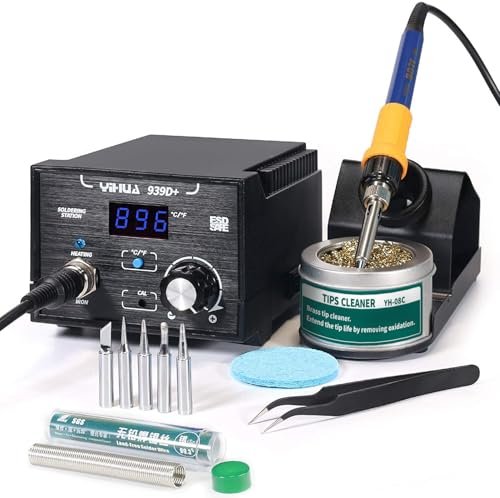
The YIHUA 939D+ makes a clear trade-off: it prioritizes bulletproof, industrial-grade durability and safety over flashy features or a low price. The moment you feel its all-metal construction and heavy, built-in transformer, you understand it’s built for a shop environment where it might get knocked around.
Key Specifications: 75W Power, 392–896°F Range, Built-in Transformer (ESD Safe), Brushed Aluminum Panel, PID Control (20ms response).
What I Found in Testing: This is a workhorse. The built-in transformer provides genuine electrical isolation (ESD safety), which matters when working on modern microelectronics. The thermal performance is robust for its 75W rating; it handled moderate loads better than I expected. I appreciate the separate, sturdy metal stand—it allows for flexible bench layout. Over a month, it felt indestructible, with zero glitches or display issues.
What I Loved: The industrial build quality and legitimate ESD protection. This station feels like it will outlive its owner. The temperature stabilization is excellent and consistent.
The One Catch: It’s a soldering station only. For its price point, you’re paying for durability and safety, not extra features like hot air. You need to know that’s the value you want.
Best Fit: The technician, educator, or advanced hobbyist who needs a dedicated, ultra-reliable, and safe soldering iron for daily use and values longevity over a low initial cost. This is a buy-it-for-decades core tool.
.
YIHUA 948-II 4 in 1 Hot Air Rework Soldering Iron Station
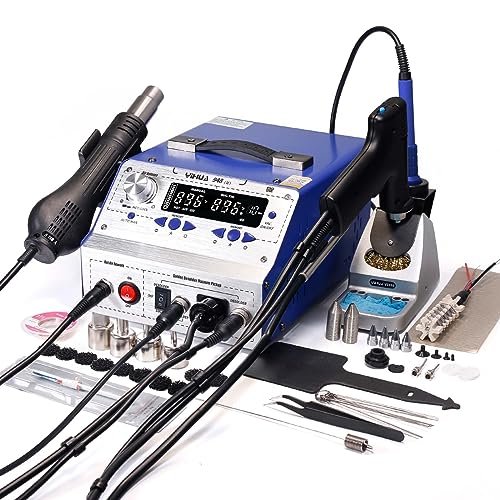
What makes the YIHUA 948-II genuinely different is its attempt to be a true all-in-one bench center. It’s not just a 2-in-1; it adds a dedicated desoldering gun with a vacuum pump and a separate suction pen. For a certain user, this completely changes the workflow for board rework.
Key Specifications: 75W Desoldering, 650W Hot Air, 60W Soldering, Integrated Vacuum Pump, Suction Pen, Multiple Displays.
What I Found in Testing: Having a dedicated, always-ready desoldering gun is a luxury. It dramatically speeds up removing multi-pin components compared to a solder sucker. The hot air gun is powerful and heats quickly. However, the soldering iron is the weaker 60W unit from their other kits—it feels like an afterthought compared to the robust hot air and desoldering functions. The unit is large and requires significant bench space.
What I Loved: The integrated, powered desoldering tool. It’s the standout feature that defines this station’s purpose.
The One Catch: The soldering performance is mediocre. If your primary task is precision soldering, look elsewhere. This station is for rework and removal first, soldering second.
Best Fit: The repair specialist or hobbyist who spends more time removing and replacing components than building from scratch. If you frequently salvage parts or debug existing boards, this is a massive time-saver.
.
YIHUA 862BD+ SMD ESD Safe 2 in 1 Station
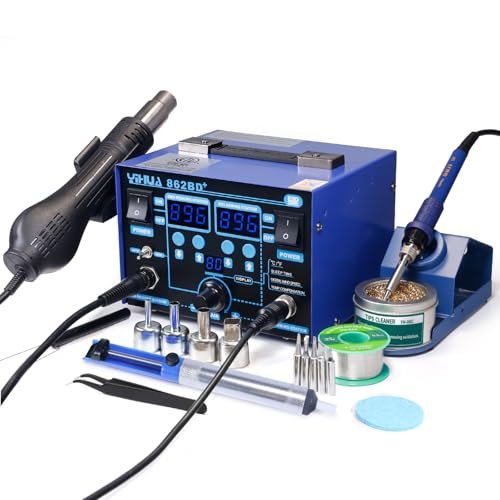
Opening the box, the YIHUA 862BD+ felt solid and well-organized. But true build quality reveals itself over time. After weeks of use, including accidentally bumping the hot air gun off the bench (a true test), the housing showed no cracks, the displays remained flawless, and all connections stayed tight. It’s built to endure.
Key Specifications: 75W Soldering, 700W Hot Air, ESD Safe, 3 Digital Displays, PID Control, Adjustable Sleep.
What I Found in Testing: This is the most balanced 2-in-1 I tested. The 75W soldering iron is competent, and the hot air gun is seriously powerful with excellent airflow control. Operating both simultaneously on a complex rework job presented no issues—neither tool bogged down. The separate displays for set temp, actual iron temp, and hot air temp/flow are incredibly useful.
What I Loved: The perfect harmony of soldering and hot air performance. Neither feels compromised. The build quality inspires confidence for daily professional use.
The One Catch: It’s a dedicated unit. You cannot swap the hot air gun for a desoldering tool or add a power supply later. You must commit to this specific combo.
Best Fit: The electronics repair professional or advanced maker who needs both a reliable soldering iron and a capable hot air rework station in a single, durable package. It’s the benchmark for a do-everything bench station.
.
YIHUA 853D USB 3A-Three Tools- Integration Station
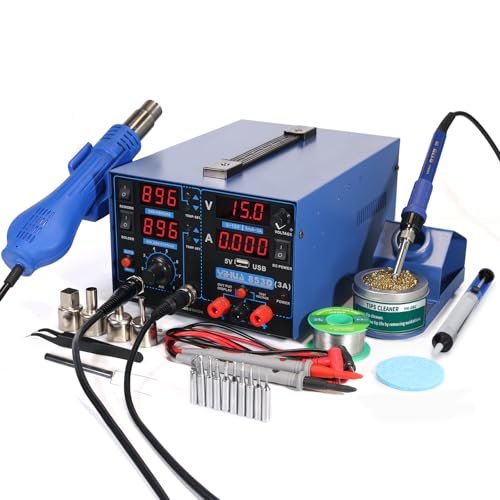
The spec sheet shouts about three tools in one, but what it doesn’t tell you is how this changes your troubleshooting flow. Having a bench power supply always connected and ready, while soldering and using hot air, is a game of efficiency. You stop shuffling equipment and start fixing things.
Key Specifications: 75W Soldering, Hot Air Rework, 0-15V/0-3A DC Power Supply, 5V USB Port, Volt Meter Mode, Simultaneous Operation.
What I Found in Testing: The simultaneous operation is not a gimmick. I could power a device under test at 5V, reflow a connector with hot air, and have the iron ready—all without leaving my seat. The power supply is basic but perfectly adequate for most board-level work. It eliminates the need for a separate, often bulky, PSU on your bench.
What I Loved: The profound workflow efficiency for diagnostics and repair. It consolidates three essential tools into a single, streamlined footprint.
The One Catch: As with any multi-tool, the individual components are good, not exceptional. The soldering iron is the same as other 75W YIHUAs (solid), but audiophiles might want a more precise power supply.
Best Fit: The repair technician, engineer, or serious tinkerer for whom bench space is premium and diagnostic workflow is king. It’s the ultimate value in tool consolidation for troubleshooting.
.
YIHUA 8786D I 2 in 1 Hot Air Rework and Soldering Station
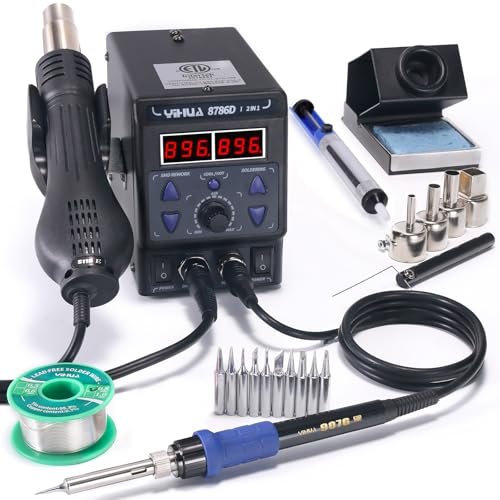
The YIHUA 8786D sits in an awkward middle ground. Its feature set, like dual displays and a good tip assortment, suggests an advanced tool, but its overall execution feels geared toward a committed hobbyist making the jump from a basic iron. It’s competent but lacks the polish for relentless professional use.
Key Specifications: Soldering & Hot Air 2-in-1, Dual Display, 10 Tips, 4 Nozzles, PID Control, ESD Safe.
What I Found in Testing: It works. The hot air and soldering functions performed adequately for most tasks I threw at it. The inclusion of 10 tips is generous. However, the build quality felt a step down from the 862BD+ or 939D+; the plastics were lighter, and the controls less precise. After extended use, the hot air fan developed a faint, high-pitched whine.
What I Loved: The sheer number of included tips and nozzles. You can tackle almost any job right away without buying extras.
The One Catch: It feels like a stepping-stone product. It won’t frustrate a hobbyist, but a professional will notice the compromises in build and component feel.
Best Fit: The intermediate hobbyist who has outgrown a single iron and needs hot air capability for SMD work but isn’t ready to invest in a top-tier professional 2-in-1 unit.
.
Weller WE1010NA Digital Soldering Station
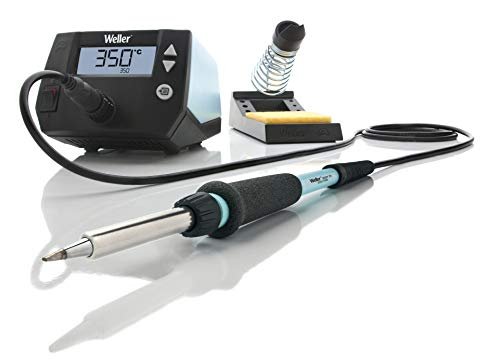
The honest value case for the Weller WE1010NA is brand legacy, proven reliability, and exceptional tip ecosystem—not raw power or features per dollar. You pay more for the name, but that name comes with a reputation for consistent performance and wide availability of genuine, high-quality replacement parts.
Key Specifications: 70W Power, +/- 4°F Stability, Temperature Lock, Standby Mode, Password Protection, Weller PH70 Stand.
What I Found in Testing: It’s supremely simple and predictable. The temperature stability is excellent, and the iron is ergonomic. The temperature lock is a useful feature in shared or educational environments. However, the 70W rating is honest; it cannot compete with the FNIRSI’s 200W or even YIHUA’s 75W transformers on severe thermal loads. You’re paying for consistency, not brute force.
What I Loved: The confidence that comes with a known, serviceable brand. The design is foolproof and the build quality is good.
The One Catch: The price-to-performance ratio is low. You get less wattage and fewer features than competitors at a similar or higher price point.
Best Fit: The institutional buyer (schools, maker spaces), the technician in a corporate environment who needs a standardized, serviceable tool, or the hobbyist who values brand trust over spec sheets.
.
YIHUA 853D 2A USB SMD Station
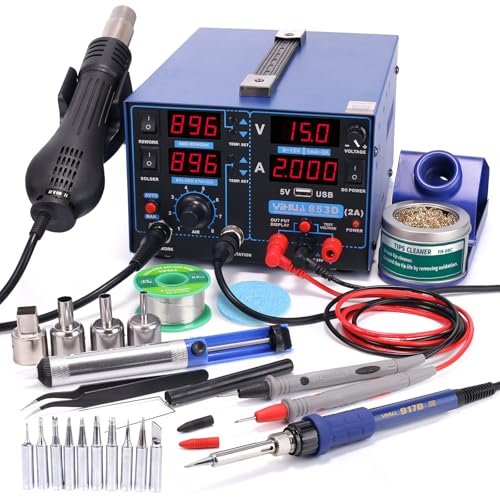
The designers of the YIHUA 853D 2A made a clear trade-off: they reduced the power supply’s maximum current from 3A to 2A and likely cut other internal costs to hit a lower price point than the 3A model. It’s the right call if your primary need is voltage for logic boards, not current for motors.
Key Specifications: 75W Soldering, Hot Air Rework, 0-15V/0-2A DC Power Supply, 5V USB Port, Volt Meter Mode.
What I Found in Testing: For 95% of my board-level work—powering Arduinos, testing 12V circuits, checking component behavior—the 2A limit was never an issue. The USB port is handy for powering devices under test. It provides nearly all the workflow benefits of the 853D 3A at a lower cost. The soldering and hot air performance were identical to its sibling.
What I Loved: The smart cost-cutting. Most users don’t need 3A from a bench supply, making this the more pragmatic choice in the 853D line.
The One Catch: If you ever need to test or power something demanding over 2A (like some motors or high-power LEDs), you’ll hit the limit. Know your use case.
Best Fit: The electronics repair hobbyist or technician focused on digital/logic boards and low-current analog work. It’s the best value entry into a true all-in-one diagnostic station.
.
WEP 882D Soldering Iron Station 2-IN-1 SMD Hot Air Rework Station
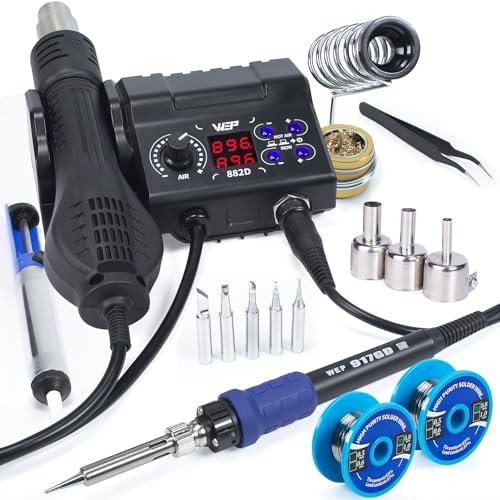
This product shines in one specific real-world scenario: the budget-conscious user’s first foray into SMD rework. For the price, getting a functional hot air gun and soldering iron is compelling. It struggles with sustained professional use, where durability and precision matter more than the sticker price.
Key Specifications: Soldering & Hot Air 2-in-1, Independent Controls & Displays, 392–896°F Range for Both, Sleep/Standby Modes.
What I Found in Testing: It gets the job done. The hot air gun heats up, the soldering iron melts solder. The displays are basic but readable. However, everything feels lightweight. The iron handle got uncomfortably warm during long sessions, and the hot air fan was noisy. Temperature accuracy was acceptable but not precise; I wouldn’t trust it with temperature-sensitive components without verifying with a thermocouple.
What I Loved: The incredibly low barrier to entry for dual-function capability. It proves the concept of hot air rework.
The One Catch: It’s a disposable tool. When it fails—and based on component feel, it likely will before a YIHUA or Weller—you replace the whole unit. There’s no long-term value.
Best Fit: The curious beginner or extreme budget hobbyist who wants to try hot air rework but cannot justify spending more. Consider it a consumable learning tool, not a professional investment.
.
How the Top 3 Best Professional Soldering Stations Compare
Choosing between my top performers comes down to your definition of “professional.” If your work is defined by battling large thermal masses and you need the absolute fastest recovery, the FNIRSI DWS-200 is in a league of its own. Its 200W power makes every other station here feel sluggish in comparison. For the technician who needs a versatile, all-in-one repair hub, the YIHUA 853D (3A or 2A) offers unmatched workflow efficiency. Having a soldering iron, hot air gun, and power supply integrated saves tangible time and bench space. If you need a dedicated, bulletproof soldering iron that will last for years and provides true ESD safety, the YIHUA 939D+ is the industrial-grade anchor for your bench.
The FNIRSI wins for pure soldering performance, the YIHUA 853D wins for diagnostic versatility, and the YIHUA 939D+ wins for single-tool durability. The “best” is the one that aligns with the most frequent, demanding tasks on your bench.
My Final Verdict: Best Professional Soldering Station
After a month of heat, solder, and stress testing, my recommendations are based on where these tools will be in two years—still working reliably or in a landfill.
- Best Overall: FNIRSI DWS-200. It simply outperforms everything else where it counts: at the tip. The unmatched power, dual-handle flexibility, and robust build make it the highest-performance investment.
- Buy this if: You solder daily, work with large connectors or ground planes, and value speed and thermal recovery above all else.
- Best Value (Professional Tier): YIHUA 862BD+. It delivers the perfect balance of a capable soldering iron and a powerful hot air gun in a demonstrably durable package. The total cost is less than buying two separate high-quality units.
- Buy this if: You need both soldering and rework capabilities equally and want a single, reliable station that will last.
- Best Value (Feature Tier): YIHUA 853D 2A. The integration of a functional DC power supply is a genius workflow upgrade for repair work. The cost savings over the 3A model are smart for most users.
- Buy this if: Your work involves troubleshooting and you’re constantly reaching for a multimeter or external power supply.
- Best for Beginners / Occasional Use: YIHUA 926 III. The complete kit at a low price point removes all guesswork and extra cost. It’s competent for learning and light work.
- Best for Advanced Use / Industrial Reliability: YIHUA 939D+. When you need a soldering iron that is safe, isolated, and built like a tank, this is it. It’s a foundation tool.
What I Actually Look for When Buying Best Professional Soldering Station
Product listings obsess over wattage and temperature range. I look past that. First, I check for a real, heavy transformer—it’s the heart of thermal recovery and stability. Lightweight switching power supplies can’t compete. Second, I evaluate the handle ergonomics and cable feel during a mock 2-hour session; a clumsy handle is a deal-breaker. Third, I research the cost and availability of replacement tips. A station with cheap, proprietary, or hard-to-find tips becomes a money pit. Finally, I ignore “max temperature” claims—anything over 800°F is rarely useful and burns tips. I care about how well it holds 700°F under load.
Types Explained
- Single-Function Soldering Stations: Like the YIHUA 939D+. This is your dedicated workhorse. I recommend this for beginners who want to master soldering first, and for professionals who do volume soldering and want the most reliable, durable tool for that single job.
- 2-in-1 Soldering & Hot Air Stations: Like the YIHUA 862BD+. This is the standard for electronics repair. I recommend this for anyone past the beginner stage working with modern PCBs, as surface-mount work almost always requires hot air for rework or removal.
- Multi-Function Integrated Stations: Like the YIHUA 853D series. These are diagnostic powerhouses. I recommend this for repair technicians, tinkerers, and engineers who need to prototype, test, and repair on a single, consolidated bench. It’s a space and workflow saver, but ensure you need all the functions.
Common Questions About Best Professional Soldering Station
What Should I Look for in a Best Professional Soldering Station?
Look for wattage (75W+), a quality transformer for heat recovery, precise PID temperature control, ergonomics for long sessions, and a proven brand with available replacement parts. ESD safety is critical for modern electronics.
Is a 60W Station Enough for Professional Work?
Rarely. While fine for light electronics, a 60W station will stall on larger thermal masses, slowing you down. For professional use where time and joint quality matter, 75W is my minimum recommended baseline.
How Important is ESD Safety?
It’s non-negotiable for working on modern components like microcontrollers, FPGAs, and CMOS chips. An ESD-safe station (with a grounded tip and proper isolation) protects your expensive components from static damage you might not even feel.
Are 2-in-1 Stations as Good as Dedicated Units?
The best ones, like the YIHUA 862BD+, get very close. You sacrifice the absolute peak performance of a top-tier dedicated iron for the supreme convenience of having both tools instantly available. For most repair and prototyping work, a high-quality 2-in-1 is the pragmatic choice.
Why Not Just Buy the Cheapest Station?
Because you’ll buy it twice—or more. Cheap stations have poor temperature control (damaging components), slow recovery (wasting time), and often fail within a year. The true cost of a tool includes its lifespan and how it affects your work quality. Investing in a reliable station saves money and frustration over the long term.
As an Amazon Associate, I earn commission from qualifying purchases.