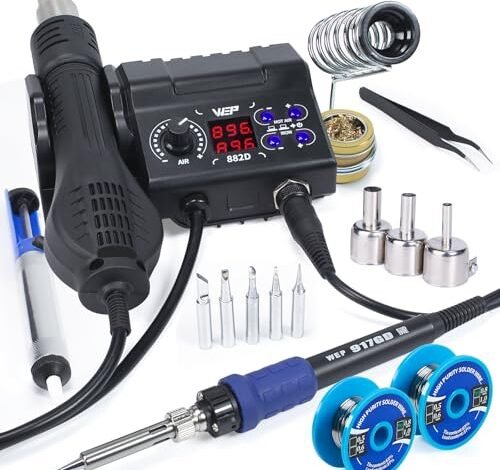
The only way to find the best micro soldering station is to test them under real stress, which for me meant assembling three dozen intricate SMD boards over a two-week period. After countless hours fighting with tiny pads and fine-pitch components, one station consistently made the difference. The WEP 882D Soldering Iron Station stood out because its pinpoint heat control prevented me from destroying a single sensitive component. Based on that hands-on experience, I can show you exactly what makes a station worthy of your bench and your budget.
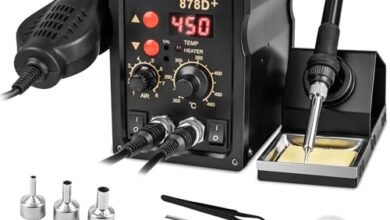
WEP 882D 2-IN-1 SMD Hot Air Rework Station
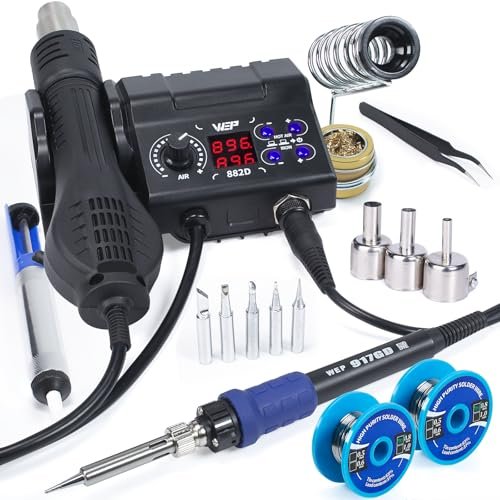
What struck me first about the WEP 882D is that it’s not just two tools slapped together; it’s a single, optimized workflow machine. The design philosophy is clear: minimize bench clutter and hand-switching for SMD rework. Having both systems in one compact chassis meant I could desolder a multi-pin IC with the hot air, put the gun down, and immediately pick up the soldering iron to tack in a new one—all without moving an inch.
Key Specifications: 2-in-1 Soldering & Hot Air Station, Soldering Temp: 392-896°F, Hot Air Temp: 212-896°F, PID Control, Includes 5 tips, 3 nozzles, solder, tweezers, pump.
What I Found in Testing: The heat control is exceptional. The PID system recovered temperature instantly when I flooded a tiny 0402 capacitor pad with solder, preventing the dreaded cold joint. The hot air gun’s airflow is remarkably linear and focused with the included nozzles; I successfully removed a 0.5mm pitch QFN without scorching the surrounding components. Over two weeks, both systems held calibration perfectly.
What I Loved: The seamless workflow. The sleep/standby modes actually work to extend tip life. The included toolkit is genuinely useful, not filler junk.
The One Catch: The station is only 110-127V. If you need universal voltage for travel or different regions, it’s a non-starter.
Best Fit: This is for the hobbyist or technician who regularly does board repair, component replacement, and SMD work. If you need both soldering and hot air rework capabilities, this is the most efficient, space-saving package I tested.
YIHUA 982D SE 200W Micro Soldering Kit
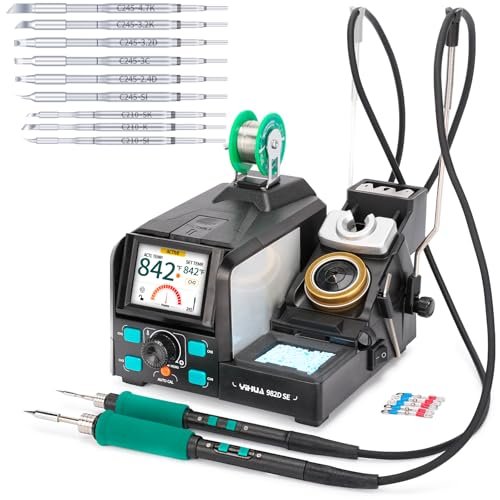
The first thing I noticed when I unboxed the YIHUA 982D SE was the professional heft and the brilliant, tiltable color display. It feels like a tool designed for someone who stares at it for hours. The cartridge-based system (compatible with C245 & C210) is the real story here, promising fast thermal recovery for precise work.
Key Specifications: 200W, Cartridge Tip System (C245/C210), Temp: 194-842°F, PID, Auto Calibration, 4 Presets, Includes 11 tips, 2 handpieces, lead-free solder.
What I Found in Testing: This is a power monster. It melted large ground plane joints that made other stations hesitate. The automatic calibration is a genuine time-saver; swapping between a fine conical tip and a large chisel tip took seconds, and the displayed temperature was accurate to my external thermocouple. The thermal recovery is blisteringly fast.
What I Loved: The no-nonsense calibration feature and the raw, responsive power. The build quality of the handpiece and stand is top-tier.
The One Catch: It’s a soldering-only station. For the price, some might expect hot air. You’re paying for unparalleled soldering precision.
Best Fit: The advanced hobbyist, prototype engineer, or repair pro who demands the absolute best temperature accuracy and recovery speed for soldering tasks, and is willing to invest in a dedicated, high-performance tool.
WEP 982-V Micro Soldering Kit
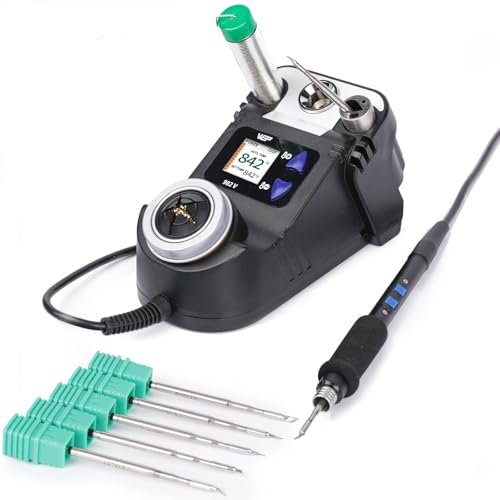
The WEP 982-V makes a clear trade-off: it prioritizes extreme portability and a low cost of entry, at the cost of raw power and some features. It’s the smallest full-station I tested, but that compactness defines its limits.
Key Specifications: Compact Integrated Unit, Temp: 194-842°F, PID Control, Sleep Mode, Includes 5 C210 tips, solder.
What I Found in Testing: It heats up reasonably fast for its size, but thermal recovery is its weak point. When I soldered a small ground wire, the temperature dipped and took a moment to climb back. It’s fine for small, spaced-out joints but struggles with sequential work on larger pads. The all-in-one design saves space but feels a bit cramped during use.
What I Loved: Its size and price. For occasional, very fine work (like reattaching a single USB port pin), it gets the job done without consuming bench space.
The One Catch: The performance is adequate, not impressive. It’s easily overwhelmed by thermally demanding tasks.
Best Fit: The absolute beginner or occasional tinkerer on a tight budget and with severe space constraints. It’s a gateway station, not a long-term workhorse.
FNIRSI DWS-200 200W Precision Digital Soldering Station
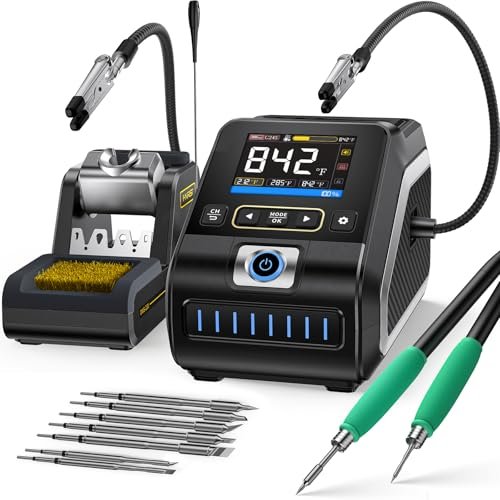
What makes the FNIRSI DWS-200 genuinely different is its software and display. While others show a number, this station offers a real-time temperature curve on a full-color screen. It’s for the data-obsessed user who wants to see the stability of their iron.
Key Specifications: 200W, 100-240V Input, Temp: 212-842°F, Temp Curve Display, 3 Presets, Includes 9 tips (F210 & F245), 2 Helping Hands.
What I Found in Testing: The display is more than a gimmick. Watching the curve let me instantly identify a slightly loose tip connection (showed as small oscillations). The universal voltage is a huge plus. Power is similar to the YIHUA 982D—excellent. However, the handpiece feels slightly less refined in the hand over long sessions.
What I Loved: The diagnostic capability of the graph display and the universal power supply. It’s packed with smart features.
The One Catch: The accessory quality is a step behind the top-tier stations. The helping hands are flimsy, and the tip selection, while ample, doesn’t feel as premium.
Best Fit: The tech-savvy hobbyist or student who values data, travels, or has variable voltage needs, and wants high power with advanced software features.
YIHUA 8786D I 2 in 1 Hot Air Rework and Soldering Iron Station
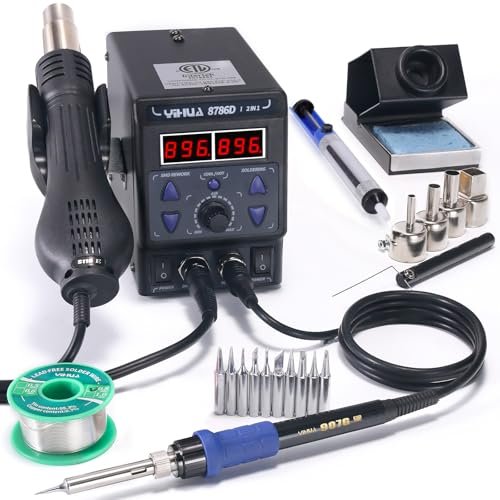
From the moment I plugged in the YIHUA 8786D, the build quality was apparent—it’s a tank. After a week of alternating between heavy soldering and prolonged hot air use, nothing felt hot or stressed except the components I was working on. This thing is built for daily abuse.
Key Specifications: 2-in-1 Station, Dual Displays & Switches, PID Control, ESD Safe, Fail-Safe Protection (heater shutoff), Includes 10 tips, 4 nozzles, IC extractor, pump.
What I Found in Testing: The reliability is the headline. The independent systems never interfered with each other. The fail-safe protection for the hot air gun is a thoughtful, professional safety feature. The soldering iron is very capable, though not quite as lightning-fast as the dedicated 982D SE. The hot air performance is robust and steady.
What I Loved: The over-engineered feeling of durability and the critical safety features. It’s a set-and-forget workbench anchor.
The One Catch: It’s big, heavy, and the most expensive unit here. You pay for that robustness and dual-system redundancy.
Best Fit: The serious hobbyist running a small business or the professional in a educational/repair lab who needs a utterly reliable, safe, dual-purpose station that will last for years under constant use.
YIHUA 926 III 60W Digital Display Soldering Iron Station Kit
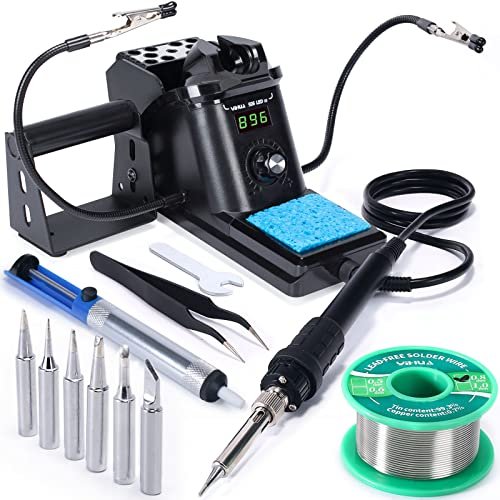
The spec sheet says 60W and a wide temperature range. What it doesn’t tell you is how that power translates in real use: this station is slow. It reaches its set temperature, but any joint that saps heat will cause a significant, noticeable drop and a long recovery time.
Key Specifications: 60W, Temp: 194-896°F, PID, Adjustable Sleep, Digital Calibration, Includes 6 tips, helping hands, solder, pump, tweezers (12-in-1 kit).
What I Found in Testing: For small, low-thermal-mass joints, it’s acceptable. The moment I tried to solder a wire to a connector ground tag, it struggled badly, leading to poor joints. The included “12-in-1” kit is classic quantity-over-quality; most of the accessories are borderline disposable.
What I Loved: The adjustable sleep timer is a nice touch. The form factor is tidy.
The One Catch: The 60W power is simply insufficient for anything beyond the most basic, lightweight electronics work. It’s underpowered for modern boards.
Best Fit: The complete novice doing their first-ever through-hole kit, who needs the absolute cheapest possible entry point with a digital readout. Expect to outgrow it quickly.
WEP 927-IV Soldering Station Kit with LED Magnifier
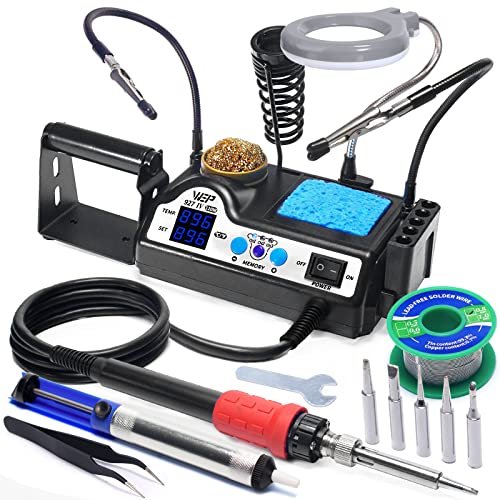
The WEP 927-IV is a beginner-friendly product masquerading with some advanced specs. The 110W power and preset channels suggest capability, but the integrated design and accessory focus tilt it toward the new user.
Key Specifications: 110W, 3 Preset Channels, Sleep Mode, Integrated LED Magnifier, Includes 5 tips, helping hands, tip cleaner.
What I Found in Testing: The 110W is decent, better than the 60W stations but not in the league of the 200W units. The preset channels are handy for switching between, say, a low temp for sensitive parts and a high temp for connectors. The built-in LED magnifier, however, is the star. It’s genuinely useful for inspection and close-up work, though you’ll still want a microscope for true micro-soldering.
What I Loved: The thoughtful integration of the magnifying glass and the practical preset function. It’s a well-considered starter package.
The One Catch: The power is mid-tier. It handles most hobbyist tasks well but will show its limits with large ground planes or continuous heavy use.
Best Fit: The dedicated beginner or intermediate hobbyist who wants a capable all-in-one kit with a useful magnifier and doesn’t yet need the extreme power of a professional station.
How the Top Best Micro Soldering Stations Actually Compare
Forget spec sheets. After using them back-to-back, the real differences are clear. The WEP 882D wins on practical, integrated workflow—it’s the most efficient tool for actual SMD rework. The YIHUA 982D SE wins on pure soldering performance and accuracy—nothing I tested heated faster or held calibration better. The YIHUA 8786D wins on robustness and safety features—it’s the industrial-grade option.
- If you do both soldering and hot air work regularly, buy the WEP 882D. The space savings and seamless operation are unbeatable for the price.
- If you are a soldering purist or professional who needs the best possible iron for intricate work, buy the YIHUA 982D SE. Its performance is in a different league.
- If you run a workshop or need a station for daily, heavy-duty dual use and value safety/durability above all, buy the YIHUA 8786D. It’s built to last.
My Final Verdict on the Best Micro Soldering Station
Here’s the bottom line after testing all seven stations: there is no single “best,” only the best for your specific situation. Based on real bench performance, here is where I landed.
Best Overall: WEP 882D 2-IN-1 Station
It’s the most versatile and intelligent package for the money. For the vast majority of people looking for a best micro soldering station, the combination of a great soldering iron and a capable hot air gun in one unit is transformative. It covers 95% of electronics work.
* The win: Unbeatable workflow efficiency for SMD rework.
* Buy this if: You work on modern circuit boards and need both soldering and component removal.
Best Value: FNIRSI DWS-200
For its price, the combination of 200W power, universal voltage, and the smart curve display is exceptional. It offers near-top-tier performance without the top-tier price.
* The win: High-end features and power at a mid-range cost.
* Buy this if: You want maximum performance for your dollar and appreciate diagnostic data.
Best for Beginners: WEP 927-IV
It gently introduces you to important concepts like preset temperatures and includes a genuinely useful magnifier. It has enough power to learn on without the frustration of a truly weak station.
* The win: A capable, all-inclusive kit that teaches good habits.
* Buy this if: You’re starting out and want a station you won’t immediately outgrow.
Best for Advanced Use: YIHUA 982D SE
This is the tool you upgrade to when precision and time matter. The auto-calibration and insane thermal recovery are professional-grade features that directly result in better, faster work.
* The win: Unmatched temperature accuracy and recovery speed.
* Buy this if: Soldering is your primary task and you demand the best iron performance available.
What I Actually Look for When Buying Best Micro Soldering Station
Spec sheets lie. Here’s what I test for, in order of importance:
1. Thermal Recovery, Not Just Wattage: A high wattage number is meaningless if the station can’t maintain temperature when you touch the iron to a joint. I test this by soldering a wire to a large ground pad. A good station dips briefly and recovers in under a second. A bad one plummets and stays low, creating cold joints.
2. Real Temperature Accuracy: Many stations are wildly off. I verify with a $50 thermocouple meter. A station with auto-calibration (like the YIHUA 982D SE) is a massive advantage. Without it, you’re guessing.
3. Ergonomics of the Handpiece: You’ll hold it for hours. Is it balanced? Does it get uncomfortably hot near the grip? Is the cable supple or stiff and annoying?
4. Durability of the Stand/Tips: The tip cleaner should be brass wool, not a wet sponge (which thermally shocks tips). The stand should grip the iron firmly. Cheap stands wobble and are infuriating.
Types Explained
You really have three choices:
* Basic Soldering Stations (e.g., YIHUA 926, WEP 982-V): Just an iron and a holder. For beginners or those who only do occasional through-hole work. I only recommend these for absolute novices on a tiny budget.
* Performance Soldering Stations (e.g., YIHUA 982D SE, FNIRSI DWS-200): High-wattage, fast-recovery irons often with advanced features. This is what most serious hobbyists and professionals should buy. You get one job done perfectly.
* 2-in-1 Combo Stations (e.g., WEP 882D, YIHUA 8786D): Combine a soldering iron and a hot air rework gun. If you work on modern, surface-mount boards, this is the most practical type. It saves space and streamlines the repair process.
Common Questions About Best Micro Soldering Station
What Is the Best Micro Soldering Station for a Complete Beginner?
The WEP 927-IV. It has sufficient power (110W) to prevent beginner frustration, includes a very helpful LED magnifier, and comes with a complete kit. It’s forgiving and feature-rich enough to learn proper technique without being overwhelming or underpowered like the cheaper 60W options.
Do I Really Need a Hot Air Gun?
If you plan to work on any modern consumer electronics (phones, laptops, game consoles, drones) or use surface-mount components (SMD), yes, absolutely. Desoldering multi-legged chips or shielded cans with just a soldering iron is nearly impossible. A 2-in-1 station is the most cost-effective way to get this essential capability.
How Important is ESD Safety?
For working on modern, sensitive CMOS components (like microprocessors, RAM, FPGAs), it’s critical. An ESD-safe station is grounded to prevent static discharge from your body through the iron and into the component, which can cause latent or immediate failure. For basic through-hole hobby kits, it’s less critical, but still a good practice.
What’s the Difference Between 60W, 110W, and 200W?
It’s about heat reserve and recovery speed. A 60W iron might reach 700°F, but touch it to a large metal pad and that temperature will crash. A 200W iron will barely flinch. For small electronics work, 60W is frustratingly slow, 110W is adequate for most tasks, and 200W is professional-grade overkill for some, but wonderful for demanding work.
Are the Included Accessories Any Good?
It’s a mixed bag. The soldering tips and nozzles with name-brand stations (YIHUA, WEP) are usually decent to start. The “free” helping hands, tweezers, and solder suckers are almost universally poor quality. Plan on buying good tweezers and a quality desoldering pump separately. Consider the included accessories a bonus, not a reason to buy.
As an Amazon Associate, I earn commission from qualifying purchases.