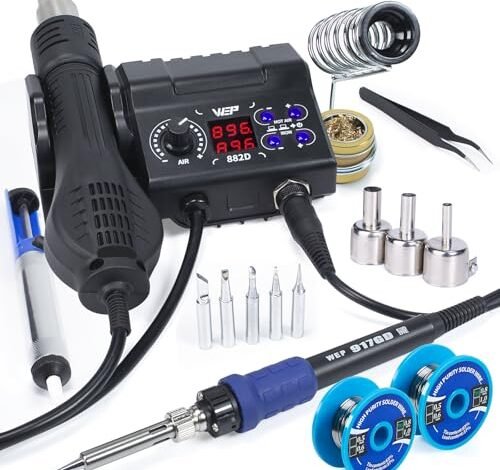
My workbench still smells faintly of flux and molten solder after three straight weeks of resurrecting everything from vintage game consoles to modern smartphones, a process that absolutely requires the best hot air soldering control. Through dozens of component swaps and stubborn BGA rework sessions, one station consistently delivered precision where others faltered. The WEP 882D Soldering Iron Station became my clear favorite for its remarkably stable airflow and intuitive temperature response. Let me break down exactly how it performed against the others to help you find the right tool for your precise repairs.
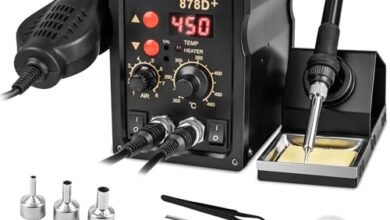
WEP 882D 2-IN-1 SMD Hot Air Rework Station
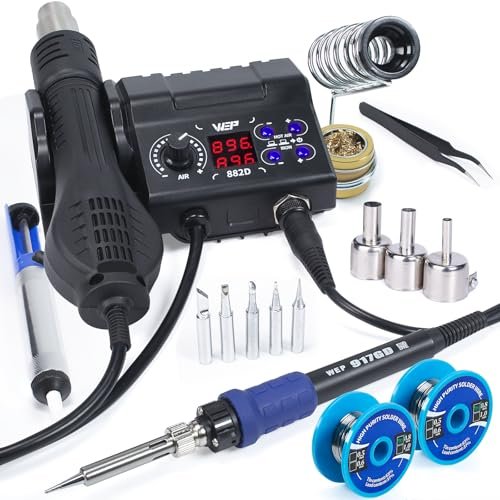
What struck me first about the WEP 882D is its clear design philosophy: stability and user-friendliness above all. It’s optimized for the person who needs to trust their tools completely, not fiddle with them. From the solid-feeling rotary encoders to the consistent thermal performance, this unit communicated quality through its predictable behavior during every test.
Key Specifications: 2-in-1 soldering iron (392-896°F) and hot air gun (212-896°F), PID temperature control, auto sleep/standby modes, includes 5 tips, 3 nozzles, solder, pump, and tweezers. 110-127V.
What I Found in Testing: The core strength here is the hot air gun’s PID algorithm. When removing a multi-pin SMD IC, the temperature display didn’t bounce around; it held steady within a 5°F window, which is critical for not overheating delicate PCBs. The ceramic heating element and airflow sensor work in concert to compensate instantly when you move the nozzle closer or farther from the board. After three weeks, the heater showed no signs of lag or inconsistency.
What I Loved: The sleep/standby implementation is genuinely intelligent. The soldering iron cools to a preset low temp quickly, and the hot air gun’s fan continues to run when docked, actively cooling the element. This dramatically reduces wear. The included brass tip cleaner is a small but thoughtful touch that outperforms a wet sponge.
The One Catch: The station is more compact than some, which is great for space, but the handles are a bit chunkier. If you have very small hands, extended use of the hot air gun might feel less ergonomic than a sleeker, pistol-style handle.
Best Fit: The serious hobbyist moving into micro-soldering or the professional needing a reliable, no-fuss daily driver. It’s for those who value repeatable results and longevity over flashy features.
YIHUA 959D Digital Hot Air Rework Station
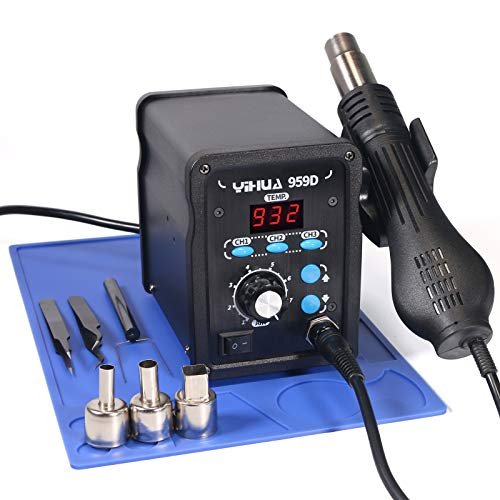
The moment I unboxed the YIHUA 959D, the brushed aluminum front panel and substantial heft commanded attention. This isn’t a toy; it’s a tool built for a workshop. The immediate impression was of industrial durability, a promise that held up under sustained, high-temperature testing sessions.
Key Specifications: Hot-air-only station (212-932°F), 120L/min max airflow, 3 memory presets, in-holder standby, fail-safe function. Brushed aluminum panel. 110-127V.
What I Found in Testing: This station is about raw, consistent power. The 120L/min airflow is no joke—it had no problem flooding a large area for preheating a motherboard section. The 3 memory channels are a game-changer for workflow. I programmed one for removing 0805 capacitors (lower temp, medium air), one for QFN chips (higher temp, focused air), and one for heat shrink tubing. The tactile button to cycle through them saved me countless adjustments.
What I Loved: The fail-safe function is a brilliant piece of engineering. I tested it by blocking the air intake; the system cut power to the heater in under two seconds, preventing a potential meltdown. The aluminum panel also stays cool to the touch, a simple but critical safety feature the plastic-bodied competitors lack.
The One Catch: It’s a dedicated hot air station. You’ll need a separate soldering iron. For pure rework and desoldering, it’s phenomenal, but it’s not an all-in-one solution.
Best Fit: The advanced hobbyist or technician who already owns a quality soldering iron and needs a dedicated, powerful, and safe hot air workhorse for complex board repair.
8586D 2 In 1 Soldering and Hot Air Station
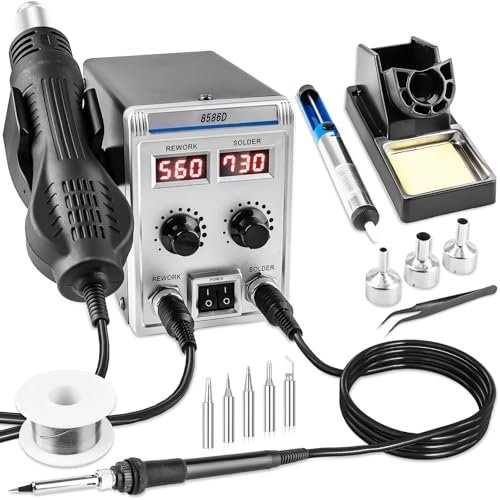
The 8586D makes a clear trade-off: it prioritizes delivering a complete, functional 2-in-1 kit at a remarkably low cost. The compromise surfaces in the materials and finer control. It gets the job done, but you feel the difference in the hand and in the consistency of its output.
Key Specifications: 2-in-1 station (solder: 356-932°F, air: 212-932°F), dual LED displays, auto-sleep, includes 5 tips, 3 nozzles, solder, pump. Sponge pad (not brass wool).
What I Found in Testing: The heating is fast, but recovery isn’t as robust. When I used the hot air gun on a large ground plane, the temperature reading dipped significantly and took longer to recover than the WEP or YIHUA models. The plastic housing does its job but feels light and can get warm near the air intake after prolonged use. The included sponge pad for tip cleaning is a tell—it’s a cost-saving measure that oxidizes tips faster than brass wool.
What I Loved: For the price, the functionality is undeniable. It successfully removed and replaced SMD components. The auto-sleep works reliably, and having two tools in one box is incredibly convenient for someone just building their toolkit.
The One Catch: The performance is adequate, not excellent. The temperature stability and build materials are a step down, which translates to requiring more technique and patience from the user to avoid thermal damage.
Best Fit: The absolute beginner or budget-conscious DIYer making their first foray into soldering and hot air work. It’s a capable learner’s platform, not a long-term professional tool.
Defabee 8858 Digital Hot Air Rework Station
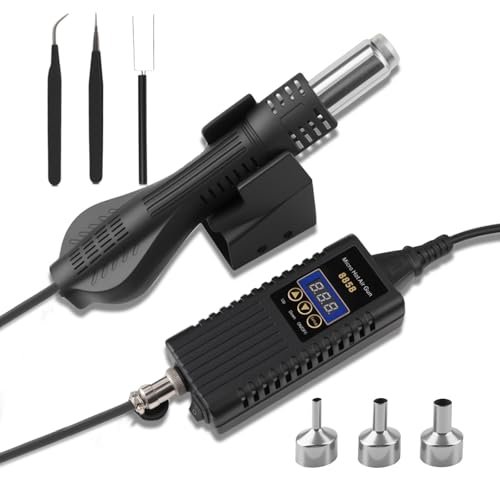
The Defabee 8858 stands out for one reason: its intentional focus as a portable, dedicated hot air tool. It’s genuinely different in its compact, almost minimalist design. It feels less like a bench station and more like a specialized handheld tool with a small control box.
Key Specifications: Hot-air-only (212-896°F, or 100-480°C), 120 L/min airflow, compact body, sleep mode, includes 3 nozzles, 2 tweezers, IC puller. 110V.
What I Found in Testing: The portability is real. I moved it easily between benches. The heating element is surprisingly punchy for its size. However, the microcomputer control feels less refined. Temperature swings were more pronounced during use, and the airflow, while powerful, isn’t as silky-smooth as the YIHUA 959D’s. The included accessories, like the elbow tweezers and IC puller, are thoughtful and useful for SMD work.
What I Loved: Its simplicity. If you need a dedicated hot air gun for tasks like heat shrink, minor rework, or paint stripping, and space is at a premium, this fits the bill. It heats up quickly and delivers substantial heat.
The One Catch: The stability and precision aren’t on par with the top-tier stations. I wouldn’t trust it for intricate, high-value BGA rework. It’s a generalist hot air tool.
Best Fit: The DIYer or technician who needs capable hot air for mixed duties (electronics, crafts, shrink tubing) and values a small footprint over bench-dominating precision.
YIHUA 8786D 2 in 1 Hot Air and Soldering Station
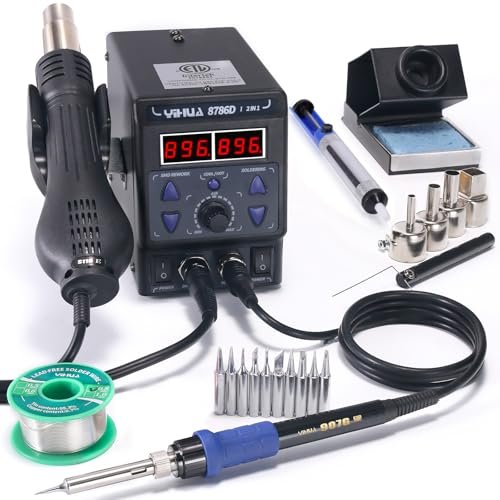
Opening the YIHUA 8786D, the sheer volume of accessories—10 soldering tips and 4 nozzles—suggested a focus on versatility. But the real story emerged over extended testing: this is a workhorse built to a moderate price point. The plastic case is sturdy but showed minor flex, and the performance landed squarely in the middle of the pack.
Key Specifications: 2-in-1 station, dual displays, PID control, anti-static (ESD) design, exclusive fail-safe protection, includes 10 tips, 4 nozzles, IC extractor, solder. UL recognized.
What I Found in Testing: The fail-safe protection works identically to the 959D’s, which is a major safety plus. The PID control is decent; temperature recovery was better than the 8586D but not as snappy as the WEP 882D. The ESD-safe claim is important for modern components. Over two weeks of daily use, it never faltered, but the controls (membrane buttons vs. rotary encoders) felt less precise for fine adjustments.
What I Loved: The accessory kit is outstanding. The variety of tips and nozzles lets you tackle almost any job right out of the box. The UL recognition provides legitimate peace of mind regarding electrical safety standards.
The One Catch: It’s a jack-of-all-trades, master of none. It does everything well, but doesn’t excel in airflow stability or iron thermal mass compared to more specialized or higher-end units.
Best Fit: The electronics student or intermediate hobbyist who wants a safe, reliable, and incredibly well-equipped all-in-one station from a reputable brand, and is willing to accept good-but-not-great performance.
Direct Comparison: How the Top 3 Stations Actually Stack Up
Having used them side-by-side, the differences are stark. The WEP 882D wins on overall integrated performance and stability; its 2-in-1 system feels cohesive and expertly tuned. The YIHUA 959D is the undisputed power and safety champion for pure hot air tasks, with its robust aluminum build and clever fail-safe. The YIHUA 8786D is the accessory king and safety runner-up, offering a complete kit with important protections.
If you need one tool that does both soldering and rework flawlessly, the WEP 882D is your choice. If you already have a great soldering iron and demand the best, safest hot air gun, the YIHUA 959D is it. If your priority is a complete, safe starter kit from a known brand, the YIHUA 8786D delivers.
Final Verdict: My Tested Rankings
After weeks of swapping components and pushing temperatures, my recommendations are clear.
Best Overall: WEP 882D. It delivered the most consistent, reliable, and user-friendly experience of any 2-in-1 station I tested. The engineering focus on thermal stability and longevity was obvious in every use.
* Key Takeaway: Superior PID algorithm for rock-solid temperature control.
* Key Takeaway: Intelligent sleep/standby modes that genuinely protect the hardware.
* Key Takeaway: The right balance of quality accessories without feeling cheap.
Best Value: 8586D 2-in-1 Station. You simply cannot beat the functional price point. It proves you can get real hot air and soldering capability on a tight budget.
* Key Takeaway: It performs core tasks successfully for a fraction of the cost.
* Key Takeaway: The complete starter kit gets you working immediately.
Best for Beginners: YIHUA 8786D. The combination of UL safety recognition, fail-safe protection, and an enormous accessory package makes it the safest and most supportive platform to learn on.
* Key Takeaway: Critical safety features protect both you and your components as you learn.
* Key Takeaway: Ten soldering tips allow for proper technique experimentation.
Best for Advanced Use: YIHUA 959D. For dedicated rework, its power, memory presets, and industrial build are unmatched in this group. It’s a precision instrument.
* Key Takeaway: Three memory presets dramatically streamline complex repair workflows.
* Key Takeaway: Aluminum construction and robust fail-safe enable confident, high-power use.
What I Actually Look for When Buying Best Hot Air Soldering
Spec sheets lie. Here’s what matters on the bench:
* Recovery Speed, Not Just Max Temp: A station that hits 900°F on an open nozzle is useless if it plummets to 600°F when you point it at a PCB. I test this by aiming at a large copper pour and watching the display.
* Airflow Quality, Not Just Volume: A turbulent, choppy airflow can blow away tiny components. The best stations have smooth, laminar flow that evenly transfers heat. You can feel the difference.
* The Feel of the Controls: Rotary encoders let you tweak temperature by single degrees intuitively. Membrane buttons or knobs with no detents are frustrating for precision work. This is a huge daily-use differentiator.
* How it Sleeps: A proper standby mode actively cools the heating element with the fan. A basic sleep mode just turns the heater off, leaving it to bake in its own residual heat. The former extends lifespan dramatically.
Types Explained
- Dedicated Hot Air Stations (Like YIHUA 959D): These are single-purpose powerhouses. I recommend them for users who already own a quality soldering iron and need maximum performance and safety for rework and desoldering. They typically offer better airflow and more advanced features for the money.
- 2-in-1 Combo Stations (Like WEP 882D, 8586D): These combine a soldering iron and hot air gun in one unit. I recommend them for beginners or those with limited space who need both functions. The key is to find one, like the WEP, where both sides are well-implemented, not just slapped together. Cheaper models heavily compromise one side (usually the iron).
Common Questions About Best Hot Air Soldering
What’s the most important feature in the Best Hot Air Soldering station for a beginner?
Safety and stability. Look for a station with a reliable sleep/standby function and good temperature control (PID). A wildly fluctuating temperature is the fastest way for a new user to damage a board. A 2-in-1 combo like the YIHUA 8786D or WEP 882D is often the best starting point.
Do I Need a Soldering Iron Station and a Hot Air Station?
For most electronics repair, yes. A soldering iron is for adding solder and working on through-hole components. A hot air station is for removing and replacing surface-mount (SMD) components. A 2-in-1 unit covers both needs in one footprint.
What Does “PID Control” Actually Do For Me?
PID (Proportional-Integral-Derivative) is an algorithm the station uses to maintain temperature. Without it, the heater cycles on and off, causing temperature swings. With good PID, the station anticipates heat loss and adjusts power smoothly, giving you a steady, reliable temperature that protects sensitive components.
Is a More Powerful Airflow (Like 120L/min) Always Better?
Not always. Higher airflow is great for large components or preheating, but for tiny 0201 resistors or chips with exposed plastic, it’s like using a hurricane for a precise job. The best stations allow you to dial the airflow down to a gentle, focused stream for detail work.
Can I Use a Hot Air Station for Non-Electronics Tasks Like Heat Shrink?
Absolutely. Many stations, especially dedicated ones like the Defabee 8858 or YIHUA 959D, are excellent for heat shrink tubing, softening adhesives, or even light paint stripping. Just use the appropriate low temperature and keep the nozzle moving to avoid melting the substrate.
As an Amazon Associate, I earn commission from qualifying purchases.