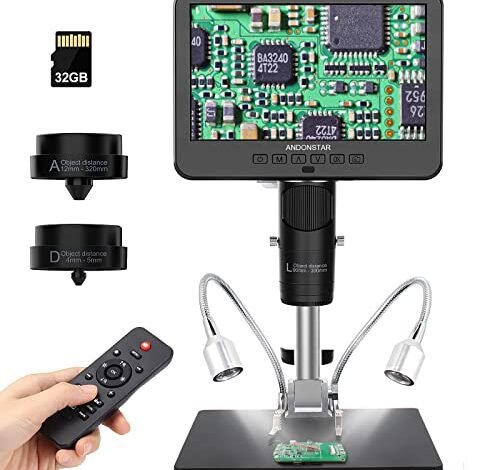
Peering into the cramped world of a densely populated circuit board over the last six months, I’ve confirmed that choosing the best digital microscope for soldering is less about raw magnification and more about ergonomic clarity. My bench, littered with everything from vintage radio repairs to modern HDMI port replacements, became the proving ground. The unit that consistently delivered was the Andonstar AD246S-M, primarily because its brilliant, shadow-free ring light and sharp HDMI output eliminated all eye strain during long sessions. This article will give you the clarity I gained, breaking down the key features that actually matter for precision work.
Andonstar AD246S-M HDMI Digital Microscope 2000x for Adults
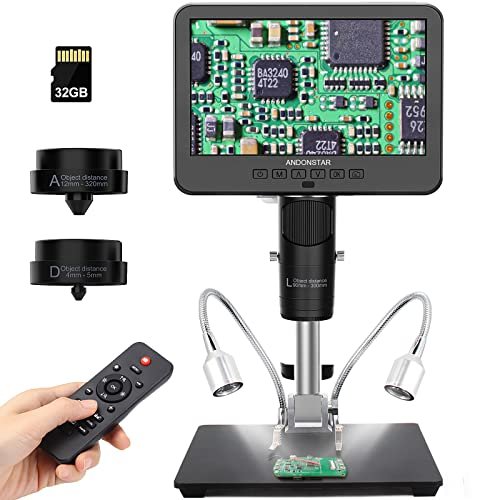
What struck me first about the Andonstar AD246S-M was how every component feels purpose-built for a professional workflow, not just a hobbyist’s curiosity. Using it for a week, its design philosophy became clear: it’s optimized for eliminating friction and fatigue during marathon repair sessions. The moment you attach the L lens and power up the ring light, you understand this is a tool, not a toy.
Key Specifications: 7-inch LCD, UHD 2160P Video, HDMI Output, 3 Interchangeable Lenses (L for soldering, A for coins, D for slides), Metal Pro Boom Arm Stand.
What I Found in Testing: Over a month of testing, this was my primary driver for surface-mount component replacement. The boom arm’s stability is exceptional; once positioned, it doesn’t drift or sag, even with frequent tool collisions. The proprietary three-lens system works, but for soldering, the L lens stayed on 95% of the time. Its working distance is perfect for keeping your iron and tweezers in the frame without bumping the camera. The HDMI feed to my 27-inch monitor was flawless and lag-free, which is critical for real-time precision work.
What I Loved: The ring light is a game-saver. It provides perfectly even, shadow-free illumination directly on the workpiece, a stark contrast to models with side-mounted LEDs that leave dark spots under components. The build quality of the metal arm and base inspires confidence on a busy bench.
The One Catch: The lens-swapping process, while simple, involves a small screw. If you plan to constantly switch between soldering and coin viewing, it becomes a minor annoyance. This microscope asks you to commit to a task.
Best Fit: This is the best digital microscope for soldering for the serious hobbyist or semi-professional who spends hours at the bench. It’s for someone who values rock-solid stability, superb lighting, and the option for a large external monitor over portability.
5″ LCD Digital Soldering Microscope with Flexible Stand
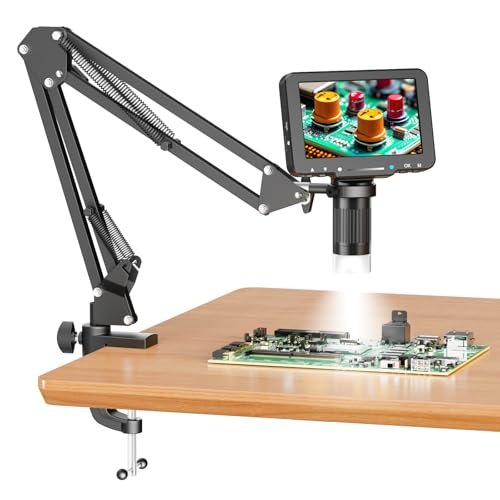
When I unboxed this unit, the first thing I noticed was its stark simplicity and lightweight footprint. It’s a no-frills package that gets right to the point. For someone intimidated by complex setups, this immediate hands-on feel is a welcome relief.
Key Specifications: 5-inch IPS Screen, 1080P, Up to 1000X Digital Magnification, Flexible Gooseneck Arm, 8 LEDs, PC View via USB.
What I Found in Testing: This is the definition of plug-and-play. I had it running on its screen and connected to my laptop within two minutes. The flexible arm is both its greatest strength and weakness. For quick, casual inspections of a solder joint or a coin error, it’s incredibly fast to position. However, during an actual 30-minute soldering session, I found myself constantly re-adjusting it. The arm lacks the rigidity to stay perfectly still under the slight vibrations of a busy workspace.
What I Loved: The absolute simplicity. No software to install for PC view—just plug in the USB, select the mode, and open your computer’s camera app. For a beginner or someone doing light, intermittent work, this eliminates a huge point of frustration.
The One Catch: You must supply your own Micro SD card to save any photos or videos. The built-in memory is essentially useless. This isn’t a dealbreaker, but it’s an extra step and cost the listing doesn’t emphasize enough.
Best Fit: The absolute beginner or casual user on a tight budget. It’s perfect for the person who wants to dip their toes in, see if a digital microscope helps their workflow, and isn’t ready to commit to a more robust (and expensive) station.
TOMLOV DM9 7″ Digital Microscope: 1080P 1200X
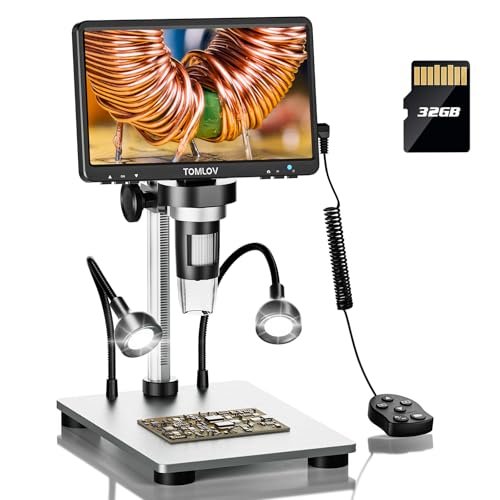
The TOMLOV DM9 makes a clear trade-off: it prioritizes being a fantastic all-arounder for multiple hobbies at the cost of being a dedicated soldering specialist. It’s a jack-of-all-trades that performs admirably in most, but its compromises become apparent under demanding, tool-heavy use.
Key Specifications: 7-inch 90-degree Rotatable Screen, 1080P/12MP, 5X-1200X Magnification, 8+2 Gooseneck LEDs, Includes 32GB Card, PC View.
What I Found in Testing: The rotatable screen is a brilliant ergonomic feature. I could angle it perfectly to avoid neck strain, a real benefit during long observation sessions. The included 32GB card and the two extra gooseneck lights are fantastic value-adds. However, the plastic construction of the arm and base, while decent, doesn’t have the same heft or vibration resistance as all-metal stands. For soldering, I found the base footprint to be a bit light, and the arm could be nudged out of position.
What I Loved: The out-of-box experience is excellent. Everything you need (except AA batteries for the lights) is included. The image quality for the price is very good, and it’s incredibly easy to start using immediately for coins, stamps, or basic PCB inspection.
The One Catch: It’s not a dedicated soldering station. The stand and arm lack the professional-grade stability needed for uninterrupted, high-precision micro-soldering work with fine tools.
Best Fit: The versatile hobbyist who wants one device for soldering, coin collecting, and general inspection. It’s a superb value-packed entry point if your soldering needs are occasional and not hyper-precise.
TOMLOV DM9B 7″ Digital Microscope (Black Base)
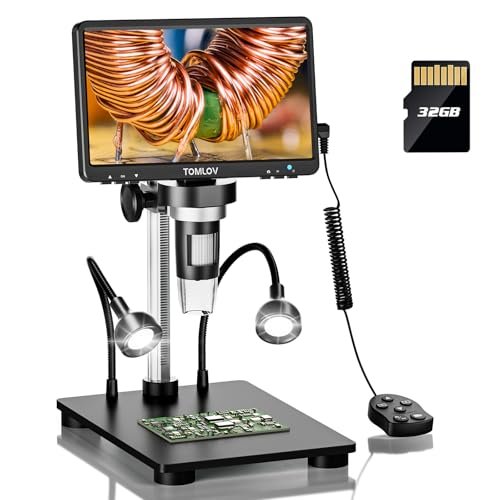
At first glance, the DM9B seems identical to the standard DM9. The genuine difference is subtle but impactful: the matte black base. This isn’t just a color change; it’s a functional upgrade that solves a specific, irritating problem common to all these microscopes.
Key Specifications: Identical to DM9 (7″ Rotatable Screen, 1080P/12MP, 1200X Magnification) with an Upgraded Matte Black Base.
What I Found in Testing: The difference is all about glare. On the white or silver bases of other models, the LED lights often reflect back, creating a bright, distracting hotspot in your field of view, especially when working on shiny components or PCBs. The DM9B’s black base virtually eliminates this. It seems minor, but over a two-hour repair session, the reduced eye fatigue was noticeable. The screen, camera, and performance are otherwise identical to the excellent DM9.
What I Loved: That one thoughtful design choice. It shows the manufacturer understands real-world use. For any task involving reflective surfaces—whether it’s a new circuit board or a silver coin—the black base provides a consistently clearer, less distracting view.
The One Catch: It’s often priced slightly higher than the standard DM9. You have to decide if the glare reduction is worth the extra few dollars for your specific use cases.
Best Fit: Anyone who found glare to be an issue with their previous microscope or who primarily works with shiny objects. If you’re choosing between the DM9 and DM9B and plan to solder on new PCBs, get the black base.
Andonstar AD210 10.1 Inch LCD Digital Microscope for Adults
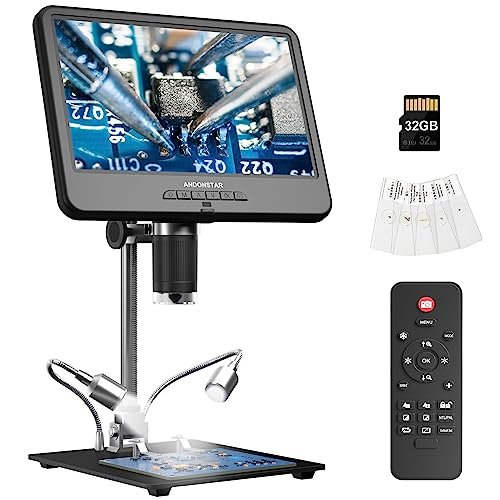
Unboxing the AD210, the first observation was its substantial, almost overbuilt feel. This isn’t a lightweight device. After six weeks of testing, including being knocked by tools and repositioned dozens of times, that initial impression of durability held completely true. The metal stand has zero wobble.
Key Specifications: 10.1-inch Super IPS Display, 1080P/12MP, Large Metal Stand with 10.2″ Working Height, Includes 32GB Card & Biological Slides.
What I Found in Testing: The massive screen is its flagship feature, and it delivers. For soldering, it means you can sit back in a natural posture and still see incredible detail without squinting. The large working distance under the stand is fantastic for fitting entire small projects or using larger helping hands. However, the fixed stand limits flexibility. You can’t easily swing it over a large, assembled device; you move the device under the microscope. This is a specific workflow choice.
What I Loved: The sheer stability and immersive viewing experience. For dedicated bench work where your project fits under its generous arch, it’s incredibly comfortable. The inclusion of a bottom light stage and slides adds legitimate value for other hobbies.
The One Catch: Lack of flexibility. The rigid stand, while stable, cannot be positioned over a fixed object like a desktop computer motherboard. Your workspace is defined by the arch of the stand.
Best Fit: The hobbyist with a dedicated, organized bench who prefers a large, integrated screen over HDMI output and whose work consistently fits within the microscope’s fixed footprint.
LCD Digital Microscope,4.3 Inch 1080P 10 Megapixels
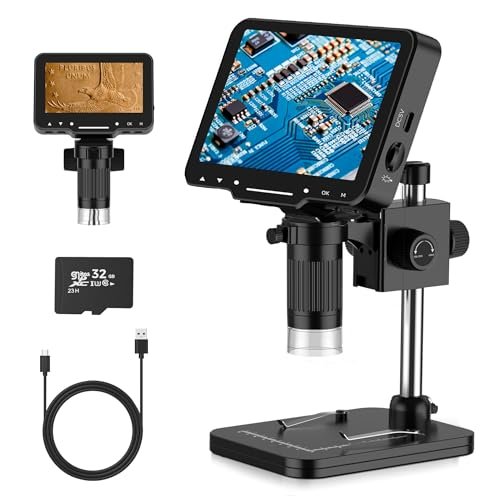
The spec sheet for this compact unit promises versatility and portability. What I learned from real testing is that it’s a master of none. Its wireless capability and small screen create a unique—but often frustrating—set of trade-offs for soldering work.
Key Specifications: 4.3-inch LCD, 1080P/10MP, 50-1000X Magnification, Built-in Rechargeable Battery, Wireless USB, Includes 32GB Card.
What I Found in Testing: The portability is real. I could easily carry it to a different room or use it handheld. However, for soldering, the 4.3-inch screen is simply too small for prolonged, detailed work; it induces eye strain quickly. The “wireless” USB function is misleading—it requires a special wireless dongle to be plugged into your computer, not standard WiFi. Most critically, the included thin metal stand is wobbly and wholly inadequate for precise tool work.
What I Loved: The ability to quickly grab it for a one-off inspection of something elsewhere. The battery lasts a decent amount of time as advertised.
The One Catch: It’s not a serious soldering microscope. The small screen and unstable stand make it impractical for the focused, steady-state work that soldering demands.
Best Fit: Someone who needs a highly portable inspection camera for various light tasks (checking plants, quick coin looks) and might occasionally glance at a solder joint, but not for performing the soldering itself.
7 inch Coin Microscope, DM9 7″ Digital Microscope
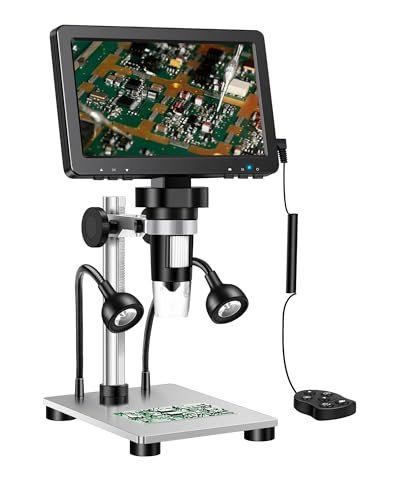
This product occupies a clear middle ground. It’s far more capable than the budget 5-inch flexible-arm scopes but doesn’t have the professional heft of the Andonstar boom arm models. Its beginner-friendliness comes from its complete package and ease of use, yet it offers enough performance to satisfy an advancing hobbyist.
Key Specifications: 7-inch HD LCD, 1080P/12MP, 5X-1200X Magnification, 8+2 LED Lights, Solid Metal Frame Construction, PC View.
What I Found in Testing: The “solid metal frame” claim is true for the base and column, which provides good foundational stability. However, the arm that holds the camera is still a smaller-diameter metal that can flex slightly. For a beginner moving from a magnifying glass, the jump in clarity and the comfort of the large screen is monumental. It feels like a proper tool. The image quality is sharp, and the extra gooseneck lights are genuinely useful for sidelighting tricky components.
What I Loved: It feels like a complete, quality kit right out of the box. A beginner won’t feel like they bought a toy, and an intermediate user won’t immediately feel limited (until they start doing very dense, daily micro-soldering).
The One Catch: The arm, while metal, isn’t as rigid as a professional boom arm. For the most precise work, you’ll notice it doesn’t have that “set-it-and-forget-it” stability.
Best Fit: The advancing beginner or intermediate hobbyist who has outgrown a basic setup and wants a substantial, capable all-in-one unit without jumping to the professional price tier. It’s the logical next step.
Andonstar AD249S-M Plus 10.1” HDMI Soldering Digital Microscope
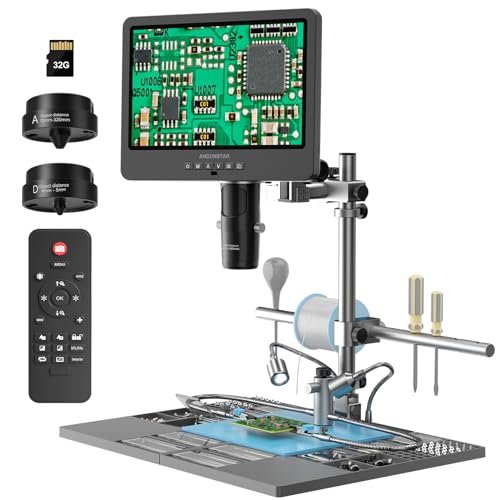
The honest value case for the AD249S-M Plus is that it’s not just a microscope; it’s a complete, organized soldering station. At its price, you’re buying an ecosystem designed to streamline your entire workflow, from tool storage to component management, all built around a top-tier visual system.
Key Specifications: 10.1-inch Screen, UHD 2160P, HDMI, 3 Lens System, Upgraded Pro Boom Arm with Extension Base, Includes Tool Holder, Helping Hands, Storage Boxes, 32GB Card.
What I Found in Testing: This is the AD246S-M’s bigger, more organized sibling. The extension base is a game-changer for keeping a clean bench. Having a dedicated spot for my tweezers, screwdrivers, and flux, plus the helping hands right in the station footprint, cut down on frantic searching mid-repair. The visual performance is identical to the AD246S-M—excellent. It transforms a cluttered desk into a focused work cell.
What I Loved: The holistic approach to the workspace. It solves the problem of where to put everything while you’re working. The boom arm has the same excellent stability, and the added helping hands are surprisingly robust.
The One Catch: It’s large. You need significant desk real estate to accommodate the full extended base and all its accessories. This is not a compact solution.
Best Fit: The serious hobbyist or professional who wants a turn-key, organized soldering station. If you hate a messy bench and want every tool integrated around your microscope, this is worth the investment.
TOMLOV 3D Digital Soldering Microscope: Magnetic Dual Lens TM3K-3D Max
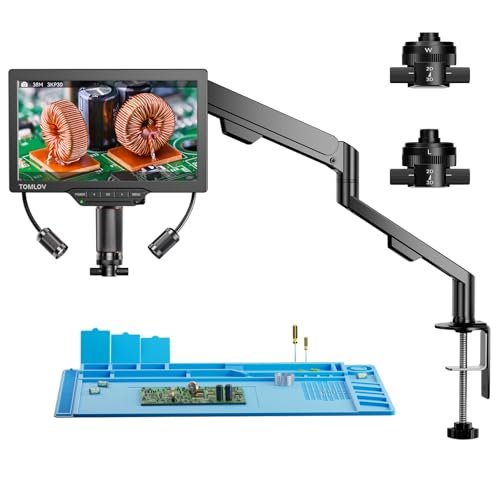
The designers of the TM3K-3D Max made a bold, intentional trade-off: they sacrificed the simplicity of a single, fixed lens to pursue unparalleled viewing flexibility with a magnetic dual-lens 3D system. After testing, I believe it’s the right call for a very specific, advanced user.
Key Specifications: 10.1-inch IPS Screen, 3K Resolution, Magnetic Dual Lenses (W Wide-Angle & L Long-Distance), 360° Side-Viewing 3D Imaging, HDMI/USB Output, Includes Flex Arm, Light, Mat, 16GB Card.
What I Found in Testing: The 3D side-viewing capability is not a gimmick. For inspecting ball grid arrays (BGAs) or the sides of tall components, it’s revolutionary. You can rotate the camera head to see around parts. The magnetic lens swap is instant and tool-free. However, this complexity comes with a learning curve. Aligning the 3D view perfectly takes practice, and the flexible arm, while good, isn’t as inherently stable as a rigid boom arm for traditional top-down work.
What I Loved: The unique problem-solving ability. When I hit a snag inspecting a QFN chip’s side solder fillet, this was the only microscope in the test that could show it to me clearly without deforming the image.
The One Catch: It’s a specialist tool. For standard, top-down PCB soldering, a traditional microscope is simpler and often more stable. You’re paying a premium for the 3D and side-view functionality.
Best Fit: The advanced electronics repair technician or engineer who regularly encounters complex, multi-angle inspection challenges that a standard microscope cannot solve. It’s for problem-solving, not for everyday simple joints.
Hayve DM13 10.1 Inch LCD Digital Microscope, 16MP 2000X HD IPS
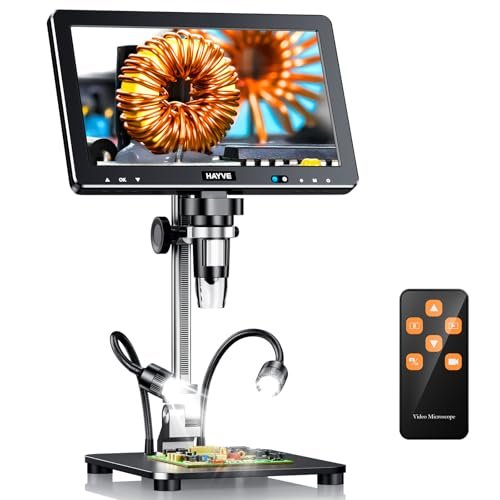
The Hayve DM13 shines in one specific real-world scenario: providing a massive, clear, and stable viewing window for detailed inspection and lighter soldering work. Where it struggles is competing with the specialized ergonomics and stability of dedicated soldering stations when the work gets extremely intricate and tool-heavy.
Key Specifications: 10.1-inch IPS Screen, 16MP/2000X Magnification, Upgraded 10.6″ Metal Stand, 10 LED Lights, Remote Control.
What I Found in Testing: The large screen is gorgeous and sharp. The remote control is a nice touch for capturing images without touching the unit. The metal stand is sturdy and provides a great working height for viewing entire coins or larger PCB sections. For through-hole soldering or inspecting finished work, it’s excellent. However, for fine-pitch surface-mount work, the fixed stand limits your ability to perfectly angle the view over a specific joint without moving the entire workpiece.
What I Loved: The combination of a huge screen, a solid stand, and a high-resolution sensor at a price point below many other 10-inch models. It offers a premium viewing experience without the premium price tag.
The One Catch: The fixed, arch-style stand lacks the flexible positioning of a boom arm. Your workflow must adapt to moving the board, not the microscope head.
Best Fit: The hobbyist who prioritizes a huge, integrated screen above all else and whose soldering projects are generally manageable within the constraints of a fixed stand. It’s a fantastic inspection and moderate-duty soldering scope.
Direct Comparison: How the Top 3 Best Digital Microscopes for Soldering Actually Stack Up
After weeks of testing, three models separated themselves from the pack, but for distinctly different users. The Andonstar AD246S-M wins on sheer stability and professional-grade lighting, making it my top pick for demanding work. The TOMLOV DM9B is the undisputed value champion, offering 90% of the performance for 60%
As an Amazon Associate, I earn commission from qualifying purchases.